建议做

Melbourne, Australia
本站使用指南
教学unit说明控准用;准用评估附prompt/output。enterprise数据、付费Copilot及review/appeal两阶段保留条件及例外。
本站解读;官方证据保留原文。
尚无完整的学生政策摘要;可先查看已收录条款及来源。
教学unit说明控准用;准用评估附prompt/output。enterprise数据、付费Copilot及review/appeal两阶段保留条件及例外。

补充资料采集: 2026-10-08 · 现行适用性未独立确认
本站解读
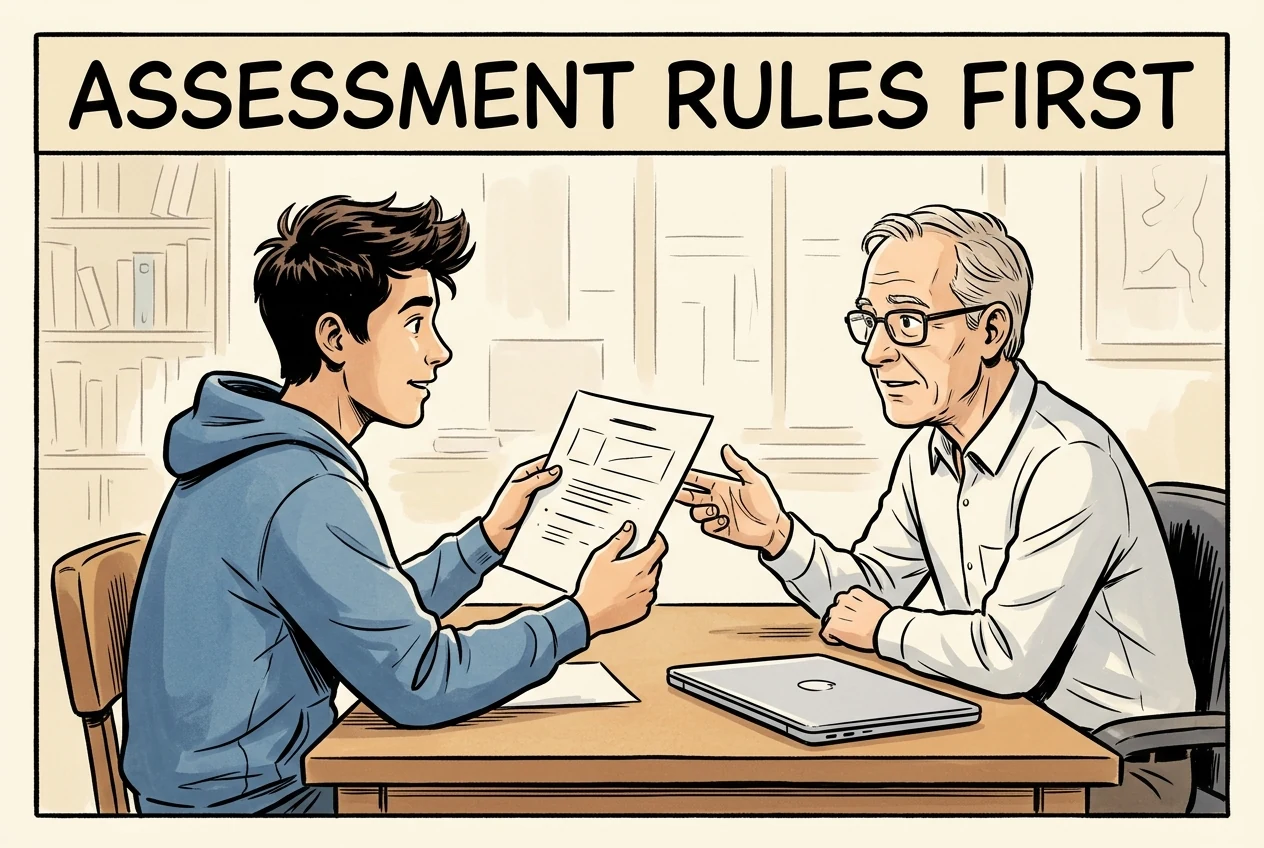
学生指导限教学人员指导及适当注明下准用GenAI;准用评估须始终把全部prompt及output作为最终提交附录。不得未经许可使用或把生成文字当本人作品;注明不自行产生许可。
适用范围: Students completing assessments under their unit teaching staff · Only the captured source, version, audience and conditions; no exhaustive currency certification.
Student guidance permits GenAI only under unit teaching-staff direction with proper acknowledgement. For permitted assessment use it says always append all prompts and outputs to the final submission; unpermitted use and passing generated text off as one’s own are prohibited. These conditions accompany permission, rather than acknowledgement creating permission.
适用范围: Students completing assessments under their unit teaching staff · university
Permitted assessment use: appendix listing all GenAI prompts and outputs; acknowledge the use.
make sure you understand how to reference your sources, including acknowledging any permitted genAI use within your assessment tasks
where genAI use is permitted in your assessment tasks, always include as an appendix to your final submission, a list of all your genAI prompts and outputs
when photocopying or making notes from texts, record all bibliographic information
acknowledge the ideas, contribution and work of others
contribute fairly to group work tasks
always complete tests and exams without cheating
ask for help from legitimate support services.
Things to avoid
Here are some things you should do in order to preserve your academic integrity:
don't use genAI if it isn't permitted
don't submit text generated by genAI (where permitted) as your own work without appropriate acknowledgment
don't leave your assignments around for others to read
don’t leave a computer unattended and take USB sticks out of the computers in the library or the computer labs
do not buy notes or assignments (this is known as contract cheating)
do not submit work unless it is your own
do not share or upload your notes where others can access or download it, as this is not your intellectual property.
Using genAI (where permitted)
Students may use genAI tools under the direction of unit teaching staff and with proper acknowledgement of its use. Read more on the appropriate use of genAI.查看官方来源 ↗采集日期: 2026-10-08 · 319–336
SHA-256: 76c2b88fb087c677096d38b6af9216f9fb736c45d9797daa67e37d7d08bacfc0
本站解读
AI程序:Public Data须守适用法律/政策,Internal Data限enterprise工具,Sensitive/Restricted须enterprise保护。学校账号enterprise服务按程序可处理各分类;非enterprise及未学校登录Copilot Chat不得用Swinburne资料。仍须认可工具内网清单及其他治理条件。
适用范围: Staff, students, researchers, contractors and affiliates using Swinburne data · Only the captured source, version, audience and conditions; no exhaustive currency certification.
AI procedures allow Public Data only consistently with applicable law/policy, Internal Data only with enterprise tools, and Sensitive/Restricted Data only with enterprise data protection. Swinburne-account enterprise AI services can handle classifications under these procedures; non-enterprise services and Copilot Chat without a Swinburne login must not receive Swinburne data. The intranet approved-tool list and other governance conditions still matter.
适用范围: Staff, students, researchers, contractors and affiliates using Swinburne data · university
Applicable laws, frameworks and approved intranet tool list; Swinburne institutional login.
No Swinburne data in non-enterprise services or Copilot Chat without the Swinburne account; Public Data sharing remains conditional on other law/policy.
4.1 Data Classification
All AI usage must align with Swinburne’s Data Classification and Privacy Frameworks:
Public Data: Can be shared into any AI system, provided such use is in line with other applicable laws, frameworks, and policies for such uses (e.g. copyright)
Internal Data: Only use with enterprise AI tools.
Sensitive or Restricted Data: Must not be entered into any AI system which does not have enterprise data protection. This includes, but is not limited to:
personally Identifiable Information (PII), as defined pursuant to section 3 of the Privacy & Data Protection Act 2014 (Vic)
health information, as defined pursuant to section 3 of the Health Records Act (Vic)
student records
staff details
research data with confidentiality requirements
commercial or proprietary university data.
A list of approved tools and allowed data classifications will be maintained on the intranet.
4.2 Use of AI tools
Enterprise AI Services (e.g. Microsoft 365 Copilot, Microsoft 365 Copilot Chat)
These services offer enterprise-level security and compliance, do not retain data for training external models, and meet the university’s data sovereignty requirements. They can be used with all classifications of data sensitivity because they provide enterprise data protection. Users must log in with their Swinburne account.
AI functions in Swinburne applications
These AI features assist users of software applications. It is recommended users exercise caution with use of all classifications of data sensitivity with these tools, particularly Restricted or Sensitive data.
Non-Enterprise AI Services
Free AI tools are accessible through the internet. However, these tools risk non-compliance with data sovereignty policies because they may retain and use input data for model training, lack enterprise security protections, and store data outside Australia. Users must not use Swinburne data with these tools. Users who log in to Microsoft 365 Copilot Chat without using their Swinburne account must not use Swinburne data, as this use is not covered by enterprise data protection.查看官方来源 ↗采集日期: 2026-10-08 · 308–326
SHA-256: 9a97d12413ecc92b1662a6500fb3bc1d506e0e1169e76d57c73a1a6dd39b6e5f
本站解读
程序区分须Swinburne付费许可并在Microsoft365应用内工作的Copilot与网页Copilot Chat;两者学校账号登录才有enterprise保护。公开程序不建立每位学生付费许可、个人确价或账号实测。
适用范围: Users with Swinburne accounts; Copilot app users additionally needing a University paid licence · Only the captured source, version, audience and conditions; no exhaustive currency certification.
The procedure distinguishes Microsoft365 Copilot, which requires a paid licence from Swinburne and works in Microsoft365 apps, from web-based Copilot Chat. Both receive enterprise data protection only under the Swinburne account login. The public procedure does not establish every student’s paid licence, exact individual price or a tested account.
适用范围: Users with Swinburne accounts; Copilot app users additionally needing a University paid licence · university
Swinburne account login for enterprise data protection; paid licence for Microsoft365 Copilot.
Microsoft 365 Copilot
An AI-powered tool that assists with tasks in Microsoft 365 apps like Word, Excel, and Outlook. It provides enterprise data protection to users who log in with their Swinburne account. Users require a paid licence from Swinburne University to access this tool. As Microsoft naming conventions change frequently, this is referred to as ‘Copilot’.
Microsoft 365 Copilot Chat
A chat-based AI tool within Microsoft 365 that uses the web to provide responses. It provides enterprise data protection to users who log in with their Swinburne account. As Microsoft naming conventions frequently change, this is referred to as ‘Copilot Chat’.查看官方来源 ↗采集日期: 2026-10-08 · 351–354
SHA-256: 9a97d12413ecc92b1662a6500fb3bc1d506e0e1169e76d57c73a1a6dd39b6e5f
Enterprise AI Services (e.g. Microsoft 365 Copilot, Microsoft 365 Copilot Chat)
These services offer enterprise-level security and compliance, do not retain data for training external models, and meet the university’s data sovereignty requirements. They can be used with all classifications of data sensitivity because they provide enterprise data protection. Users must log in with their Swinburne account.
AI functions in Swinburne applications
These AI features assist users of software applications. It is recommended users exercise caution with use of all classifications of data sensitivity with these tools, particularly Restricted or Sensitive data.
Non-Enterprise AI Services
Free AI tools are accessible through the internet. However, these tools risk non-compliance with data sovereignty policies because they may retain and use input data for model training, lack enterprise security protections, and store data outside Australia. Users must not use Swinburne data with these tools. Users who log in to Microsoft 365 Copilot Chat without using their Swinburne account must not use Swinburne data, as this use is not covered by enterprise data protection.查看官方来源 ↗采集日期: 2026-10-08 · 321–326
SHA-256: 9a97d12413ecc92b1662a6500fb3bc1d506e0e1169e76d57c73a1a6dd39b6e5f
本站解读
AI使用须按学校惯例引用、尊重包括原住民文化权利的知识产权、审偏见及人类监督;可辅助而不可成为评分/录取/招聘唯一权威。外部合作须隐私/第三方/安全风险评估;基金申请、同行评审及作者资格仍须相关资助者/期刊规则。
适用范围: Swinburne AI users; research/external-collaboration scope where applicable · Only the captured source, version, audience and conditions; no exhaustive currency certification.
AI users must reference use under University conventions, respect intellectual property including Indigenous cultural rights, assess bias and retain human oversight. AI may assist but cannot be the sole authority for grading, admissions or hiring. External collaborations require privacy/third-party/security risk assessments; research funding, peer review and authorship remain subject to relevant funder/publisher rules.
适用范围: Swinburne AI users; research/external-collaboration scope where applicable · university
Human oversight and relevant risk assessments; ARC/NHMRC/funder/publisher requirements.
Integrity and purposeful use
Users must ensure AI-generated content complies with Swinburne’s intellectual property and academic integrity policies and regulations.
Users must respect intellectual property laws, including Indigenous cultural and intellectual property considerations, and creators’ moral rights of attribution and integrity.
Users must ensure AI use is appropriately referenced in accordance with university referencing conventions.
Transparency and accountability
Users may use AI to assist decision-making but not as the sole authority in critical decisions, such as student grading, admissions, and hiring.
Fairness and accuracy
Users must assess AI-generated outputs for bias, particularly in hiring, admissions, research, and policymaking.
Users must apply human oversight when using AI tools for decision-making, ensuring AI recommendations are reviewed before implementation.
Privacy and data protection
Users must use AI in accordance with Swinburne’s Data Classification and Privacy Frameworks.
Users must ensure compliance with Swinburne’s data security, ethics, integrity and sovereignty requirements when using AI as part of an external collaboration. AI partnerships should be reviewed for risks related to intellectual property, data sharing, and regulatory compliance and as a result a Privacy Impact Assessment (PIA), Third Party Risk Assessment (TPRA) and Security Risk Assessment (SRA) need to be conducted.
Users must ensure compliance with Australian Research Council and National Health and Medical Research Council, funder and publisher policies on the use of AI in grant applications, peer review and authorship.查看官方来源 ↗采集日期: 2026-10-08 · 285–297
SHA-256: 9a97d12413ecc92b1662a6500fb3bc1d506e0e1169e76d57c73a1a6dd39b6e5f
本站解读
一般学术违规条例由授权人员基于证据合理认定后选择纠正、改分、fail、停学等一项/多项。额外长期停学/除名权限须先告拟决定并给合理陈述机会;决定作出起5working days书面通知,是校方通知义务,非学生提交期或自动AI处分。
校方 · 采用此程序时须遵守
校方 · 起算:authorised officer decision made
Source unit preserved; no calendar calculation.;Only the cited route; no calculated deadline.
适用范围: Students subject to general academic-misconduct decisions · Only the captured source, version, audience and conditions; no exhaustive currency certification.
The general academic-misconduct regulations allow an authorised officer, reasonably satisfied on evidence, to choose one or more listed actions including corrective work, mark changes, failure or suspension. The additional longer-suspension/exclusion powers require prior advice of the proposed decision and reasonable opportunity to submit. Written notice must be given within5 working days after the decision is made; this is the University’s notification duty, not a student filing limit or automatic AI penalty.
适用范围: Students subject to general academic-misconduct decisions · university
Evidence-based reasonable satisfaction; stronger reg10(3) powers require proposed-decision notice and reasonable opportunity to make a submission.
1. The Vice—Chancellor must appoint authorised officers for the purposes of these Regulations.
2. If an authorised officer becomes aware of, or has brought to his or her attention, an act of academic misconduct and if the authorised officer is reasonably satisfied based on the evidence (including any evidence that the authorised officer may have gathered through investigation) that a student has engaged in academic misconduct, the authorised officer may do any one or more of the following—
a. reprimand and caution the student;
b. agree with the student a course of corrective action;
c. agree with the student on a course of counselling;
d. suspend a student for up to two weeks;
e. prohibit or deny access to or use of University premises, University facilities and services or University activities for up to two weeks;
f. require the student to refrain from contact with specified persons;
g. impose conditions on the student’s attendance at University premises, participation in University activities or use of University facilities and services;
h. require the student to re-submit the whole or part of the assessment, examination or research;
i. disallow or amend a mark or grade for the whole or part of the assessment, examination or research;
j. fail the student;
k. in the case of research misconduct concerning externally funded research under a contract requiring the misconduct to be dealt with in accordance with the Australian Code for the Responsible Conduct of Research, take a course of action in accordance with that Code.
3. In addition to those actions listed in subregulation (2), an authorised officer may—
a. suspend the student for longer than two weeks;
b. prohibit or deny access to or use of University premises, University facilities and services or University activities for longer than two weeks;
c. exclude the student; or
d. prevent the student from re-enrolling, receiving results, graduating or receiving an award.
4. The power conferred by subregulation (3) may only be exercised if the student has first been advised of the proposed decision and given reasonable opportunity to make a submission to the authorised officer.
5. A student who fails to comply with a sanction given under this regulation is guilty of general misconduct for the purposes of the Student General Misconduct Regulations 2012.
11. Notice to student
The student must be informed in writing of the decision by the authorised officer within five working days of the decision being made.查看官方来源 ↗采集日期: 2026-10-08 · 337–358
SHA-256: 7bba0e4e530ce0f8072d09c1036c76b54a8dc90ac54e121daaaf02206c5cca85
本站解读
可review决定须用Schedule1书面说明理由交Registrar,通知决定或deemed refusal后21working days;Registrar可按迟度、原因、损害/行政影响例外收迟交,不保证受理。学生指南包括学术违规可review。
学生 · 采用此程序时须遵守
学生 · 起算:student notified of decision, or deemed refusal
Source unit preserved; no calendar calculation.;Registrar may accept late application under reg15 considering lateness, reasons and prejudice/adverse effect.
适用范围: Students applying for review of a reviewable University decision · Only the captured source, version, audience and conditions; no exhaustive currency certification.
A reviewable decision may be reviewed by a written Schedule1 application stating grounds to the Registrar within21 working days after notification, or after deemed refusal. The Registrar may accept a late review considering lateness, reasons and prejudice/adverse administrative effect; acceptance is not guaranteed. Academic-misconduct decisions are among the guide’s reviewable categories.
适用范围: Students applying for review of a reviewable University decision · university
Registrar has discretionary late acceptance under reg15; no guarantee.
14. Application for review of a decision
1. A person may apply for review of a decision if
a. the decision was a reviewable decision affecting the person in his or her capacity as a student; and
b. unless accepted under regulation 15, the application is made within 21 working days after
i. the student has been notified of the decision; or
ii. the deemed refusal.
2. An application for review of a decision must
a. be made in writing in the form set out in Schedule 1;
b. specify the grounds on which the applicant relies; and
c. be lodged with the Registrar.
15. Acceptance of application by Registrar
1. The Registrar may accept a late application for review of a decision, taking into consideration
a. how late the application is;
b. the reasons why it is late; and
c. whether the delay has caused prejudice or will have an adverse effect on University administration.查看官方来源 ↗采集日期: 2026-10-08 · 356–370
SHA-256: c5be33cfe90ce12cc5bbb23bb825de4b29f157b27731b690a89f67020d316bd9
Can I apply for a review?
You can apply for a review of a University decision if:
you apply within 21 working days of receiving notice of the decision
the decision is 'reviewable'.
'Reviewable' decisions
A decision will be 'reviewable' if it falls under one of the following categories:
Type of 'reviewable' decision
Description
Example
General misconduct decision
A decision made about the general misconduct of a student under University regulations.
A student engages in threatening behaviour. The student is suspended for the remainder of the semester.
Academic misconduct decision
A decision made about the academic misconduct of a student under University regulations.
A student cheats in an assessment task. The responsible staff member decides that the student will receive no grade for that item of assessment.查看官方来源 ↗采集日期: 2026-10-08 · 269–283
SHA-256: 6318d191ee3ceee0dd47bd3886b8188f0d607bf63a5c6677e3c311546ac83199
本站解读
向University Secretary申诉为独立第二阶段,列明理由含review officer未在reg16(1)内作决定,以及针对review决定的理由。Schedule2书面申请通常通知后21working days,受reg18(4)/(5)限制。18(4)的deemed affirmation原文交叉引用(2)(d),不擅改为(2)(e)或推算日期。Secretary可按迟度、原因及损害/行政影响收迟交;SSA提供保密协助。
学生 · 采用此程序时须遵守
学生 · 起算:person notified of review officer decision
Source unit preserved; no calendar calculation.;Subject to reg18(4)/(5); University Secretary may accept late application considering lateness, reasons and prejudice/adverse effect. Failure-to-decide ground18(2)(e) also exists;18(4) literally cross-refers to(2)(d), without inferred date calculation.
适用范围: Students appealing a review decision or a review officer failing to decide within regulation16(1) · Only the captured source, version, audience and conditions; no exhaustive currency certification.
Appeal to the University Secretary is a separate second stage with specified grounds, including a review officer failing to decide within regulation16(1), as well as grounds concerning a review decision. Applications use Schedule2 in writing, normally within21 working days after notification, subject to regulation18(4)/(5). Regulation18(4) literally cross-refers to (2)(d) for a deemed affirmation; this unusual reference is preserved, not corrected to (2)(e), and no inferred date is calculated. The Secretary may accept late applications considering lateness, reasons and prejudice/adverse effect. SSA advocacy offers confidential help.
适用范围: Students appealing a review decision or a review officer failing to decide within regulation16(1) · university
Regulation18(2)(e) includes failure to decide within16(1);18(4) literally cross-refers to(2)(d). Preserve that reference without inferring a deemed date.
Secretary discretionary late acceptance; prescribed appeal grounds, no automatic acceptance.
18. Grounds for appeal
1. A person may apply to the University Secretary to appeal the decision of a review officer.
2. An application to appeal must be on one or more of the following grounds—
a. that there is relevant evidence that—
i. was not taken into consideration by the review officer; and
ii. which could not have been known by the person prior to the review;
b. that the decision was manifestly wrong
c. a procedural irregularity occurred which may have affected the review officer's decision
d. that a penalty imposed on the person was manifestly excessive;
e. that the review officer failed to make a decision within the time required by regulation 16(1).
3. An application to appeal must be—
a. in writing in the form set out in Schedule 2;
b. subject to subregulations (4) and (5), lodged within 21 working days after the person was notified of the decision.
4. For the purposes of an appeal under subregulation (2)(d), the review officer is deemed to have affirmed the reviewable decision.
5. The University Secretary may accept a late application for appeal, taking into consideration—
a. how late the application is;
b. the reasons why it is late;
c. whether the delay has caused prejudice or will have an adverse effect on University administration.查看官方来源 ↗采集日期: 2026-10-08 · 415–432
SHA-256: c5be33cfe90ce12cc5bbb23bb825de4b29f157b27731b690a89f67020d316bd9
Who can help me apply for an appeal?
If you need help applying for an appeal, you can make a confidential appointment with a Swinburne Student Life Advocacy Officer.查看官方来源 ↗采集日期: 2026-10-08 · 314–315
SHA-256: 6318d191ee3ceee0dd47bd3886b8188f0d607bf63a5c6677e3c311546ac83199
Student support and services
Support
SSA Advocacy Service (SAS)
If you require further assistance, contact SSA Advocacy Service to get independent, confidential advice from an advocacy officer who can help you apply for a review or an appeal.查看官方来源 ↗采集日期: 2026-10-08 · 338–341
SHA-256: 6318d191ee3ceee0dd47bd3886b8188f0d607bf63a5c6677e3c311546ac83199
已发布的来源补充。英文摘要与原语言引文和已审核记录分开展示。这里列出可能的程序与结果,不是使用 AI 的自动处罚;现行适用性尚未独立确认,请核对来源的适用范围和版本。
按所存原文核对;不是官方译文
哈希仅用于核对所存内容,不证明现行有效性或不可篡改。这些主题不表示每个学生都会经历的流程。
能获取工具不等于获准在作业中使用。请同时核对任务规则、适用人员和数据限制。
存档工具记录;当前获取方式请核对官方来源。 以下获取说明与证据引用保留原文语言。
原文引用
Swinburne has official AI usage procedures that apply to staff, students, researchers, contractors and affiliates using AI tools in Swinburne-related operations and commercial or academic activities.原文引用
The Artificial Intelligence (AI) usage procedures establish the criteria for the responsible use of AI tools at Swinburne University of Technology.Copilot inside Microsoft365 apps requires a paid licence from Swinburne. Institutional login supplies the described enterprise protection under data/approved-tool conditions; no every-student entitlement inferred.
Swinburne account and University paid licence; consult approved tool list.
Paid licence required; exact price and individual payer not established.
补充来源核对日期:
原文引用
Microsoft 365 Copilot
An AI-powered tool that assists with tasks in Microsoft 365 apps like Word, Excel, and Outlook. It provides enterprise data protection to users who log in with their Swinburne account. Users require a paid licence from Swinburne University to access this tool. As Microsoft naming conventions change frequently, this is referred to as ‘Copilot’.
Microsoft 365 Copilot Chat
A chat-based AI tool within Microsoft 365 that uses the web to provide responses. It provides enterprise data protection to users who log in with their Swinburne account. As Microsoft naming conventions frequently change, this is referred to as ‘Copilot Chat’.原文引用
Enterprise AI Services (e.g. Microsoft 365 Copilot, Microsoft 365 Copilot Chat)
These services offer enterprise-level security and compliance, do not retain data for training external models, and meet the university’s data sovereignty requirements. They can be used with all classifications of data sensitivity because they provide enterprise data protection. Users must log in with their Swinburne account.
AI functions in Swinburne applications
These AI features assist users of software applications. It is recommended users exercise caution with use of all classifications of data sensitivity with these tools, particularly Restricted or Sensitive data.
Non-Enterprise AI Services
Free AI tools 原文引用
are accessible through the internet. However, these tools risk non-compliance with data sovereignty policies because they may retain and use input data for model training, lack enterprise security protections, and store data outside Australia. Users must not use Swinburne data with these tools. Users who log in to Microsoft 365 Copilot Chat without using their Swinburne account must not use Swinburne data, as this use is not covered by enterprise data protection.Web Chat is separate from paid integrated Copilot. Swinburne login is required for enterprise protection; no Swinburne data in unprotected public/non-enterprise sessions.
Use the Swinburne account login and applicable data classification/approved-tool requirements.
No price or Premium entitlement established.
补充来源核对日期:
原文引用
Microsoft 365 Copilot
An AI-powered tool that assists with tasks in Microsoft 365 apps like Word, Excel, and Outlook. It provides enterprise data protection to users who log in with their Swinburne account. Users require a paid licence from Swinburne University to access this tool. As Microsoft naming conventions change frequently, this is referred to as ‘Copilot’.
Microsoft 365 Copilot Chat
A chat-based AI tool within Microsoft 365 that uses the web to provide responses. It provides enterprise data protection to users who log in with their Swinburne account. As Microsoft naming conventions frequently change, this is referred to as ‘Copilot Chat’.原文引用
Enterprise AI Services (e.g. Microsoft 365 Copilot, Microsoft 365 Copilot Chat)
These services offer enterprise-level security and compliance, do not retain data for training external models, and meet the university’s data sovereignty requirements. They can be used with all classifications of data sensitivity because they provide enterprise data protection. Users must log in with their Swinburne account.
AI functions in Swinburne applications
These AI features assist users of software applications. It is recommended users exercise caution with use of all classifications of data sensitivity with these tools, particularly Restricted or Sensitive data.
Non-Enterprise AI Services
Free AI tools 原文引用
are accessible through the internet. However, these tools risk non-compliance with data sovereignty policies because they may retain and use input data for model training, lack enterprise security protections, and store data outside Australia. Users must not use Swinburne data with these tools. Users who log in to Microsoft 365 Copilot Chat without using their Swinburne account must not use Swinburne data, as this use is not covered by enterprise data protection.Reviewed record
3 条已审核条款
Academic Integrity
标准化值: Permitted genAI use requires direction from unit teaching staff and proper acknowledgement.
原始证据
证据 1Students may use genAI tools under the direction of unit teaching staff and with proper acknowledgement of its use. A student submits work as their own for assessment that has been fully or partially completed by a third party, either paid or unpaid. This includes work that is produced by artificial intelligence content producing tools (or other technologies) without permission or Swinburne approved acknowledgement.
隐私
标准化值: Sensitive or restricted data is not to be entered into AI systems without enterprise data protection.
原始证据
证据 1All AI usage must align with Swinburne’s Data Classification and Privacy Frameworks: Public Data: Can be shared into any AI system, provided such use is in line with other applicable laws, frameworks, and policies for such uses (e.g. copyright) Internal Data: Only use with enterprise AI tools. Sensitive or Restricted Data: Must not be entered into any AI system which does not have enterprise data protection.
Ai Tool Treatment
标准化值: Official AI usage procedures apply across listed user groups and Swinburne-related activities.
原始证据
证据 1The Artificial Intelligence (AI) usage procedures establish the criteria for the responsible use of AI tools at Swinburne University of Technology. They align with ethical principles, legal requirements, and institutional policies to ensure that AI use supports educational, research, and administrative activities without compromising security, privacy, or fairness.
Source record
3 个来源
swinburne.edu.au
swinburne.edu.au
swinburne.edu.au
Citation: University AI Policy Tracker. "Swinburne University of Technology AI Policy Tracker record." Last checked May 16, 2026. https://eduaipolicy.org/universities/swinburne-university-of-technology
Original university source language remains canonical. This tracker is not an official university statement.
打开变更日志Saved from University AI Policy Tracker. This record summarizes the cited sources; it is not an official university statement or assessment permission. Source and review dates are listed above. Hashes identify retained content, not authorization.