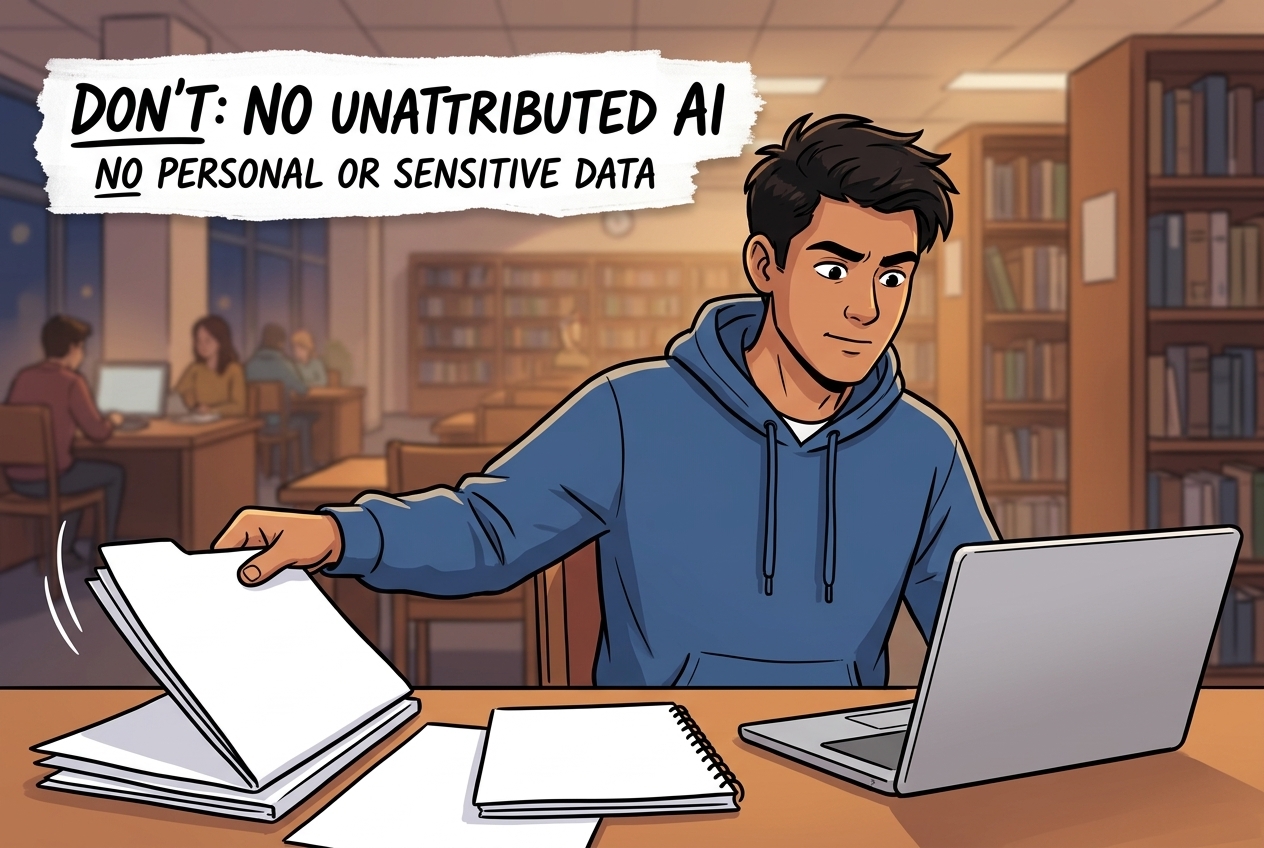
Wel doen
- Follow the task’s explicit AI permission and guidance.
- Acknowledge permitted tools, timing and methods as instructed.
- Seek AUSA advice and arrange representation in advance.

Aberdeen, United Kingdom
Student guide · Course guidance and attribution
The 2026/27 academic discipline Code preserves permission conditions, evidence review and separate School/University hearing powers. Students can seek AUSA representation and submit mitigation. The student AI guide requires author permission for course material and no personal/sensitive data input; issued AI-tool accounts remain unverified.
De onderstaande richtlijnen zijn in het Engels; officiële bewijsstukken behouden hun oorspronkelijke taal.
Er is nog geen volledige samenvatting van de studentenregels; bekijk de verzamelde uitspraken en bronnen.
The 2026/27 academic discipline Code preserves permission conditions, evidence review and separate School/University hearing powers. Students can seek AUSA representation and submit mitigation. The student AI guide requires author permission for course material and no personal/sensitive data input; issued AI-tool accounts remain unverified.

Aanvulling verzameld: 2026-10-08 · Huidige toepasselijkheid niet onafhankelijk bevestigd
Samenvatting momenteel beschikbaar in het Engels
Interpretatie van de site
Aberdeen’s student GenAI guidance says not to outsource critical thinking, analysis, evaluation or synthesis. Generating assessed content without authorisation or acknowledgement is investigated as plagiarism under the academic discipline code.
Reikwijdte: students · Code of Practice on Student Discipline (Academic) 2026/27, approved June 2026; currently registered UG/PGT/PGR, UG/PGT graduates and visiting PGR, excluding PGR graduates. More stringent professional-body regulations take precedence.
Reikwijdte: students · university
Important: You must not use GenAI to do your critical thinking, analysis, evaluation, or
synthesis. Neither should you use it to generate essays, poems, or any creative works.
The purpose of these assignments is to demonstrate your unique ideas and creativity.
Remember, using GenAI tools to generate content for work submitted for assessment, without
authorisation or acknowledgement, will be regarded as academic misconduct and investigated as a
plagiarism offence under the Code of Practice on Student Discipline (Academic). You can find out
more by watching our introductory video. Bekijk officiële bron ↗Verzameld: 2026-10-08 · 17–23
SHA-256: 795bbe9842102c811182c1105fd9d269e82162f6819e4e52d0bd7f8b9d394209
Interpretatie van de site
The 2026/27 Code defines misuse of AI as unauthorised or unacknowledged generated assessment content, unless explicit permission/guidance is given as part of the assessment method. Unedited or unacknowledged generation, or failure to follow guidelines fully, may constitute misconduct; preserve the stated permission exception and may wording.
Reikwijdte: students · Code of Practice on Student Discipline (Academic) 2026/27, approved June 2026; currently registered UG/PGT/PGR, UG/PGT graduates and visiting PGR, excluding PGR graduates. More stringent professional-body regulations take precedence.
Reikwijdte: students · university
Misuse of Artificial Intelligence
Misuse of Artificial Intelligence is defined as the unauthorised or unacknowledged use of artificial intelligence
tools to generate content for work submitted for assessment, unless explicit permission / guidance has been
given to use them as part of the assessment method. Using GenAI tools such as ChatGPT to generate material
for work submitted for assessment, without any form of editing or acknowledgement, or by not following the
assessment guidelines fully, may constitute academic misconduct. Bekijk officiële bron ↗Verzameld: 2026-10-08 · 348–354
SHA-256: b17b44e1c253c3eab7e651a5977e9332a054d5c786905d4aafb98b5ee9b52097
Interpretatie van de site
Aberdeen student guidance requires explicit author permission before putting learning materials or assessment information into GenAI. Never enter personal or sensitive data, and review the tool’s privacy policy and terms. Examples of named tools in the guidance do not establish University-issued student accounts.
Reikwijdte: students · Code of Practice on Student Discipline (Academic) 2026/27, approved June 2026; currently registered UG/PGT/PGR, UG/PGT graduates and visiting PGR, excluding PGR graduates. More stringent professional-body regulations take precedence.
Reikwijdte: students · university
1.2 Privacy and data considerations
There are risks to data privacy and intellectual property when entering prompts or data into GenAI
tools. Always ensure that you have the appropriate permissions in place before entering any data
into these tools. Please note that any learning materials (e.g. lectures) and assessment information
(e.g. questions, tasks, activities) must not be entered into these tools without the explicit permission
of the author (e.g. Course Coordinator, Lecturer).
What you can do: Never enter personal and sensitive data into GenAI tools. Review
their privacy policy and terms of use, or equivalent statements, to inform your use.
Further support on information security is available. Bekijk officiële bron ↗Verzameld: 2026-10-08 · 53–61
SHA-256: 795bbe9842102c811182c1105fd9d269e82162f6819e4e52d0bd7f8b9d394209
Interpretatie van de site
Aberdeen’s July 2026 quick guide requires permitted assessment AI use to acknowledge the tools, when used and how generated content was used. It recommends tool names, purposes, prompts and generation dates; if permitted but unused, students should state that no GenAI content was used. Citation-style guidance remains provisional.
Reikwijdte: students · Code of Practice on Student Discipline (Academic) 2026/27, approved June 2026; currently registered UG/PGT/PGR, UG/PGT graduates and visiting PGR, excluding PGR graduates. More stringent professional-body regulations take precedence.
Reikwijdte: students · university
If you are permitted to use GenAI tools for your assessment, you must ensure you acknowledge which tools
you have used, when you used them, and how you used the content that they generated.
Acknowledging the Use of GenAI Tools
It is recommended that you provide the name(s) of the GenAI tool(s) used, a statement summarising how
they were used, the prompts used, the date on which the content was generated and a description of how
the generated content was used. This can be represented as follows:
I acknowledge the use of [Insert name of GenAI tool(s)] from [company, url of GenAI tool(s)] to [Insert a
statement summarising their use]. I entered the following prompts on [Insert date]: [Insert prompts] and
[Insert description of how the generated content was used]
For example:
I acknowledge the use of Copilot (Microsoft, https://copilot.microsoft.com/) to generate content for
background research on this assignment. I entered the following prompts on 10 September 2025:
• Provide information on the ethical considerations when using generative artificial intelligence tools
• Describe the challenges and opportunities that GenAI tools offer to Higher Education and Careers
The content generated from these prompts was used to create an outline structure, which I then refined by
drawing on academic sources I identified through searching electronic databases and Primo.
If you have been permitted to use GenAI tools, but do not make use of them, you should acknowledge this:
No content generated by a GenAI tool(s) has been used in this assignment.
Citing and Referencing GenAI Content, in Addition to Acknowledging their Use
You may need to cite and reference material generated by a GenAI tool. Since content generated by a
GenAI tool is a nonrecoverable source, it is recommended that you use the reference style for personal
communication, unless specific guidelines are available. For example, for the Harvard Style:
In-text citation:
Format: creator (year)
Microsoft Copilot (2025) stated that “A generative artificial intelligence tool is a tool that uses AI to create
new and realistic content, such as text, images, music, audio, and video, based on existing data or inputs”
Reference:
Format: creator (year of communication) title/name of GenAI response to ‘name of person who conducted
the search’, day month accessed
Microsoft (2025) Copilot response to Joe Bloggs, 12 September
PAGE 2
University of Aberdeen: Centre for Academic Development Reviewed: 22/07/2026
Quick Guide Number: QG34
Q u i c k G u ide t o A c kn o w le d g in g an d C i ti n g t he Us e of
G e n AI
Please note that this guidance is provisional and subject to change as the Library develops detailed Bekijk officiële bron ↗Verzameld: 2026-10-08 · 8–46
SHA-256: d12be4d378ae9138a992ea781e251d193fa38e17a4703f1dcbb43c504b3f7541
Interpretatie van de site
For a School-level investigation, a meeting should be arranged no later than ten working days after the allegation is raised, with at least five working days’ notice unless otherwise agreed in writing. Students receive the allegation and all supporting evidence, may bring another person, and may be questioned about understanding the submitted work.
Instelling · Dient ingediend te worden
Binnen de vermelde termijn. Controleer startpunt, reikwijdte en uitzonderingen in de samenvatting en oorspronkelijke tekst.
Reikwijdte: students · Code of Practice on Student Discipline (Academic) 2026/27, approved June 2026; currently registered UG/PGT/PGR, UG/PGT graduates and visiting PGR, excluding PGR graduates. More stringent professional-body regulations take precedence.
Reikwijdte: students · university
4.1.2 The procedure to be followed by the Head of School when conducting a School-level Investigation is as
follows, with further provisions applying to both School-level Investigation meetings and Discipline
Hearings outlined in Appendix B:
(a) a meeting, held on campus or online (e.g. via Microsoft Teams) , should be arranged with the
student no later than 10 working days after the allegation is raised, giving the student at least 5
working days’ notice of the meeting, unless otherwise agreed in writing;
(b) the student should be contacted, in writing, outlining the reasons for the meeting, clearly stating
PAGE 3
3
Approved by the University Court (June 2026)
the allegation, and confirming that they may be accompanied by another person if they wish. At
the same time the student must be provided with copies of all evidence supporting the allegation
of Academic Misconduct (see Section 5) . Such meetings will be held in the appropriate way,
whether on-campus or online;
(c) where relevant, the student may be questioned to determine their level of understanding of the
work submitted . In some cases, an appropriate subject specialist will be invited to attend the
meeting to facilitate this. The student should be informed if any additional members of staff will
be invited to attend the meeting.
(d) another member of staff shall be present at the meeting for the purpose of taking a record of the
discussion, and additional staff members may be present if the Head of School requests; and
(e) the student should be sent a copy of the meeting’s outcome (using the appropriate pro forma)
and record of the discussion to confirm its accuracy, no later than 5 working days after the
meeting is held. Bekijk officiële bron ↗Verzameld: 2026-10-08 · 94–117
SHA-256: b17b44e1c253c3eab7e651a5977e9332a054d5c786905d4aafb98b5ee9b52097
Interpretatie van de site
After a School-level finding, options include guidance, assessing only independent work, deduction up to three CGS points, uncapped or D3-capped resubmission, or G3 for extensive misconduct. The selected outcome considers mitigation and significance; this is not an automatic AI penalty.
Reikwijdte: students · Code of Practice on Student Discipline (Academic) 2026/27, approved June 2026; currently registered UG/PGT/PGR, UG/PGT graduates and visiting PGR, excluding PGR graduates. More stringent professional-body regulations take precedence.
Reikwijdte: students · university
outcomes available to dispose of the case. The outcome chosen can be based on consideration of
mitigating circumstances raised by the student during the School-level Investigation or the general
significance of the elements of the assessment in question:
(a) To signpost the student to available guidance, additional training or support to avoid academic
misconduct in the future (which may include referral to the Student Learning Service for advice
and support), with or without any additional penalty;
(b) To ask that work be assessed ignoring the sections where academic misconduct was found,
and a mark (or outcome) be provided in the usual way, reflecting the amount of independent
work of the student;
(c) To deduct up to a maximum of 3 CGS points1;
(d) To allow the student to resubmit the work in question for assessment, taking into account
advice given during the meeting on avoiding academic misconduct and any other support
deemed appropriate for the specific case (which may include referral to the Student
Learning Service for advice and support and/or signposting to additional training), as a first
attempt and therefore without capping the grade (or outcome);
(e) To allow the student to resubmit the work in question for assessment, taking into account
advice given during the meeting on avoiding plagiarism/collusion and any other support
deemed appropriate for the specific case (which may include referral to the Stu dent
Learning Service for advice and support) with the ultimate grade for the assessment in
question being capped at a D32;
(f) To award a CGS of G3 for the component of assessment (for example, a written examination
or piece of in -course assessment) in which extensive academic misconduct occurred. If the
imposition of this penalty means that the student fails the course and a resit is permitted, the
CGS mark attainable following reassessment will be restricted to a maximum of CGS D33. Bekijk officiële bron ↗Verzameld: 2026-10-08 · 160–184
SHA-256: b17b44e1c253c3eab7e651a5977e9332a054d5c786905d4aafb98b5ee9b52097
Interpretatie van de site
At a Discipline Hearing, the Investigating Officer may reject an allegation or dismiss it for procedural irregularity. If upheld, further possible outcomes include course CGS G3 and expulsion ratified by the Principal or nominee. Expulsion is a possible upheld-case outcome, not a result implied merely by tool use.
Reikwijdte: students · Code of Practice on Student Discipline (Academic) 2026/27, approved June 2026; currently registered UG/PGT/PGR, UG/PGT graduates and visiting PGR, excluding PGR graduates. More stringent professional-body regulations take precedence.
Reikwijdte: students · university
6.2 Possible outcomes where an allegation of academic misconduct is upheld at Discipline Hearing
6.2.1 Following a Discipline Hearing, t he Investigating Officer , having completed the investigation and
considered all of the evidence submitted, may:
(a) Decide that academic misconduct has not occurred and the allegation is not upheld, or
(b) Decide that academic misconduct has occurred and the allegation is upheld, or
(c) Decide that the case should be dismissed due to procedural irregularity.
6.2.2 Where an allegation of academic misconduct is upheld at Discipline Hearing, the possible outcomes are
those listed in Section 4.2.4, in addition to:
(a) The student shall be awarded an overall CGS G3 for the course(s) in which academic
misconduct occurred. If a resit is permitted, the CGS mark attainable following
reassessment will be restricted to a maximum of CGS D34.
(b) The student shall be expelled from the University. In this case, the outcome shall be
ratified by the Principal (or their nominee). Bekijk officiële bron ↗Verzameld: 2026-10-08 · 280–292
SHA-256: b17b44e1c253c3eab7e651a5977e9332a054d5c786905d4aafb98b5ee9b52097
Interpretatie van de site
Aberdeen’s academic discipline standard is the balance of probabilities: after reviewing available evidence, the decision-maker considers whether the event more likely than not occurred. University-level Investigating Officers come from a different School; an allegation can be upheld, not upheld or dismissed.
Reikwijdte: students · Code of Practice on Student Discipline (Academic) 2026/27, approved June 2026; currently registered UG/PGT/PGR, UG/PGT graduates and visiting PGR, excluding PGR graduates. More stringent professional-body regulations take precedence.
Reikwijdte: students · university
2.2 For cases that are being dealt with at University level, a n Investigating Officer will be selected from a
list of academics approved by Senate. The Investigating Officer will be from a different School from
which the allegation has been raised.
2.3 The standard of proof that shall be used in all cases under this Code is the balance of probabilities. This
means that a Head of School, Investigating Officer or anyone else permitted to make a decision under
this Code will be satisfied that an event occurred if they decide, having reviewed the evidence available,
that the occurrence of the event was more likely than not.
2.4 The possible decisions an Investigation Officer can take when deciding if a case of alleged Academic
Misconduct has taken place are that the allegation is: upheld; not upheld; or case dismissed. Bekijk officiële bron ↗Verzameld: 2026-10-08 · 31–41
SHA-256: b17b44e1c253c3eab7e651a5977e9332a054d5c786905d4aafb98b5ee9b52097
Interpretatie van de site
The appeal policy gives valid-ground appeals against discipline decisions a direct equivalent of Part C, bypassing the standard first and initial stages. Late submission is accepted only exceptionally with good reasons. Its legacy role names differ from the 2026/27 Code’s Investigating Officer; check Registry and the outcome notice for the applicable form and clock.
Reikwijdte: students · Code of Practice on Student Discipline (Academic) 2026/27, approved June 2026; currently registered UG/PGT/PGR, UG/PGT graduates and visiting PGR, excluding PGR graduates. More stringent professional-body regulations take precedence.
Reikwijdte: students · university
11.4 APPEALS AGAINST THE OUTCOME OF DISCIPLINARY HEARINGS UNDER THE CODE OF PRACTICE
ON STUDENT DISCIPLINE (ACADEMIC AND NON-ACADEMIC)
Under the Code of Practice on Student Discipline (Academic) and Code of Practice on Student Discipline
(non-Academic) (see glossary of terms) a student can appeal against the decision of a Disciplinary
Officer, a Senior Disciplinary Officer or a Disciplinary Committee, but only if there are valid grounds
to do so (section 1 refers). A student in this position will be considered to have exhausted the first
steps and initial stage of a standard appeal and, as such, will be invited to complete a form
equivalent to that of a Part C.
The submission of the appropriate form (and supporting documentation) will be logged, given a
reference number and will be allocated to a Case Officer. An email will be sent to the student confirming
these details. Late submission will only be accepted in exceptional circumstances where good reason
can be given for the delay.
Where the discipline case File Record has not been provided by the student, this will be sought from the
appropriate internal department by the case officer. The process for this type of appeal will then follow
the procedures as laid out above (section 11.3 refers). Bekijk officiële bron ↗Verzameld: 2026-10-08 · 437–454
SHA-256: 712b58bd1b8f165f3cd0cedbbd311e0df3e8d42f824d363129ef66a91317f0d8
Interpretatie van de site
Discipline Hearings require at least five working days’ notice in teaching time or ten outside teaching time unless prior agreement is reached. Students may bring or be represented by a chosen person, with details in advance and co-alleged individuals excluded. AUSA can advise and represent; late mitigation needs an accepted explanation.
Instelling · Verplicht bij deze procedure
Minstens dit aantal dagen vóór de hoorzitting. Controleer startpunt, reikwijdte en uitzonderingen in de samenvatting en oorspronkelijke tekst.
Reikwijdte: students · Code of Practice on Student Discipline (Academic) 2026/27, approved June 2026; currently registered UG/PGT/PGR, UG/PGT graduates and visiting PGR, excluding PGR graduates. More stringent professional-body regulations take precedence.
Reikwijdte: students · university
1 Procedure when arranging a meeting/Discipline Hearing under this Code
1.1 The student who is the subject of action under this Code shall be informed in writing of any allegations made
against them and the date, time and location of the proposed meeting/Discipline Hearing. Such meetings
will be held in the appropriate way, whether on-campus or online. For School-level meetings, notice of at least
five working days shall normally be given of any meeting that requires the student’s attendance. For
Discipline Hearings, notice of at least five working days during teaching time (ten working days outside
teaching time) shall be given, unless the prior agreement with the student has been reached.
1.2 The student shall be provided a copy of this Code and any other relevant Codes of Practice as part of the
initial communication regarding the meeting/Discipline Hearing. The student shall also be provided with
copies of all written submissions which are to be considered at the hearing.
1.3 The student shall be invited to respond in writing to allegations but shall not be required to do so.
1.4 The student shall be required to confirm that they will attend the hearing on the specified date/time and
provide details of any witnesses they wish to be present at the meeting/Discipline Hearing.
2 Representation
2.1 The student may be accompanied or represented at any meeting/Discipline Hearing by one person of their
choice, provided that details of the accompanying person are submitted in advance . The Head of
School/Investigating Officer has the discretion to permit additional persons to accompany the student at
any meeting/ Discipline Hearing, though the student must request this , and provide details of anyone
accompanying them, in advance.
2.2 Where a student is alleged to have committed an offence under this Code with another individual, that
individual may not accompany the student at any meeting/Discipline Hearing connected with the offence.
That other individual may, however, be called as a witness at the meeting by either the Head of
School/Investigating Officer or the student to which the meeting/Discipline Hearing relates.
2.3 The University will not provide legal or other representation for students subject to proceedings under this
Code. Students can seek independent advice on the application of this Code, and obtain representation at
a meeting/Discipline Hearing, from Aberdeen University Students’ Association.
3 Extenuating or Mitigating Circumstances
3.1 If a student believes that a medical condition or other personal circumstances have affected their
performance in an assessment, they must notify the relevant School(s) at the first possible opportunity. The
University’s Policy and Procedures on Student Absence provides further information on the procedure
which must be followed.
3.2 Where a student has not given notice of extenuating or mitigating circumstances within the required
timescale, they cannot be accepted as evidence under this Code unless permitted by the Head of School
after a satisfactory explanation for the delay in providing the information is given. Bekijk officiële bron ↗Verzameld: 2026-10-08 · 395–429
SHA-256: b17b44e1c253c3eab7e651a5977e9332a054d5c786905d4aafb98b5ee9b52097
Gepubliceerde brongebaseerde aanvullingen. Engelse samenvattingen en oorspronkelijke citaten staan los van het beoordeelde dossier. Mogelijke procedures en uitkomsten zijn geen automatische straffen voor AI. De huidige toepasselijkheid is niet onafhankelijk bevestigd; controleer de bronreikwijdte en versie.
Vergeleken met opgeslagen tekst; geen officiële vertaling
Hashes maken vergelijking van opgeslagen teksten mogelijk; ze bevestigen geen actuele geldigheid of onveranderlijkheid. De onderwerpen vormen geen verplichte volgorde.
Toegang is geen toestemming voor gebruik bij een beoordeling. Controleer opdrachtregels, toegelaten gebruikers en databeperkingen.
Voor deze universiteit is nog geen betrouwbaar toolrecord vastgesteld. Dat betekent niet dat tools ontbreken of AI verboden is.
Reviewed record
Beoordeelde uitspraken: 7
Academic Integrity
Genormaliseerde waarde: students_must_acknowledge_permitted_genai_use
Oorspronkelijk bewijs
Bewijs 1If you are permitted to use GenAI tools for your assessment, you must ensure you acknowledge which tools you have used, when you used them, and how you used the content that they generated.
Academic Integrity
Genormaliseerde waarde: unattributed_unedited_genai_assessment_use_academic_integrity
Oorspronkelijk bewijs
Bewijs 1Generative Artificial Intelligence Unattributed or unedited use of GenAi tool in work submitted for assessment.
Onderwijs
Genormaliseerde waarde: course_coordinators_must_state_genai_assessment_permissions
Oorspronkelijk bewijs
Bewijs 1Course Coordinators must provide clear guidance to students on what is permitted in relation to the use of GenAI tools for the preparation of work that will be submitted for assessment.
Privacy
Genormaliseerde waarde: students_must_not_enter_learning_assessment_personal_sensitive_data_without_permission
Oorspronkelijk bewijs
Bewijs 1Please note that any learning materials (e.g. lectures) and assessment information (e.g. questions, tasks, activities) must not be entered into these tools without the explicit permission of the author (e.g. Course Coordinator, Lecturer). What you can do: Never enter personal and sensitive data into GenAI tools.
Privacy
Genormaliseerde waarde: staff_should_not_enter_university_data_into_genai_without_permissions
Oorspronkelijk bewijs
Bewijs 1You should not be entering any University data, such as student work, research data, lecture materials, without appropriate permissions.
Ai Tool Treatment
Genormaliseerde waarde: students_must_not_outsource_critical_or_creative_assessment_work_to_genai
Oorspronkelijk bewijs
Bewijs 1Important: You must not use GenAI to do your critical thinking, analysis, evaluation, or synthesis. Neither should you use it to generate essays, poems, or any creative works.
Ai Tool Treatment
Genormaliseerde waarde: inclusive_ethical_trustworthy_ai_commitment
Oorspronkelijk bewijs
Bewijs 1The University is committed to inclusive, ethical and trustworthy use of AI.
Source record
Bronnen: 6
abdn.ac.uk
abdn.ac.uk
abdn.ac.uk
abdn.site
abdn.site
abdn.site
Citation: University AI Policy Tracker. "University of Aberdeen AI Policy Tracker record." Last checked May 16, 2026. https://eduaipolicy.org/universities/university-of-aberdeen
Original university source language remains canonical. This tracker is not an official university statement.
Wijzigingslogboek openenSaved from University AI Policy Tracker. This record summarizes the cited sources; it is not an official university statement or assessment permission. Source and review dates are listed above. Hashes identify retained content, not authorization.