Perkara yang perlu dilakukan
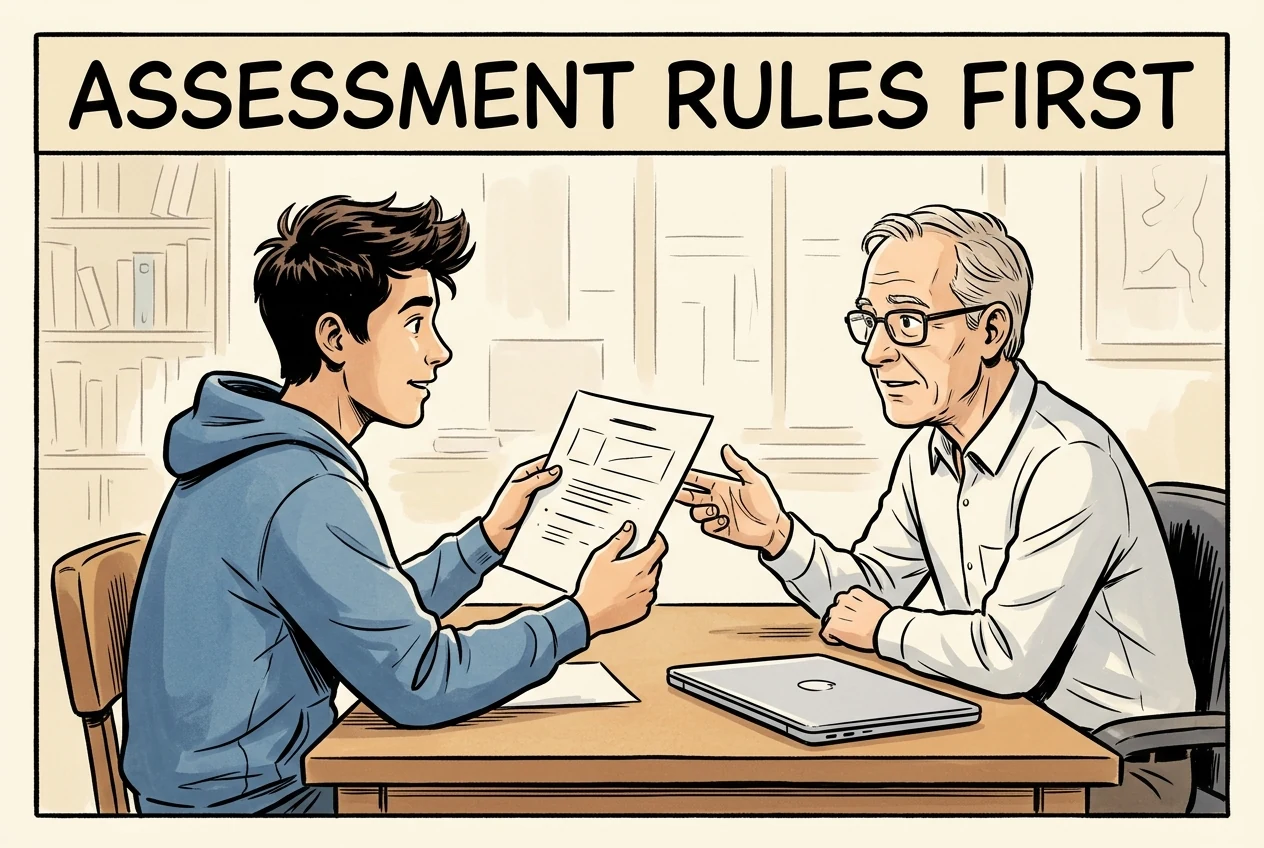
- Read the assessment’s technology-use statement.
- Retain notes, drafts and resource materials.
- Check the final written penalty notice and appeal link.

Brisbane, Australia
Student guide · Task scope and procedure
The assessment procedure requires an AI-use statement. Integrity authentication and formal misconduct appeals retain their own scope; public student acknowledgement guidance was not acquired from the failed link.
Panduan dasar di bawah adalah dalam bahasa Inggeris; bukti rasmi dikekalkan dalam bahasa asal.
Ringkasan lengkap peraturan pelajar belum tersedia; rujuk pernyataan dan sumber yang dikumpulkan.
The assessment procedure requires an AI-use statement. Integrity authentication and formal misconduct appeals retain their own scope; public student acknowledgement guidance was not acquired from the failed link.

Tambahan dikumpulkan: 2026-10-09 · Pemakaian semasa belum disahkan secara bebas
Ringkasan kini tersedia dalam bahasa Inggeris
Tafsiran laman
The assessment procedure requires assessment task information to include a statement on use of technologies such as AI. Read that task statement; the public procedure does not itself give blanket GenAI permission or a complete acknowledgement template.
Skop: Students in the cited programme/course/stage only · Only the captured source, version, audience and conditions; no exhaustive currency certification.
Bukti pengesanan · Sokongan dan penyesuaian
Skop: Students in the cited programme/course/stage only · university
Top of Page
Section 12 - Communication to Students of Assessment Requirements
Unit outlines
(85) The assessment scheme of a unit, implemented in the unit offering and published on the unit’s Canvas site, must align with the approved unit outline, including due dates.
(86) There must be clear communication in the unit outline of how each assessment item contributes to the final grade and the unit’s method for determining the final grade (Unit and Module Information Policy) if it is not the standard cumulation of marks resulting in a grade.
(87) The unit outline must include in the assessment items’ descriptions:
a statement as to the use of technology such as artificial intelligence tools (see Digital Workplace, Generative AI and assessment);
a statement for assignments, as defined in the Student Academic Concessions Policy, that the assessment is eligible for the late submission period and assignment extensions or that there is an approved exception to that Policy.
(88) As a minimum, the unit outline should specify the week/s of the teaching period that the assessment will be due or scheduled for completion.
The specific due date is communicated to students through the unit’s Canvas site.Lihat sumber rasmi ↗Dikumpulkan: 2026-10-09 · 344–353
SHA-256: 2aa0f2b8515355c86c3c2037ea6331b1df169140e380a0f9f0399065e0d943a2
Tafsiran laman
QUT requires an academic-integrity module in the first teaching period for undergraduate and coursework postgraduate students, including return after an absence of two years or more. Unauthorised examination material, technology or technology assistance can breach integrity, whether conduct is intentional or unintentional.
Skop: Undergraduate and coursework postgraduate students for mandatory module; examination conduct scope as cited · Only the captured source, version, audience and conditions; no exhaustive currency certification.
Bukti pengesanan · Sokongan dan penyesuaian
Skop: Undergraduate and coursework postgraduate students for mandatory module; examination conduct scope as cited · university
Section 6 - Academic Integrity Education
(8) QUT has an educative approach to academic integrity and supports students to understand how to approach their academic work and assessment in a way that upholds appropriate standards of academic integrity by:
requiring all undergraduate and coursework postgraduate students to complete a mandatory module on academic integrity in the first teaching period of their course;
requiring all undergraduate and coursework postgraduate students returning to study at QUT after an absence of two years or more, to complete a mandatory module in academic integrity in the first teaching period of their return to study;
providing students with discipline specific guidance and resources where relevant to develop understanding of appropriate standards and practices of academic integrity;
fostering a learning environment based on mutual respect and trust between academic staff and students;
adopting an educative approach to resolving cases of poor academic practice; and
providing practical tools and resources that enable students to self-assess their compliance with appropriate integrity standards prior to submitting assessment items.
(9) A student who has completed and passed the mandatory module on academic integrity will be determined to have an awareness of the standards of academic integrity at QUT.
Top of Page
Section 7 - Academic Integrity Breaches
(10) A breach of academic integrity is conduct, intentional or unintentional, that fails to demonstrate ethics, fairness, honesty, respect and accountability when undertaking academic work and assessment.
(11) A range of conduct may fail to uphold the standards of academic integrity and be classified as a breach of this Policy.
Cheating in examinations
(12) All forms of cheating are a breach of academic integrity, including, but not limited to:
having, accessing or using unauthorised material or technology during an examination;
any unauthorised communication by any means;
obtaining or seeking assistance from a third party or technology to complete the examination when it is not authorised;Lihat sumber rasmi ↗Dikumpulkan: 2026-10-09 · 159–176
SHA-256: 79bac6a03d4a3ad65e14e78fc0c8cd63edf7acf80db48a75b3369cc640783070
Tafsiran laman
A misconduct meeting must occur no less than 10 and no more than 20 working days after the allegation notice is sent. These are institutional scheduling bounds, not student appeal time. Students can respond in writing and use the permitted support arrangements; legal representatives are excluded under the cited clauses.
Institusi · Diperlukan bagi prosedur ini
Tempoh minimum untuk memberi respons. Semak titik mula, skop dan pengecualian dalam ringkasan serta teks asal.
Institusi · Diperlukan bagi prosedur ini
Dalam tempoh yang dinyatakan. Semak titik mula, skop dan pengecualian dalam ringkasan serta teks asal.
Skop: Students in the cited programme/course/stage only · Only the captured source, version, audience and conditions; no exhaustive currency certification.
Bukti pengesanan · Sokongan dan penyesuaian
Skop: Students in the cited programme/course/stage only · university
the student's right to respond to the allegation(s) by, if the student elects, attending the meeting, and in any case, by providing written submissions on the allegation(s) or the type of penalty which could be imposed if an allegation is substantiated;
the student's right to arrange for the voluntary attendance of a person with relevant information to be interviewed by the misconduct committee at the meeting;
the student's right to be accompanied or represented by a support person at the meeting (clause 23);
the consequences of non-attendance or of failing to provide written submissions, including the authority of the misconduct committee to determine an allegation in the student's absence and recommend a penalty to be imposed on the student;
a matrix providing information about the penalties which may be imposed depending on the nature and seriousness of a case; and
the support services provided by the QUT Student Guild to assist a student in responding to allegations
the student’s right to accept responsibility for the misconduct and make an early submission on circumstances relevant to the penalty to be applied, in accordance with clause (14)e.
(15) The chair of the misconduct committee must ensure that an allegation notice in this form is sent to the student. Copies of all documents or written evidence to be taken into consideration by the misconduct committee should be provided to the student at the same time as the allegation notice is sent or as soon as they are received by the committee.
(16) The chair will give due consideration to possible risks to the health, wellbeing and safety of others associated with the allegation which may result from disclosure of documents or written evidence and, where necessary, may determine that a redacted version of documents or evidence or a summary of the substance of the evidence be provided.
Time for Meeting
(17) The misconduct committee meeting at which the allegation(s) will be considered must be held not less than 10 working days and not more than 20 working days after the date upon which the allegation notice was sent to the student.
Meeting Procedures
(18) Meetings of the relevant misconduct committee will be conducted in accordance with Council Procedure 1 Committee Operations, and any operating procedures established by the misconduct committee. For cases involving allegations of Gender-based Violence, sexual harassment, sexual assault, or discrimination, the misconduct committee must ensure that, where necessary in dealing with the allegation, such allegations are addressed utilising a trauma-informed approach, whilst still ensuring that procedural fairness is observed.
(19) The misconduct committee conducts its proceedings without undue formality and in a non-adversarial manner. If there is a requirement for the University to be represented at the meeting by an officer of the University to address the allegations, then that officer must not be legally qualified (that is, the officer must not hold a degree or other formal qualifications in law and/or must not be an officer who has been admitted as a lawyer in any Australian jurisdiction).
(20) A student may attend the meeting at which the allegations are considered, including by electronic means by prior arrangement and with the agreement of the chair. If a student is not present at the meeting within 10 minutes of the nominated time for consideration of the student's case, the misconduct committee may proceed to determine the matter in the student’s absence, though the misconduct committee must take into account any written submissions provided by the student prior to the meeting date and time.
(21) If the student is present, the student must be given the opportunity to ask questions of any person interviewed by the committee, subject to the conditions outlined below, and may present any facts, evidence, documents or oral submissions relevant to the allegation(s).
(22) Where the student is unable to attend a meeting, an appropriately authorised representative may attend the meeting in the student's place, and holds the same category of invitee as the student. The student is not entitled to have a legal representative (being a person who holds a degree or other formal qualifications in law and/or a person who has been admitted as a lawyer in any Australian jurisdiction) present during the meeting.
(23) The student may be accompanied to the meeting by a support person, who will be categorised as an observer as defined in Council Procedure 1 - Committee Operations. A support person must not be another student involved in or associated with the allegations and must not be legally qualified. The support person’s role is confined to assisting a student during the meeting to understand the process undertaken and to help the student when the student puts their response to the misconduct committee.Lihat sumber rasmi ↗Dikumpulkan: 2026-10-09 · 127–144
SHA-256: 2cbac26b68fc46378d292b10a1686676656c7dd6e2afa705934bd8b354cd455f
Tafsiran laman
Lodge a misconduct appeal within 20 working days of receiving final written notice of the penalty decision; academic appeals use the outcome-letter link. The secretary confirms receipt within five working days of submission, and the student is advised of the appeal outcome within five working days of the committee meeting. Institutional periods are separate from the student’s submission window.
Pelajar · Diperlukan bagi prosedur ini
Dalam tempoh yang dinyatakan. Semak titik mula, skop dan pengecualian dalam ringkasan serta teks asal.
Institusi · Diperlukan bagi prosedur ini
Dalam tempoh yang dinyatakan. Semak titik mula, skop dan pengecualian dalam ringkasan serta teks asal.
Institusi · Diperlukan bagi prosedur ini
Dalam tempoh yang dinyatakan. Semak titik mula, skop dan pengecualian dalam ringkasan serta teks asal.
Skop: Students in the cited programme/course/stage only · Only the captured source, version, audience and conditions; no exhaustive currency certification.
Skop: Students in the cited programme/course/stage only · university
(46) University Appeals Committee considers appeals on misconduct matters. A student, graduate or graduand upon whom a penalty has been imposed under Section 9, for misconduct is entitled to appeal to the Appeals Committee on one or more of the following grounds:
that the decision is manifestly unreasonable taking into account all the circumstances of the case or cannot be supported by the evidence that was available at the time the decision was made;
that procedural requirements specified in this Policy were not followed and resulted in a decision which was manifestly unfair;
that relevant evidence was not considered in reaching the decision or that irrelevant evidence was relied upon in reaching the decision;
that fresh evidence has become available to the student which was not available or not known to the student at the time of the allegation(s) being heard or decided; and
that a penalty imposed under Section 9, Penalties was manifestly excessive or inappropriate, taking into account all the circumstances of the case.
(47) An appeal must be lodged with the secretary of Appeals Committee within 20 working days of receiving final written notice of the penalty decision. A student may provide any written evidence, information or submissions relevant to the grounds of appeal relied upon.
Appeals for academic misconduct must be submitted through the link provided in the outcome letter.
Appeals for non-academic misconduct must be submitted through the relevant Appeal against penalty for non-academic misconduct request form.
(48) The secretary of the Appeals Committee must confirm receipt of an appeal within five working days of its submission and confirm the meeting date the appeal has been allocated to, noting that appellants do not attend meetings of the Appeals Committee.
(49) The Appeals Committee may:
dismiss the appeal by confirming the decision initially made;
uphold the appeal by revoking the finding of misconduct;
confirm, vary or revoke any penalty imposed.
(50) Where the Appeals Committee concludes that the required procedures for considering allegations of misconduct have not been followed, it may refer the matter back to the relevant misconduct committee or University Officer to be dealt with in accordance with the procedures set out in this Policy. The student must be advised of the outcome of the appeal within 5 working days of the meeting of the Appeals Committee.Lihat sumber rasmi ↗Dikumpulkan: 2026-10-09 · 205–219
SHA-256: 2cbac26b68fc46378d292b10a1686676656c7dd6e2afa705934bd8b354cd455f
Tafsiran laman
Technology may assist detection and investigation, but the policy does not make a detector result conclusive. Where reasonable concerns arise, authentication can require resource notes/drafts, a viva or supervised practical work, with an opportunity for the student to demonstrate knowledge and integrity.
Skop: Students in the cited programme/course/stage only · Only the captured source, version, audience and conditions; no exhaustive currency certification.
Skop: Students in the cited programme/course/stage only · university
Other third parties may report suspected breaches to the University with supporting evidence. Reports of suspected breaches submitted by third parties will be considered only where supported by credible, verifiable evidence sufficient to demonstrate a reasonable basis for the allegation.
(41) The University will adopt reasonable processes to proactively detect breaches of academic integrity and support staff with training and resources.
(42) Technology may be used to assist in identifying and mitigating potential breaches of academic integrity. This includes technology to detect plagiarism, the use of artificial intelligence, and technologies that support verification of student identity and proctoring.
Authentication of learning
(43) If a Unit Coordinator has reasonable concerns that a student’s actions could be classified as academic misconduct, the Unit Coordinator may require the student to authenticate their learning. The Unit Coordinator will consider the outcome of the authentication of learning process in determining whether the conduct is a breach of the Policy.
(44) The authentication process must provide the student with an opportunity to demonstrate:
their competence or knowledge in the subject matter of the assessment item in question, in a manner that is appropriate to the nature of the assessment item; and
that the assessment item was completed with integrity.
(45) This might include (but is not limited to) the Unit Coordinator:
requesting the student to provide evidence of resource materials used in the production of the assessment, such as notes, drafts, sketches, concept drawings and reading materials;
conducting a viva in which the student’s task-related learning is tested; and/or
requiring the student to undertake a practical exercise under supervision.Lihat sumber rasmi ↗Dikumpulkan: 2026-10-09 · 298–309
SHA-256: 79bac6a03d4a3ad65e14e78fc0c8cd63edf7acf80db48a75b3369cc640783070
Tambahan berasaskan sumber yang diterbitkan. Ringkasan Inggeris dan petikan asal dipisahkan daripada rekod yang disemak. Proses dan hasil bukan hukuman automatik bagi penggunaan AI. Pemakaian semasa belum disahkan secara bebas; semak skop dan versi sumber.
Disemak dengan teks tersimpan; bukan terjemahan rasmi
Hash membolehkan perbandingan teks tersimpan; ia tidak mengesahkan kesahan semasa atau ketidakbolehubahan. Tema ini bukan urutan wajib.
Akses alat bukan kebenaran menggunakannya dalam penilaian. Semak peraturan tugasan, pengguna yang layak dan sekatan data.
Rekod alat berasaskan sumber belum diwujudkan untuk universiti ini. Ini tidak bermaksud alat tiada atau AI dilarang.
Reviewed record
Pernyataan yang disemak: 4
Academic Integrity
Nilai ternormalisasi: unauthorised_or_inappropriate_technology_can_be_integrity_breach
Bukti asal
Bukti 1it is a breach of academic integrity when technology is used inappropriately, or its use is not authorised, and it: replaces or obscures the student’s own academic effort
Pengajaran
Nilai ternormalisasi: unit_outlines_include_ai_tool_use_statement
Bukti asal
Bukti 1The unit outline must include in the assessment items’ descriptions: a statement as to the use of technology such as artificial intelligence tools
Privasi
Nilai ternormalisasi: staff_not_require_non_qut_genai_tools
Bukti asal
Bukti 1Due to data security, intellectual property and privacy concerns, staff must not require students to use GenAI for learning and assessment outside of those tools provided by QUT.
Ai Tool Treatment
Nilai ternormalisasi: unit_coordinator_sets_genai_assessment_permission
Bukti asal
Bukti 1Your unit coordinator will let you know if you can use GenAI in the preparation or completion of assessment tasks.
Source record
Sumber: 3
mopp.qut.edu.au
mopp.qut.edu.au
libguides.library.qut.edu.au
Citation: University AI Policy Tracker. "Queensland University of Technology (QUT) AI Policy Tracker record." Last checked May 15, 2026. https://eduaipolicy.org/universities/queensland-university-of-technology
Original university source language remains canonical. This tracker is not an official university statement.
Buka log perubahanSaved from University AI Policy Tracker. This record summarizes the cited sources; it is not an official university statement or assessment permission. Source and review dates are listed above. Hashes identify retained content, not authorization.