Perkara yang perlu dilakukan
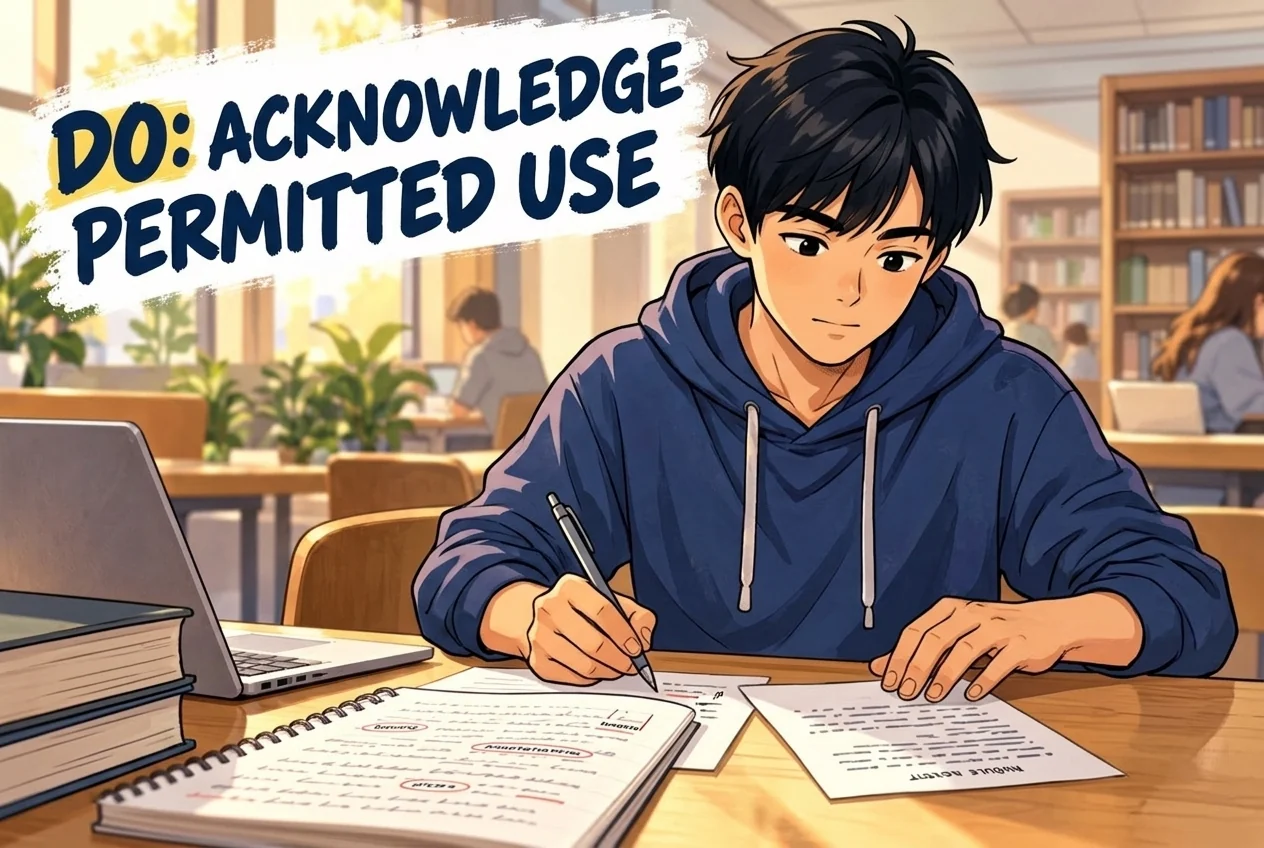
- Agree thesis use with the supervisor.
- Declare tools, stages, purposes and checks.
- Upload the thesis for the required source check.
Venice, Italy
Student guide · Task scope and procedure
Bachelor/Master thesis use must be agreed, declared and verified. Teaching examples, Compilatio checking and the dated research guideline remain separate from complete disciplinary rules or tool licences.
Panduan dasar di bawah adalah dalam bahasa Inggeris; bukti rasmi dikekalkan dalam bahasa asal.
Ringkasan lengkap peraturan pelajar belum tersedia; rujuk pernyataan dan sumber yang dikumpulkan.
Bachelor/Master thesis use must be agreed, declared and verified. Teaching examples, Compilatio checking and the dated research guideline remain separate from complete disciplinary rules or tool licences.
Tambahan dikumpulkan: 2026-10-08 · Pemakaian semasa belum disahkan secara bebas
Ringkasan kini tersedia dalam bahasa Inggeris
Tafsiran laman
Teaching guidance asks teachers to specify permitted and forbidden uses for each activity; its language-assistance and brainstorming examples are suggested notes where AI is anticipated, not permission for every assessment. Copy-paste without verification/reworking is listed as not permitted.
Skop: Teachers/students within the specific activity instructions · Only the captured source, version, audience and conditions; no exhaustive currency certification.
Bukti pengesanan · Sokongan dan penyesuaian
Skop: Teachers/students within the specific activity instructions · university
thinking. This approach can better assess the actual knowledge and skills related to
the subject matter. Such verification is an essential part of the exam and must be
carried out in accordance with the Student Careers Regulations regarding the
validation of exam grades.
Students may have unrealistic expectations regarding the capabilities and outcomes
of AI. Therefore, teachers should offer clear guidance on how to properly use these
tools during tests and activities, explicitly stating what is permitted and what is not
allowed in each situation.
Where AIs are anticipated to assist in testing, for example, it is advisable to clarify
the rules regarding permitted and non-permitted uses by including notes like those
below:
5/12
• Permitted: use AI tools as language assistants to enhance your texts (e.g.,
check syntax and terminology). In this case, AI does not add new content.
• Permitted: using AI tools as a search engine or for brainstorming, but users
should not use the output directly. Instead, they should verify the information
through alternate reliable sources and critically assess the results.
• NOT permitted: Copy and paste of AI-generated content without proper
source verification and re-elaboration.Lihat sumber rasmi ↗Dikumpulkan: 2026-10-08 · 185–208
SHA-256: 6b1ea4bd62ef423bdcd826b177890eaa69d5bb7f3489996fa0f0601f8d0170c5
Tafsiran laman
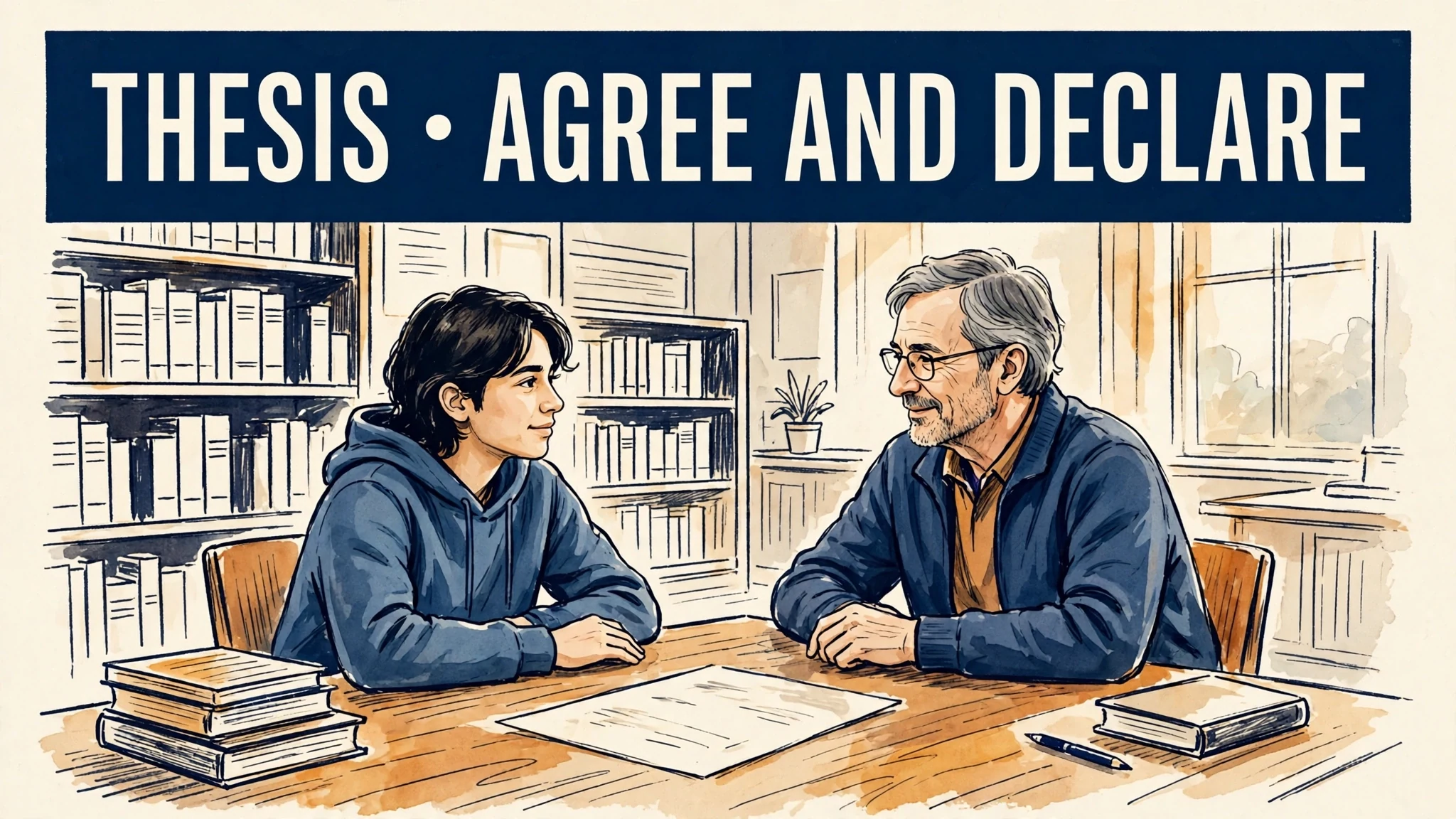
For Bachelor/Master final papers, AI use must be agreed with the supervisor, declared and verifiable. An introductory methodological declaration identifies tools, stages, purposes and verification; AI images require software attribution and copyright checks. External tools must not receive personal/sensitive/confidential information. Institutional tools are strongly advised, not a named licence promise.
Skop: Bachelor/Master thesis and final paper preparation · Only the captured source, version, audience and conditions; no exhaustive currency certification.
Bukti pengesanan · Sokongan dan penyesuaian
Skop: Bachelor/Master graduating students and thesis supervisors · university
During the preparation of your thesis/final paper, it is essential to pay particular attention to the correct use of sources and to the responsible use of Artificial Intelligence tools.
You are therefore invited to consult the Guidelines for thesis/final paper provided by the University, which contain useful instructions on how to prepare your work, use sources appropriately and follow good academic practices.
Please also note that uploading your thesis/final paper in your Personal area is mandatory, as your work will be checked using the Compilatio software, adopted by the University to verify the proper use of sources and ensure the authenticity of submitted work.
You are also required to include in your thesis/final paper a declaration clearly stating:
whether you used Artificial Intelligence tools during the preparation of your work;
if so, how and in which context they were used.
This declaration is intended to ensure transparency and academic integrity in the preparation of your final work.
Guidelines for thesis/final paper [ITA]
How to create the file of your thesis/final paper and upload it on your Personal Area:
Use of AI
Upload thesis/final paper
Anti-plagiarism software
Format of thesis/final paper
Copyright
Use of AI
How to use AI tools in the preparation of your thesis/final paper
The use of Artificial Intelligence (AI) tools, including generative models (e.g. ChatGPT, Copilot, Gemini, Claude, etc.), is permitted in the preparation of your final paper or thesis, provided that it complies with the principles of academic responsibility, originality, and scientific rigour.
As indicated in the Guidelines for thesis/final paper, such use must be aware, declared, verifiable, and must be agreed upon with your supervisor. For this reason, you will be required to include, in an introductory methodological section of your final paper or thesis, a declaration stating:
which AI tools were used;
at which stages of the work they were employed;
for what purposes (e.g. writing support, language editing, data analysis or data presentation);
that you have verified the accuracy and reliability of the content produced.
To prepare this declaration, use the downloadable template provided below.
AI tools may provide useful support in improving clarity, structure, and conciseness; however, the work must remain personal and original. You remain fully responsible for all content produced, including content generated with AI: you must ensure its accuracy, avoid misleading information, and comply with citation and plagiarism regulations.
If AI-generated images or other content are used, you must indicate the software used, verify their relevance and accuracy, and ensure compliance with copyright regulations.
Finally, you are strongly advised to use University-provided tools in order to ensure appropriate data protection. When using external tools, you must not enter personal data or sensitive or confidential information, as such data may be processed or retained by service providers.Lihat sumber rasmi ↗Dikumpulkan: 2026-10-08 · 44–69
SHA-256: ffa5936e45bec1951a417c621300aa8adb9a6208cf7fa89c4d7abc142cdff7f2
Tafsiran laman
The captured research guideline requires verification of AI outputs and keeps authors responsible for research/publication integrity. Its footer says November2024, while the AI portal announces research-guideline modification by Decree214 of March16,2026, effective March23. The dated English document and portal update are retained without claiming the linked English text is a fully reconciled current version.
Skop: Researchers using the captured English guideline · Only the captured source, version, audience and conditions; no exhaustive currency certification.
Bukti pengesanan · Sokongan dan penyesuaian
Skop: Researchers using the captured English guideline · university
Use of Generative AI in Research:
● The results generated by AI tools must always be verified through various
control steps. Generative AI systems do not guarantee accuracy and lack
mechanisms to ensure the truthfulness of their claims. They may produce what is
known as "bias" – grammatically correct content that appears plausible at first
glance but contains false information. It is essential to seek out original
sources and properly attribute them to their creators. As AI tools operate more
"autonomously," the associated risks increase. Consequently, as the potential for
damage grows, the level of verification required by researchers must also
intensify.
● Individuals using AI are fully responsible for the outcomes and the
appropriateness of the research processes involving AI. Responsibility cannot
be transferred to AI tools, and it is essential to stay informed about how these
tools are used. This means that everyone employing these systems for their
research is accountable for any misuse, such as failing to adhere to the principles
of scientific integrity on issues such as plagiarism and proper citation of sources.
This principle aligns with the Committee of Publication Ethics (COPE) stance,
which asserts that authors are entirely responsible for the content of their work,
Computer Services and Telecommunication Area (ASIT)
Working Group for ICT Research Support Activities, November 2024
4
Ca’ Foscari University of Venice
Dorsoduro 3246, 30123 Venice, Italy
www.unive.it
including any sections generated by AI tools. Therefore, they can be held
accountable for any violations of publication ethics. Additionally, ALLEA's 2023
European Code of Conduct for Research Integrity mandates that the use of AI
tools be reported in accordance with the standards relevant to the specificLihat sumber rasmi ↗Dikumpulkan: 2026-10-08 · 151–182
SHA-256: 52da288957b2cf88a5ba4640dc292a984f94995dc283da544a7a34e269219696
Guidelines for the Responsible Use of Artificial Intelligence in Research
by the "Working Group for ICT Research Support Activities”, coordinated by Prof. Marco S. Nobile and advised by Chiara Gallese, Marie Curie Fellow at the University of Turin and member of the EU’s AI Office Working Group on “General-Purpose AI Code of Practice”. Guidelines modified by the Rectoral Decree No. 214 of 16/03/2026, and entered into force on 23/03/2026.439 K
Guidelines for the Responsible Use of Generative AI in Teaching and Learning
by the Working Table on the use of AI for Teaching, coordinated by Prof. Sabina Rossi and Dr. Teresa Scantamburlo, Ca' Foscari's representative in the Working Group on the “General-Purpose AI Code of Practice” of the AI Office of the European Community317 KLihat sumber rasmi ↗Dikumpulkan: 2026-10-08 · 50–53
SHA-256: bf624775dc75e44bd84abb3717908393c43034a30bf89e7f2b7890ecf4e28e1c
Tafsiran laman
The thesis must be uploaded in the Personal Area for Compilatio source/authenticity checking. It also requires a declaration whether AI was used and how. The page does not establish a detector score as proof or give a disciplinary appeal deadline.
Skop: Bachelor/Master thesis upload · Only the captured source, version, audience and conditions; no exhaustive currency certification.
Skop: Graduating Bachelor/Master students · university
During the preparation of your thesis/final paper, it is essential to pay particular attention to the correct use of sources and to the responsible use of Artificial Intelligence tools.
You are therefore invited to consult the Guidelines for thesis/final paper provided by the University, which contain useful instructions on how to prepare your work, use sources appropriately and follow good academic practices.
Please also note that uploading your thesis/final paper in your Personal area is mandatory, as your work will be checked using the Compilatio software, adopted by the University to verify the proper use of sources and ensure the authenticity of submitted work.
You are also required to include in your thesis/final paper a declaration clearly stating:
whether you used Artificial Intelligence tools during the preparation of your work;
if so, how and in which context they were used.
This declaration is intended to ensure transparency and academic integrity in the preparation of your final work.Lihat sumber rasmi ↗Dikumpulkan: 2026-10-08 · 44–50
SHA-256: ffa5936e45bec1951a417c621300aa8adb9a6208cf7fa89c4d7abc142cdff7f2
Tafsiran laman
The teaching guidance suggests documenting interactions for transparency and says it is unwise to assess students solely with AI detectors because of false positives. Suggested recording is not a universal student full-log obligation, and the detector caution does not abolish source verification or the thesis upload requirement.
Skop: Teachers evaluating learning and considering AI detection · Only the captured source, version, audience and conditions; no exhaustive currency certification.
Skop: Teachers evaluating learning and considering AI detection · university
Transparency
AI tools are ‘black boxes’: it is not possible to know or analyse the processes that
lead to a given output. Therefore, promoting transparency through a critical and
mindful approach is essential. To achieve this, teachers could track interactions with
the tool. For instance, it would be helpful to document the name of the tool used, the
prompts entered along with their corresponding outputs, any prompt engineering
techniques applied, the purpose of using the tool, and the strengths and limitations
encountered during its use. These measures not only enhance transparency but also
help build trust between teachers and learners.
AI detector
There are currently no software tools that can accurately determine if a text was
generated by an AI. Therefore, it is unwise to evaluate students solely based on AI
detection software, as recent studies show a significant number of false positives.5
For this reason, it is crucial for teachers to evaluate students' work based on their
individual experiences, skills, and knowledge of the subject. Just like with plagiarismLihat sumber rasmi ↗Dikumpulkan: 2026-10-08 · 211–227
SHA-256: 6b1ea4bd62ef423bdcd826b177890eaa69d5bb7f3489996fa0f0601f8d0170c5
Tambahan berasaskan sumber yang diterbitkan. Ringkasan Inggeris dan petikan asal dipisahkan daripada rekod yang disemak. Proses dan hasil bukan hukuman automatik bagi penggunaan AI. Pemakaian semasa belum disahkan secara bebas; semak skop dan versi sumber.
Disemak dengan teks tersimpan; bukan terjemahan rasmi
Hash membolehkan perbandingan teks tersimpan; ia tidak mengesahkan kesahan semasa atau ketidakbolehubahan. Tema ini bukan urutan wajib.
Akses alat bukan kebenaran menggunakannya dalam penilaian. Semak peraturan tugasan, pengguna yang layak dan sekatan data.
Rekod alat berasaskan sumber belum diwujudkan untuk universiti ini. Ini tidak bermaksud alat tiada atau AI dilarang.
Reviewed record
Pernyataan yang disemak: 4
Pengajaran
Nilai ternormalisasi: teaching_learning_guidance_for_faculty_students
Bukti asal
Bukti 1These guidelines regarding the potential use of AI tools in teaching and learning are intended for faculty and students. They apply to all forms of AI, regardless of the type of input and output, with a particular focus on commercial applications.
Paparan setempat only
The teaching and learning guidance is explicitly addressed to faculty and students and applies broadly to AI tools, with focus on commercial applications.
Privasi
Nilai ternormalisasi: admin_ai_guidance_no_personal_or_confidential_data_inputs
Bukti asal
Bukti 1The staff should therefore not input the following data into AI tools: Personal data that could directly or indirectly identify individuals. Data that is important for future research use and might be protected by intellectual property law. Data subject to contracts with third parties, such as companies. Data protected by copyright or confidentiality restrictions, unless permission is obtained from the owner.
Paparan setempat only
Administrative staff guidance says not to enter personal, contract, protected intellectual-property, or confidentiality-restricted data into AI tools unless permission applies.
Penyelidikan
Nilai ternormalisasi: research_ai_responsible_use_transparency_citation
Bukti asal
Bukti 1Researchers should ensure maximum transparency regarding their use of AI tools in scientific activities. This means that the way AI tools are used should be described in detail in ad hoc sections of the article (e.g., 'Materials and methods' and/or 'Further information'), specifying the prompts (where relevant), which tools were used and which version.
Paparan setempat only
The research guidance advises transparent disclosure of AI tool use, including prompts where relevant, tools used, and versions.
Source Status
Nilai ternormalisasi: official_ai_guidance_hub_with_linked_guidelines
Bukti asal
Bukti 1The Rector's Delegates for Digital innovation in teaching and research, supported by the staff of the Computer Services and Telecommunications Area (ASIT), have prepared the following guidelines: Guidelines for the Responsible Use of Artificial Intelligence in Research; Guidelines for the Responsible Use of Generative AI in Teaching and Learning.
Paparan setempat only
The official AI hub links Ca' Foscari's research and teaching/learning AI guideline PDFs and separately lists administrative-services AI guidance.
Source record
Sumber: 4
unive.it
unive.it
unive.it
unive.it
Citation: University AI Policy Tracker. "Ca' Foscari University of Venice AI Policy Tracker record." Last checked May 18, 2026. https://eduaipolicy.org/universities/ca-foscari-university-of-venice
Original university source language remains canonical. This tracker is not an official university statement.
Buka log perubahanSaved from University AI Policy Tracker. This record summarizes the cited sources; it is not an official university statement or assessment permission. Source and review dates are listed above. Hashes identify retained content, not authorization.