À faire
- Read the task category and reporting requirements.
- Clarify uncertainty and individual study arrangements.
- Use the decision-receipt trigger for misconduct rectification.

Oulu, Finland
Student guide · Task scope and procedure
Required, prohibited, restricted and allowed AI categories have different reporting rules. Maturity tests prohibit AI. Institutional tool inventory qualifications and the assessment-rejection rectification route remain visible.
Le guide ci-dessous est en anglais ; les preuves officielles restent dans leur langue d’origine.
Aucun résumé complet des règles pour les étudiants n’est disponible ; consultez les énoncés et sources recueillis.
Required, prohibited, restricted and allowed AI categories have different reporting rules. Maturity tests prohibit AI. Institutional tool inventory qualifications and the assessment-rejection rectification route remain visible.
Complément collecté: 2026-10-09 · Applicabilité actuelle non confirmée indépendamment
Résumé disponible actuellement en anglais
Interprétation du site
The teacher specifies required, prohibited, restricted or allowed AI use; reporting differs by category and task. Required AI needs skills support, and the guideline discusses individual study-arrangement writing aids. Students retain responsibility and must clarify doubts. AI is prohibited in maturity tests.
Portée: Students in the cited programme/course/stage only · Only the captured source, version, audience and conditions; no exhaustive currency certification.
Portée: Students in the cited programme/course/stage only · university
Maturity tests prohibit AI; individual study-arrangement writing aid provision; reporting not universal.
Principles of responsible use
Generative AI is a tool that can be utilized in many ways. At the University of Oulu, it is important that teachers and students share a common understanding of what is acceptable and what is prohibited regarding AI, as well as what constitutes responsible use in support of learning. Within the university community, students are supported in this goal through academic advising, seminars, methodology courses, and during study modules.
Within the framework of these guidelines, the teacher may specify the use of generative AI in a pedagogically appropriate manner with respect to the learning objectives of an assignment or course. For a given assignment or course, the teacher may, at their discretion, whether the use of AI is: 1) required (must 2 be used, must be reported, affects assessment); 2) prohibited (not to be used); 3) restricted (can be used, must be reported); or 4) allowed (can be used, need not be reported).
The teacher must justify why generative AI is to be used (e.g., to strengthen generic skills or for another pedagogical reason) or why it is not allowed in the completion of course assignments. If the use of generative AI is required in a course, the teacher must ensure that students have sufficient skills for AI use. If a student has a recommendation from individual study arrangements that includes the use of technical aids in writing, it is recommended that the student be allowed to use generative AI—this is the student's right. The teacher may monitor the use of AI.
The teacher may require students to report which AI applications were used and how. If AI use is permitted, data protection requirements must be considered and other University of Oulu guidelines on the processing of personal data must be followed. The teacher may require students to use only systems for which the University has conducted a risk assessment. The teacher must provide instructions on the use of AI for the course and assignments. Use the so-called "traffic light model" by Arene is recommended to illustrate the ways generative AI can be used in the course. The traffic light model can also be applied in Moodle course areas.
The student is always personally responsible for the output they submit, and output produced by AI may not be presented as one's own or as a source. AI can provide study support but it is not a substitute for one’s own learning, thought, and practice. It is recommended that students use generic AI to support their learning and studying.
The student is responsible for following the instructions given by the teacher. In cases of uncertainty, the student is encouraged to discuss with the teacher and confirm whether their intended use of AI is permitted.
The impact of a student’s use of generative AI on the assessment of their performance depends on the assignment and the relevant instructions for AI use. The student's use of AI may affect the grade negatively, neutrally, or positively depending on whether AI use is prohibited, allowed, or required. The use of AI should not negatively affect the assessment if the student uses AI in a permitted way. The teacher may require a report from the student on their use of AI. The teacher is not obligated to arrange an alternative assignment for a student who refuses to use AI if the course or implementation details indicate that AI use is required. In assessment, it should also be noted that it can be difficult to reliably detect the use of AI. If there is suspicion of misconduct, the University of Oulu’s procedures for handling academic misconduct cases will be followed.
The use of AI is prohibited in maturity tests.Voir la source officielle ↗Collecté: 2026-10-09 · 90–98
SHA-256: 9bc8225ff250a84294f18f37d86694e17a6b2dbf4f8c8aa96dd7b7ff33c13836
Interprétation du site
Permitted AI must comply with personal-data rules; the teacher may restrict use to risk-assessed systems. The guideline notes reliable detection can be difficult and directs suspected misconduct to the University procedure rather than a detector verdict.
Portée: Students in the cited programme/course/stage only · Only the captured source, version, audience and conditions; no exhaustive currency certification.
Portée: Students in the cited programme/course/stage only · university
The teacher may require students to report which AI applications were used and how. If AI use is permitted, data protection requirements must be considered and other University of Oulu guidelines on the processing of personal data must be followed. The teacher may require students to use only systems for which the University has conducted a risk assessment. The teacher must provide instructions on the use of AI for the course and assignments. Use the so-called "traffic light model" by Arene is recommended to illustrate the ways generative AI can be used in the course. The traffic light model can also be applied in Moodle course areas.
The student is always personally responsible for the output they submit, and output produced by AI may not be presented as one's own or as a source. AI can provide study support but it is not a substitute for one’s own learning, thought, and practice. It is recommended that students use generic AI to support their learning and studying.
The student is responsible for following the instructions given by the teacher. In cases of uncertainty, the student is encouraged to discuss with the teacher and confirm whether their intended use of AI is permitted.
The impact of a student’s use of generative AI on the assessment of their performance depends on the assignment and the relevant instructions for AI use. The student's use of AI may affect the grade negatively, neutrally, or positively depending on whether AI use is prohibited, allowed, or required. The use of AI should not negatively affect the assessment if the student uses AI in a permitted way. The teacher may require a report from the student on their use of AI. The teacher is not obligated to arrange an alternative assignment for a student who refuses to use AI if the course or implementation details indicate that AI use is required. In assessment, it should also be noted that it can be difficult to reliably detect the use of AI. If there is suspicion of misconduct, the University of Oulu’s procedures for handling academic misconduct cases will be followed.Voir la source officielle ↗Collecté: 2026-10-09 · 94–97
SHA-256: 9bc8225ff250a84294f18f37d86694e17a6b2dbf4f8c8aa96dd7b7ff33c13836
Interprétation du site
The Finnish ICT inventory lists Microsoft M365 Copilot Chat for staff and students with oulu.fi credentials and enterprise data protection. It records Allowed: Yes and highest classification Confidential 3Y, but also status “Selvityksessä” and check date 9 June 2026. Preserve those qualifications; no account or data-handling entitlement was independently tested.
Portée: Students in the cited programme/course/stage only · Only the captured source, version, audience and conditions; no exhaustive currency certification.
Portée: Students in the cited programme/course/stage only · university
Inventory status Selvityksessä retained; not blanket personal-data authorization.
Microsoft M365 Copilot Chat (Enterprise data protection)
Valmistaja: Microsoft
Tuotteen tyyppi: AI-avustaja/chatbot
Lisenssi: Enterprise data protection -ominaisuuksilla käytettävä palvelu yliopiston sopimuksen piirissä
Käyttötarkoitus: Yleiskäyttöinen tekoälyavusteinen työskentely Edge-selaimessa ja työpöytäsovelluksessa
Sallittu: Kyllä
Käsiteltävän aineiston korkein sallittu luokitus: Luottamuksellinen 3Y
Tila: Selvityksessä
Tarkistettu (PVM): 9.6.2026
Miten käyttäjä saa pääsyn työkaluun: Saatavilla oulu.fi-tunnuksilla henkilökunnalle ja opiskelijoille Edge-selaimessa ja työpöytäsovelluksessa, Copilot-tekoälychat opiskelijalle.Voir la source officielle ↗Collecté: 2026-10-09 · 162–171
SHA-256: 136872aafbbdff03b63da8498ceac8c26377c57c8d149be69a14bfb28dafa8c1
Interprétation du site
The captured code effective 1 August 2024 separates disciplinary sanctions from assessment rejection. Written warning is decided by the Rector; fixed suspension is decided by the University Board and is at most one year. Before a decision the student must be informed of the allegation and heard; these are possible sanctions, not automatic AI penalties.
Portée: Students in the cited programme/course/stage only · Only the captured source, version, audience and conditions; no exhaustive currency certification.
Portée: Students in the cited programme/course/stage only · university
The actual disciplinary measures are laid down in Section 45 of the Universities Act (558 / 2009):
The Universities Act, Section 45
Disciplinary action
A student who is guilty of infringement of the university's teaching or research activities or has
otherwise violated university order, may be given a written warning or be suspended from the
university for a fixed period of one year at most, depending on the seriousness of the misconduct. The
decision on a warning to be issued to a student is made by the Rector of the University, whereas the
decision on a fixed-period suspension shall be made by the University Board of Directors. Before
making the decision, the student must be verifiably informed of which offence he or she is being
accused of and given an opportunity to be heard in the matter.
Depending on the seriousness of the misconduct, the Rector shall decide about giving a warning to the
student, or to propose the student's temporary dismissal to the University Board. The decision to
temporary suspension is made by the University Board. The student can be suspended for a maximum of
one year.Voir la source officielle ↗Collecté: 2026-10-09 · 605–620
SHA-256: bed80c3d47dedfe38c05e2c7a22ae0d1b5df756f41984e66dbccb1fcfff4f56e
15 Effective date
This decision enters into force 1 August 2024.Voir la source officielle ↗Collecté: 2026-10-09 · 668–669
SHA-256: bed80c3d47dedfe38c05e2c7a22ae0d1b5df756f41984e66dbccb1fcfff4f56e
Interprétation du site
If a study attainment is rejected for misconduct, request rectification to the Board of Examiners within 14 days of receipt of the decision. A separate disciplinary decision may be appealed to administrative court; the cited section supplies no numerical court deadline. Suspension may be enforced during appeal unless otherwise ordered.
Étudiant · Obligatoire dans cette procédure
Dans le délai indiqué. Vérifiez le point de départ, la portée et les exceptions dans le résumé et le texte original.
Portée: Students whose study attainment is rejected for misconduct; disciplinary route distinct · Only the captured source, version, audience and conditions; no exhaustive currency certification.
Portée: Students whose study attainment is rejected for misconduct; disciplinary route distinct · university
Disciplinary administrative-court appeal is separate; suspension may continue unless otherwise ordered.
14 Appeal and the student's legal protection
The student whose study attainment is rejected based on misconduct in studies can submit a request for
rectification within 14 days of receipt of the decision to the University Board of Examiners, if he or she is
dissatisfied with the decision.
A written decision regarding a disciplinary issue shall specify what factors have contributed to the
conclusion. The student shall be verifiably informed about the decision, and he or she shall have the right to
appeal about the disciplinary decision to administrative court. A decision regarding a student's temporary
suspension may be enforced regardless of appeal, unless otherwise ordered by the university or
administrative court.Voir la source officielle ↗Collecté: 2026-10-09 · 656–665
SHA-256: bed80c3d47dedfe38c05e2c7a22ae0d1b5df756f41984e66dbccb1fcfff4f56e
Compléments publiés fondés sur des sources. Les résumés anglais et citations originales sont séparés du dossier vérifié. Les procédures et résultats possibles ne sont pas des sanctions automatiques liées à l’IA. L’applicabilité actuelle n’a pas été confirmée indépendamment ; vérifiez la portée et la version de la source.
Comparaison au texte conservé ; traduction non officielle
Les empreintes permettent de comparer les textes conservés ; elles ne certifient ni leur validité actuelle ni leur immuabilité. Ces thèmes ne sont pas une séquence obligatoire.
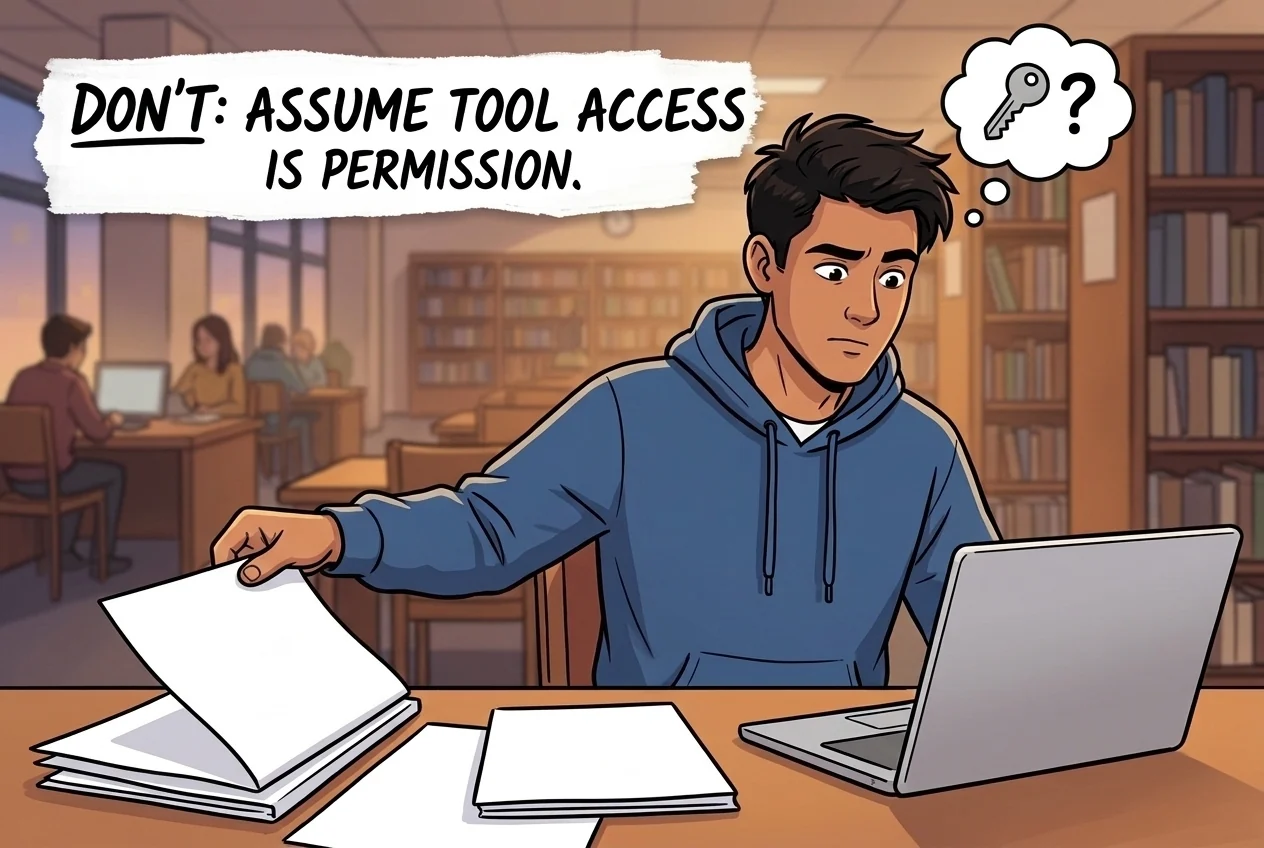
L’accès à un outil ne vaut pas autorisation pour une évaluation. Vérifiez les consignes, les personnes éligibles et les restrictions de données.
Enregistrement archivé ; consultez la source officielle pour l’accès actuel. Les informations d’accès et les citations conservent leur langue originale.
University of Oulu's internal AI platform supports secure research and teaching use.
Complete the access form.
Not specified.
Citation originale
Lehmus AI: Yliopiston sisäinen tekoälyalusta. Lisenssi: Lisensoitu/on-prem. Sallittu: Kyllä. Miten käyttäjä saa pääsyn työkaluun: Täyttämällä lomakkeen.Finnish inventory permits staff/students with oulu.fi credentials, with maximum Confidential 3Y, but records status Selvityksessä and check date 9 June 2026. Not blanket personal-data permission.
oulu.fi credentials via Edge or desktop; verify current inventory status and task rules.
No individual price established.
Date de vérification du complément:
Citation originale
Microsoft M365 Copilot Chat (Enterprise data protection)
Valmistaja: Microsoft
Tuotteen tyyppi: AI-avustaja/chatbot
Lisenssi: Enterprise data protection -ominaisuuksilla käytettävä palvelu yliopiston sopimuksen piirissä
Käyttötarkoitus: Yleiskäyttöinen tekoälyavusteinen työskentely Edge-selaimessa ja työpöytäsovelluksessa
Sallittu: Kyllä
Käsiteltävän aineiston korkein sallittu luokitus: Luottamuksellinen 3Y
Tila: Selvityksessä
Tarkistettu (PVM): 9.6.2026
Miten käyttäjä saa pääsyn työkaluun: Saatavilla oulu.fi-tunnuksilla henkilökunnalle ja opiskelijoille Edge-selaimessa ja työpöytäsovelluksessa, Copilot-tekoälychat opiskelijalle.Reviewed record
7 énoncés examinés
Academic Integrity
Valeur normalisée: student_responsible_ai_output_not_own_source
Preuve originale
Preuve 1The student is always personally responsible for the output they submit, and output produced by AI may not be presented as one's own or as a source. AI can provide study support but it is not a substitute for one’s own learning, thought, and practice.
Affichage localisé only
Students remain responsible for submitted output and may not present AI output as their own or as a source.
Enseignement
Valeur normalisée: education_ai_guidelines
Preuve originale
Preuve 1The University of Oulu has drawn up common policies on the use of artificial intelligence (AI) in education. The guidelines describe what kind of use of AI is allowed or prohibited at the University of Oulu and how it can be used responsibly to support studies.
Affichage localisé only
The University of Oulu has common AI-in-education guidelines describing allowed, prohibited, and responsible uses.
Enseignement
Valeur normalisée: teacher_may_define_course_ai_use
Preuve originale
Preuve 1For a given assignment or course, the teacher may, at their discretion, whether the use of AI is: 1) required (must 2 be used, must be reported, affects assessment); 2) prohibited (not to be used); 3) restricted (can be used, must be reported); or 4) allowed (can be used, need not be reported).
Affichage localisé only
Teachers may set assignment or course AI use as required, prohibited, restricted, or allowed.
Confidentialité
Valeur normalisée: ai_use_data_protection_requirements
Preuve originale
Preuve 1If AI use is permitted, data protection requirements must be considered and other University of Oulu guidelines on the processing of personal data must be followed. The teacher may require students to use only systems for which the University has conducted a risk assessment.
Affichage localisé only
Permitted AI use must consider data protection and follow University of Oulu personal-data-processing guidance.
Recherche
Valeur normalisée: research_genai_guidelines_exist
Preuve originale
Preuve 1For this reason, the University of Oulu has drawn up guidelines for its researchers on the responsible use of generative artificial intelligence (GenAI) in research. The guidelines are reviewed and updated as necessary by the university's Steering Group for Responsible Science.
Affichage localisé only
The university says it has drawn up GenAI research-use guidelines for researchers.
Ai Tool Treatment
Valeur normalisée: {"tool":"institutional_ai_service","rawToolName":"Lehmus AI","description":"University of Oulu's internal AI platform supports secure research and teaching use.","howToObtain":"Complete the access form.","costToUser":"Not specified.","availability":"allowed","endorsementType":"self_hosted_system"}
Preuve originale
Preuve 1Lehmus AI: Yliopiston sisäinen tekoälyalusta. Lisenssi: Lisensoitu/on-prem. Sallittu: Kyllä. Miten käyttäjä saa pääsyn työkaluun: Täyttämällä lomakkeen.
Affichage localisé only
Lehmus AI: Yliopiston sisäinen tekoälyalusta. Lisenssi: Lisensoitu/on-prem. Sallittu: Kyllä. Miten käyttäjä saa pääsyn työkaluun: Täyttämällä lomakkeen.
Autre
Valeur normalisée: library_ai_information_searching_guidance
Preuve originale
Preuve 1Discuss with the course teacher or thesis instructor well in advance whether the use of AI applications (and which ones) is allowed for information retrieval in your work.
Affichage localisé only
The library guide advises students to ask the course teacher or thesis instructor whether AI applications are allowed for information retrieval.
Source record
4 sources
libguides.oulu.fi
oulu.fi
ict.oulu.fi
oulu.fi
Citation: University AI Policy Tracker. "University of Oulu AI Policy Tracker record." Last checked July 19, 2026. https://eduaipolicy.org/universities/university-of-oulu
Original university source language remains canonical. This tracker is not an official university statement.
Journal des modifications ouvertSaved from University AI Policy Tracker. This record summarizes the cited sources; it is not an official university statement or assessment permission. Source and review dates are listed above. Hashes identify retained content, not authorization.