À faire
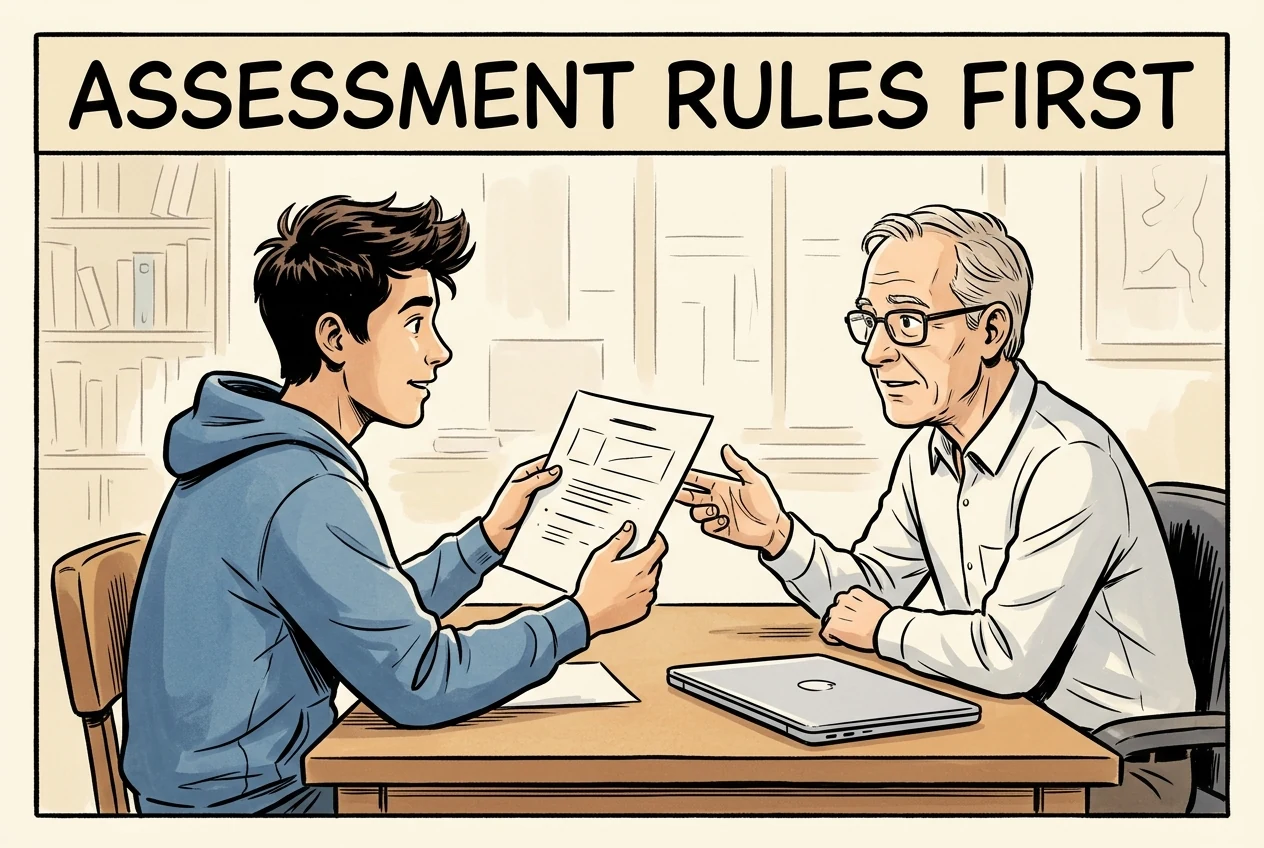
- Find the host faculty’s applicable framework.
- Follow task conditions and disclose assistance.
- Keep evidence that the achievement is your own.

Maastricht, Netherlands
Student guide · Task scope and procedure
The University framework and FSE faculty default have separate scopes. FSE permits restrictions and requires credible personal achievement. Research and employee data rules do not establish a student upload entitlement.
Le guide ci-dessous est en anglais ; les preuves officielles restent dans leur langue d’origine.
Aucun résumé complet des règles pour les étudiants n’est disponible ; consultez les énoncés et sources recueillis.
The University framework and FSE faculty default have separate scopes. FSE permits restrictions and requires credible personal achievement. Research and employee data rules do not establish a student upload entitlement.

Complément collecté: 2026-10-09 · Applicabilité actuelle non confirmée indépendamment
Résumé disponible actuellement en anglais
Interprétation du site
The December 2024 University framework requires programmes to assess individual achievement and follow the relevant examination-board rules at all times. It is not itself universal permission for every assignment; check the faculty and assessment instructions.
Portée: Students in the cited programme/course/stage only · Only the captured source, version, audience and conditions; no exhaustive currency certification.
Portée: Students in the cited programme/course/stage only · university
II-A. Intended learning objectives reliability, validity, and transparency with the use
The effect of GenAI on the intended learning of GenAI in mind.
objectives (ILOs) is to be evaluated on a
programme-by-programme basis. Where possible, 11. Study programmes need to consider how
evaluations are carried out jointly, focusing on: examination boards will be able to determine
that students have personally attained the ILOs,
6. Complementing the current ILOs on traditional given permitted use of GenAI.
academic skills with relevant ILOs on the
development of skills related to GenAI. 12. Definitions of fraud and plagiarism are revised
in the context of GenAI, and rules developed with
7. Ensuring the relevance of the current ILOs to regard to permitted uses.
the changing professional field (e.g. altered or
obsolescent work processes). 13. The rules and guidelines of the relevant
examination boards are followed at all times.Voir la source officielle ↗Collecté: 2026-10-09 · 215–228
SHA-256: de6a8bf74e2cbbe284f699ee4dd7b8c34529d5a576387f18ca16049142964847
Interprétation du site
FSE’s October 2025 framework allows GenAI by default but permits restrictions to protect assessment validity, integrity or legal/ethical requirements. Students may use AI only as permitted by the assessment instructions and disclose as required. This is FSE education, including visitors taking FSE courses, not a University-wide default.
Portée: Faculty of Science and Engineering (FSE) · Only the captured source, version, audience and conditions; no exhaustive currency certification.
Portée: Staff and students in education hosted under FSE responsibility · faculty
Relevant EER and University policy prevail; activities hosted elsewhere follow the host faculty unless deans agree otherwise.
Default. Generative AI may be used by default; restrictions are applied where needed to protect assessment
validity, academic integrity, or legal/ethical requirements.
Assessment instructions. For each assessment, the assessment instructions (assignment
sheet/LMS/rubric/syllabus) state permitted uses, any conditions (incl. disclosure), and any restrictions.
Responsibilities. Students and staff uphold academic integrity and comply with the assessment instructions.
Support. The faculty ensures training and student support for responsible use of generative AI.
3. Requirements
Teaching & Learning. Students may use generative AI by default, provided academic integrity is maintained and
their own achievement remains assessable. Teaching/learning are designed assuming generative AI is available;
where its use would undermine learning or assessment validity/integrity, restrictions or conditions are set in the
assessment instructions.
Assessment & QA. Generative AI is allowed by default; restrictions are introduced when needed to protect
assessment validity, academic integrity, or legal/ethical requirements. Where generative AI use is not allowed for a
specific task, the module’s assessment design, taken together, includes reasonable safeguards that make
unauthorised generative AI use unlikely and ineffective for achieving a pass in the module without demonstrable
personal achievement. The module assessment plans and the programme assessment plan (toetsprogramma)
must demonstrate measurable attainment of module/programme ILOs and be robust to unauthorised generative-
AI use. Within the PDCA cycle, programmes review changed summative assessments for generative-AI-related risks
and record mitigations. Before awarding credits or the degree, the BoE must be satisfied that the assessed work
credibly evidences the student’s own achievement; the BoE is not required to investigate the precise means by
which the work was produced and may, on reasonable grounds to doubt authorship, require a verification
assessment (e.g., oral defence or supervised reproduction). Staff retain professional autonomy within this policy;
structural or substantial deviations are justified with programme leadership.
Students. Students must submit work that credibly evidences their own achievement; generative AI may be used
only as permitted in the assessment instructions and must be disclosed as required. Misrepresentation may
constitute academic misconduct handled under the applicable programme EER and faculty/university regulations.Voir la source officielle ↗Collecté: 2026-10-09 · 15–40
SHA-256: e652b4510ff1e1b6b7c59e69f29af14d90f31a0d14692dc7ec041b22b489d3e4
This framework supplements the programme Education and Examination Regulations (EERs) and applicable
university policy. In the event of any inconsistency, the relevant EER and university policy prevail.
2. Scope & applicability
The policy framework applies to all activities related to teaching, learning, and assessment under the responsibility
of FSE. It is intended for all teaching staff, students, support staff, and guest lecturers involved in FSE education,
regardless of their primary faculty affiliation or employment contract. All FSE students and staff are expected to be
familiar with this policy framework and to act in accordance with its recommendations. Where educational activities
involve collaboration with other faculties or external partners, the applicable policy framework depends on where
the activity takes place. Students and staff coming into FSE to take or teach courses are bound by the FSE policy
framework, while FSE students and staff participating in activities hosted by another faculty are bound by that
faculty’s framework, unless otherwise agreed by the deans of the respective faculties.Voir la source officielle ↗Collecté: 2026-10-09 · 64–76
SHA-256: e652b4510ff1e1b6b7c59e69f29af14d90f31a0d14692dc7ec041b22b489d3e4
Interprétation du site
Within FSE, external assistance must be acknowledged in line with assignment instructions. Where there is reasonable doubt about authorship, students may be required to provide clarification or evidence. Misrepresentation may be academic misconduct; a clarification request is not itself a proven offence.
Portée: FSE · Only the captured source, version, audience and conditions; no exhaustive currency certification.
Portée: Students in FSE-hosted educational activities · faculty
5. Policy framework for students
- Students are expected to submit their own work. Where genAI is used, students must follow the assessment
instructions, disclose such use when required, and uphold academic integrity.
- Submitting work that does not represent a student’s own achievement prevents teaching staff and examiners
from reliably assessing learning and may be treated as academic misconduct, with consequences under faculty
and university regulations.
- Where any external assistance is used (including AI tools, services, or people), it must be acknowledged in line
with the assignment instructions.
- If there is reasonable doubt about the authorship or originality of submitted work, students may be required to
provide clarification or evidence that the work is genuinely their own.
- Any attempt to circumvent this framework or to misrepresent achievement may be treated as academicVoir la source officielle ↗Collecté: 2026-10-09 · 135–145
SHA-256: e652b4510ff1e1b6b7c59e69f29af14d90f31a0d14692dc7ec041b22b489d3e4
Interprétation du site
Researchers retain final accountability, observe research-integrity and data rules, and use extra caution with non-anonymized personal or privacy-sensitive information, including ethics approval when necessary. The operations section separately limits employee processing of personal/organisation-sensitive data and treats free unsecured tools as unauthorised third parties. These scopes do not create student upload permission.
Portée: Researchers and employees in the respective research and operations sections · Only the captured source, version, audience and conditions; no exhaustive currency certification.
Portée: Researchers and employees in the respective research and operations sections · university
our core values as an institution. referenced appropriately by researchers.12
Furthermore, it is important that researchers
1. Researchers hold final accountability for the disclose the use of GenAI during ethical review by
ethical use of GenAI tools in their research and act the UM ethical committees (if applicable).
in accordance with the Netherlands Code of
Conduct for Research Integrity,8 rules on the IV. Operations
processing of personal data9 and all UM codes of
conduct and policy,10 including the code of Beyond education and research, UM strives to
conduct for data management.11 Extra caution is facilitate the responsible use of GenAI in the
required when processing non-anonymized day-to-day work of all employees.
personal data or privacy-sensitive information,
with strict adherence to applicable regulations 1. GenAI tools are never used to process personal
(see Appendix A) and, if necessary, approval from or organisation-sensitive data in the absence of
the ethics committee. To avoid potential breaches transparency about how these data are used and
of confidentiality, researchers should also be without safeguarding that all applicable
aware that existing confidentiality agreements conditions for the use of GenAI have been met.
may apply to unpublished research when using The existing rules on the handling of personal and
GenAI. organisation-sensitive data apply, such as the
provisions on confidentiality from the
2. Researchers need to have a solid understanding employment contract. Sensitive data may not be
of the capabilities and limitations of GenAI shared with third parties. As free, unsecured AI
models/applications. This does not require tools are regarded as unauthorised third parties,
advanced technical expertise, but should suffice sharing information with such tools essentially
to enable them to use GenAI in their research in means making that information public, which
an ethical and responsible manner. To this end, amounts to a data breach.Voir la source officielle ↗Collecté: 2026-10-09 · 260–284
SHA-256: de6a8bf74e2cbbe284f699ee4dd7b8c34529d5a576387f18ca16049142964847
Compléments publiés fondés sur des sources. Les résumés anglais et citations originales sont séparés du dossier vérifié. Les procédures et résultats possibles ne sont pas des sanctions automatiques liées à l’IA. L’applicabilité actuelle n’a pas été confirmée indépendamment ; vérifiez la portée et la version de la source.
Comparaison au texte conservé ; traduction non officielle
Les empreintes permettent de comparer les textes conservés ; elles ne certifient ni leur validité actuelle ni leur immuabilité. Ces thèmes ne sont pas une séquence obligatoire.
L’accès à un outil ne vaut pas autorisation pour une évaluation. Vérifiez les consignes, les personnes éligibles et les restrictions de données.
Aucun outil étayé par une source n’est encore enregistré pour cette université. Cela ne signifie ni indisponibilité ni interdiction.
Reviewed record
9 énoncés examinés
Academic Integrity
Valeur normalisée: presenting_genai_as_own_dishonesty
Preuve originale
Preuve 1Using GenAI to generate content and present it as one’s own constitutes academic dishonesty, akin to plagiarism or fraud.
Enseignement
Valeur normalisée: permitted_uses_defined_by_level
Preuve originale
Preuve 1Permitted uses of GenAI are clearly defined at every relevant level: activity, course/module, study programme and faculty.
Enseignement
Valeur normalisée: assessment_ai_conditions_investigation
Preuve originale
Preuve 1These AI systems may only be used under certain mandatory conditions. These conditions must be thoroughly investigated at UM before AI systems can be used to assess students or assist in selection and admission procedures.
Confidentialité
Valeur normalisée: no_sensitive_data_without_safeguards
Preuve originale
Preuve 1GenAI tools are never used to process personal or organisation-sensitive data in the absence of transparency about how these data are used and without safeguarding that all applicable conditions for the use of GenAI have been met.
Recherche
Valeur normalisée: researcher_final_accountability
Preuve originale
Preuve 1Researchers hold final accountability for the ethical use of GenAI tools in their research and act in accordance with the Netherlands Code of Conduct for Research Integrity, rules on the processing of personal data and all UM codes of conduct and policy.
Recherche
Valeur normalisée: research_transparency_reference
Preuve originale
Preuve 1Researchers are transparent about substantial use of GenAI in their research. This includes clear communication about the use of GenAI with supervisors, collaboration partners and other relevant stakeholders. The use of GenAI should be referenced appropriately by researchers.
Ai Tool Treatment
Valeur normalisée: facilitate_encourage_where_relevant
Preuve originale
Preuve 1Rather than prohibiting the technology, we facilitate and encourage its use where relevant in education, research and operations.
Source Status
Valeur normalisée: officially_adopted_policy_framework
Preuve originale
Preuve 1Maastricht University has officially adopted a policy framework on Generative Artificial Intelligence (GenAI). This document clarifies UM’s position on GenAI and provides guidelines for its responsible use in education, research, and operations.
Autre
Valeur normalisée: comply_with_laws
Preuve originale
Preuve 1GenAI is used at all times in compliance with applicable laws and regulations. Where specific laws and regulations are lacking, we act in the spirit of those that do exist.
Source record
5 sources
maastrichtuniversity.nl
maastrichtuniversity.nl
maastrichtuniversity.nl
maastrichtuniversity.nl
maastrichtuniversity.nl
Citation: University AI Policy Tracker. "Maastricht University AI Policy Tracker record." Last checked May 15, 2026. https://eduaipolicy.org/universities/maastricht-university
Original university source language remains canonical. This tracker is not an official university statement.
Journal des modifications ouvertSaved from University AI Policy Tracker. This record summarizes the cited sources; it is not an official university statement or assessment permission. Source and review dates are listed above. Hashes identify retained content, not authorization.