Qué hacer
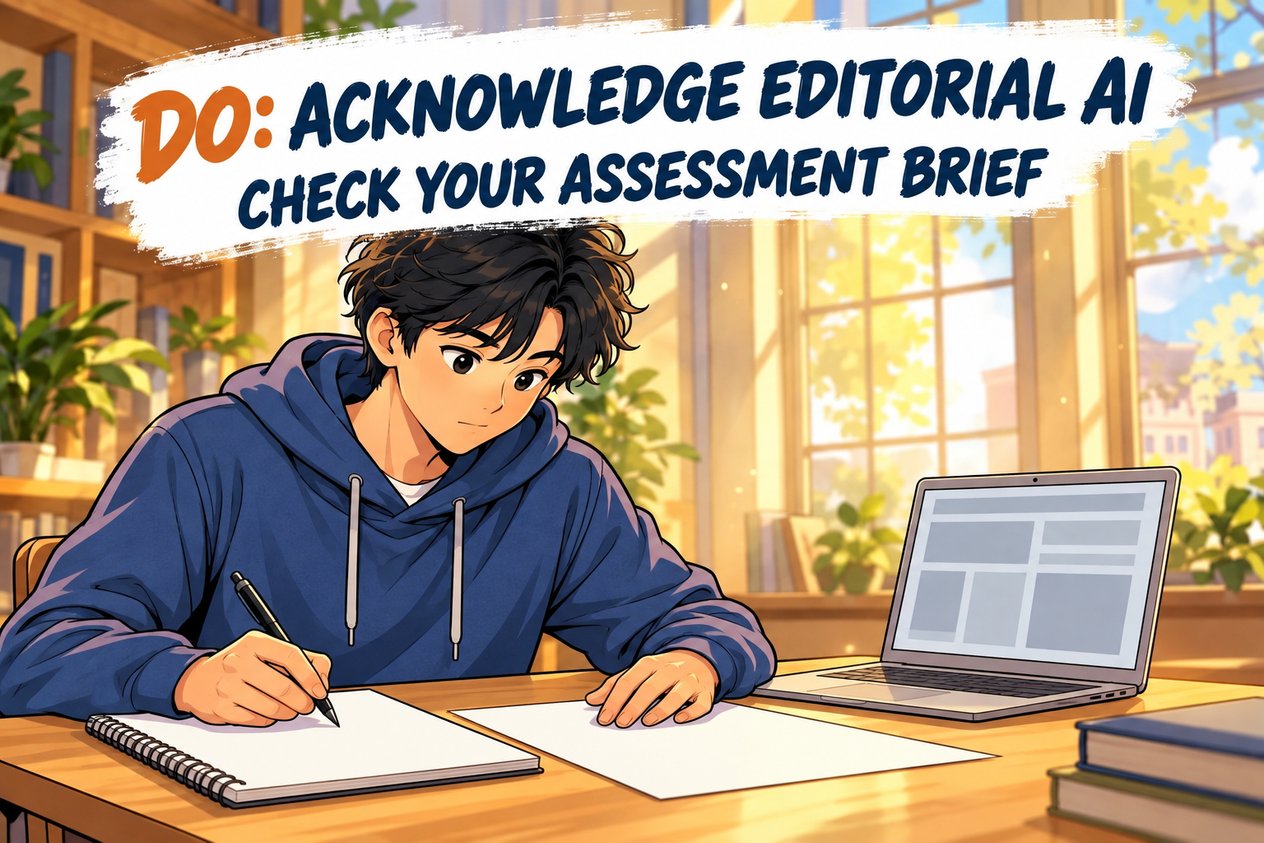
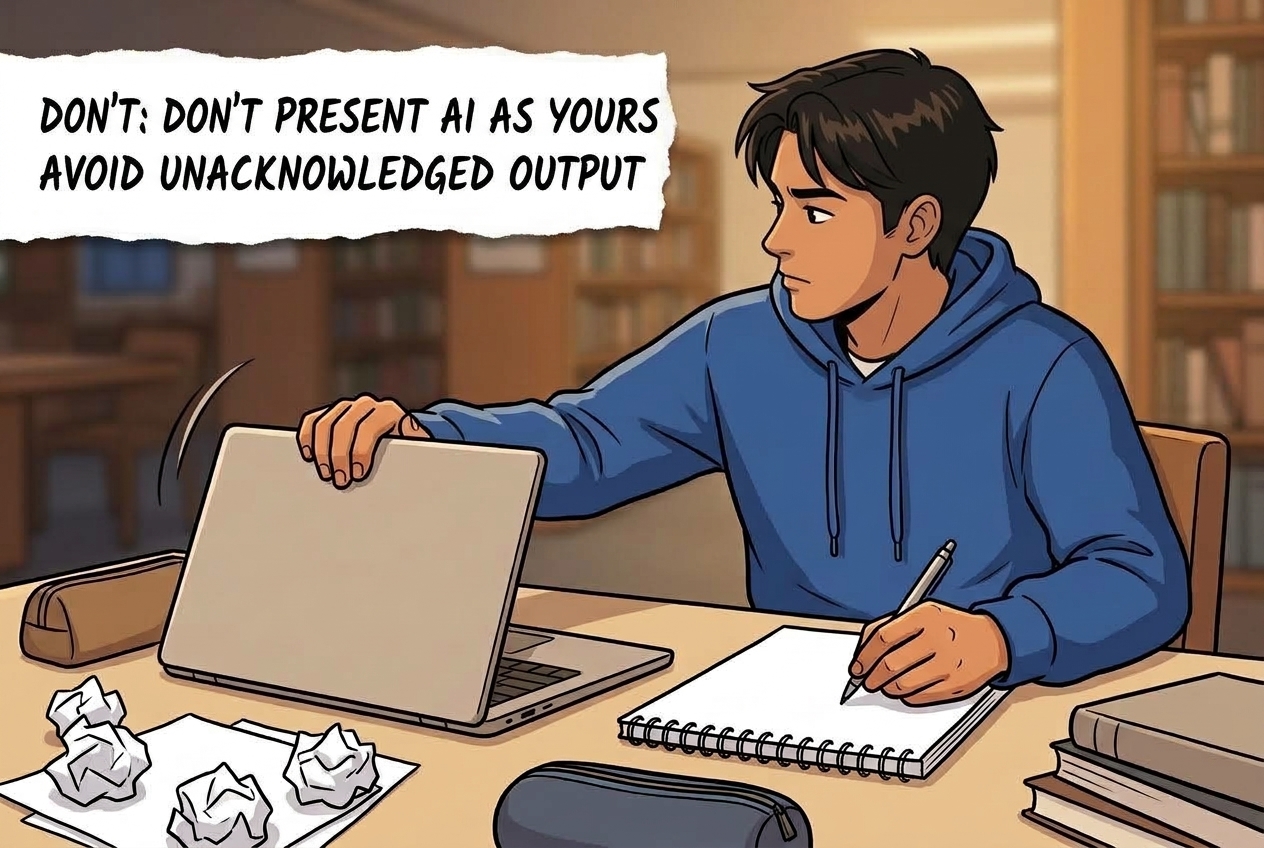
- Check the actual assessment brief and its stated AI conditions.
- Acknowledge AI contributions while preserving your own voice.
- Ask Union Advice about the allegation and permitted hearing support.
Kingston upon Thames, United Kingdom
Student guide · Task rules and procedure
The captured 2026/27 AR6 requires own-voice work and acknowledged AI contributions, with a stated assessment-brief exception. Course teams carry the evidence burden. Accompaniment and exceptional representation differ. AR8 review is limited by procedure grounds; its full filing clock remains unverified. Research AR7 is separate.
La guía siguiente está en inglés; las pruebas oficiales conservan su idioma original.
Aún no hay un resumen completo de las normas para estudiantes; consulta las afirmaciones y fuentes recopiladas.
The captured 2026/27 AR6 requires own-voice work and acknowledged AI contributions, with a stated assessment-brief exception. Course teams carry the evidence burden. Accompaniment and exceptional representation differ. AR8 review is limited by procedure grounds; its full filing clock remains unverified. Research AR7 is separate.

Complemento recopilado: 2026-10-08 · Aplicabilidad actual no confirmada de forma independiente
Resumen disponible actualmente en inglés
Interpretación del sitio
The 2026/27 taught-course AR6 requires work in the student’s own voice and proper acknowledgement of contributions by AI tools. This taught-course regulation is distinct from the research-degree AR7.
Ámbito: taught-course students · Scope is limited to the cited official source and stated conditions; this is a local candidate, not a complete university rule set.
Ámbito: taught-course students · university
9. Academic integrity means demonstrating honest, moral behaviours when
producing academic work. This involves acknowledging the work of others,
giving appropriate credit to others where their ideas are presented as part
of a students’ work and the importance of producing work in the student’s
own voice. Contributions by artificial intelligence (AI) tools must also be
properly acknowledged. As part of a learning community students share
ideas and develop new ones- they need to be able to interpret and present
other people’s ideas and combine these with their own when producing their
work. To achieve this, students need to develop skills of reflection and self-
awareness about topics such as fairness, responsibility and respect in
academic practice.Ver fuente oficial ↗Recopilado: 2026-10-08 · 156–166
SHA-256: acfb85c29fe926871e6ed46aad3ad0463ca15ec8e6012199a93e9723721ab340
Interpretación del sitio
AR6 defines unacceptable GenAI use as presenting generated content as one’s own without proper acknowledgement, except where the assessment’s nature permits this and the brief explicitly states it. Preserve both the acknowledgement condition and the stated exception.
Ámbito: taught-course students · Scope is limited to the cited official source and stated conditions; this is a local candidate, not a complete university rule set.
Ámbito: taught-course students · university
Unacceptable use of Generative Artificial Intelligence
16. The University defines the unacceptable use of Generative Artificial
Intelligence as the act of presenting content generated by artificial
intelligence tools (such as text, media, tables etc – list not exhaustive), as
one’s own without proper acknowledgement, except where the nature of the
assessment makes this permissible and is explicitly stated in the
assessment brief.Ver fuente oficial ↗Recopilado: 2026-10-08 · 264–271
SHA-256: acfb85c29fe926871e6ed46aad3ad0463ca15ec8e6012199a93e9723721ab340
Interpretación del sitio
The taught-course finding uses balance of probability: course teams must provide evidence that the defined misconduct occurred. Students are not required to prove that it did not. Both parties may present their viewpoint.
Ámbito: taught-course students · Scope is limited to the cited official source and stated conditions; this is a local candidate, not a complete university rule set.
Ámbito: taught-course students · university
3. The procedures allow both parties to present their viewpoints. Further
information relating to accompaniment and representation can be found in
the sections below.
4. A finding that academic misconduct has occurred is a judgement based on
available evidence, the standard of proof being the balance of probability.
What this means is that, on the basis of the evidence, it is more likely than
not that academic misconduct has occurred. Course teams are therefore
required to provide evidence that academic misconduct against the
definitions provided in this procedure has taken place. The student is not
required to prove that it has not.Ver fuente oficial ↗Recopilado: 2026-10-08 · 112–122
SHA-256: acfb85c29fe926871e6ed46aad3ad0463ca15ec8e6012199a93e9723721ab340
Interpretación del sitio
The formal notice supplies relevant allegation evidence; the examples include a marked submission/Turnitin sources or invigilator material. Contact Kingston Students’ Union Advice Centre for advice and possible observation; the cited officers cannot act as advocates. A Turnitin-source report here is not proof of an AI detector licence.
Ámbito: taught-course students · Scope is limited to the cited official source and stated conditions; this is a local candidate, not a complete university rule set.
Ámbito: taught-course students · university
36. If the individual considering the case judges that a formal hearing is
justified, the student will be provided with:
(a) a copy of these procedures;
(b) written details of the allegation and a copy of all evidence provided for
the hearing by the academic who had made the allegation. This will
include specific reference to the assessment in question and the nature
of the suspected misconduct. For example:
(i) in a case of suspected plagiarism, the student should be provided
with a copy of their work with the sections where plagiarism is
suspected indicated which may include a copy of the Turnitin
report detailing the identified sources;
(ii) in a case of suspected cheating in an examination venue the
student should be provided with a copy of the (suitably redacted)
Chief Invigilators’ report and copies of any materials removed
from the student in the exam venue (if applicable);
(c) advice to contact the Kingston Students’ Union Advice Centre (see
http://www.kingstonstudents.net/advice or email
support@kingston.ac.uk). Although the Kingston Students’ Union
officers cannot act as advocates, they may be able to advise on the
case and may agree to act as an observer at the hearing;Ver fuente oficial ↗Recopilado: 2026-10-08 · 499–521
SHA-256: acfb85c29fe926871e6ed46aad3ad0463ca15ec8e6012199a93e9723721ab340
Interpretación del sitio
AR6 distinguishes penalties A–D, from zero for an assessment element with possible retake to zero for a module and termination by the PAB. Retake/repeat permissions and pass-mark caps differ by penalty and standard regulations. These are conditional outcomes, not automatic AI sanctions.
Ámbito: taught-course students · Scope is limited to the cited official source and stated conditions; this is a local candidate, not a complete university rule set.
Ámbito: taught-course students · university
Summary of penalties applicable for Academic Misconduct
Penalty Summary
Penalty A Element of assessment awarded a mark of zero (Z). reassessment by
retake is permitted if required.
Penalty B Module and element of assessment awarded a mark of zero (Z).
Reassessment by retake is permitted, if this is allowed by the
standard assessment regulations.
If the reassessment is being undertaken in retake mode, the penalty
only requires reassessment in the piece of work in which the academic
misconduct took place. However, where other elements are failed,
these too should be set as retake as per assessment regulations.
Where any subsequent reassessment is judged to be of the required
pass standard, the overall module result will be capped at the
minimum pass mark.
Additional learning support to be provided.
Penalty C Module and element of assessment awarded a mark of zero (Z).
Reassessment by retake will not be permitted.
An opportunity to repeat/replace the module is permitted, if this is
allowed by the standard assessment regulations.
Where any subsequent reassessment is judged to be of the required
pass standard, the overall module result will be capped at the
minimum pass mark.
Penalty D Module and element of assessment awarded a mark of zero (Z).
A PAB will terminate the registration and award based on credit
achieved at that point.Ver fuente oficial ↗Recopilado: 2026-10-08 · 935–970
SHA-256: acfb85c29fe926871e6ed46aad3ad0463ca15ec8e6012199a93e9723721ab340
Interpretación del sitio
A taught-course student may seek AR8 review after the Misconduct Panel or final Programme Assessment Board decision where the procedure was not followed; otherwise the Board’s penalty cannot be appealed. AR6 does not provide a filing deadline in this passage, so no numeric AR8 clock is inferred.
Ámbito: taught-course students · Scope is limited to the cited official source and stated conditions; this is a local candidate, not a complete university rule set.
Ámbito: taught-course students · university
79. A student can use the procedures set out in Academic Regulations 8:
Academic Appeals (Taught Courses) to request a review of an outcome in
relation to Academic Misconduct either following the Academic Misconduct
Panel or following the final decision of the Programme Assessment Board if
there is evidence that the procedure was not followed.
80. A student cannot otherwise appeal against the penalty imposed by the
Programme Assessment Board.Ver fuente oficial ↗Recopilado: 2026-10-08 · 860–867
SHA-256: acfb85c29fe926871e6ed46aad3ad0463ca15ec8e6012199a93e9723721ab340
Interpretación del sitio
One eligible companion may attend a hearing but cannot make representations or ask/answer for the student. Third-party representation requires a compelling reason such as illness/disability, the Academic Registrar’s approval and signed consent. Do not treat accompaniment as unrestricted advocacy.
Ámbito: taught-course students · Scope is limited to the cited official source and stated conditions; this is a local candidate, not a complete university rule set.
Ámbito: taught-course students · university
57. Students invited to attend a hearing may be accompanied by one friend,
family member, officer or staff member from the Kingston Students’ Union
Advice Centre, or a Trade Union or professional association staff member, if
applicable. The individual accompanying is not permitted to make
representations, or ask or answer questions on behalf of the student.
Representation
58. Representation by any third party will only be permitted where there is a
compelling reason, for example, ill health and/or disability and if considered
necessary by the Academic Registrar (whose decision is final). In such
circumstances, the student must provide signed written consent for the
representation.Ver fuente oficial ↗Recopilado: 2026-10-08 · 685–697
SHA-256: acfb85c29fe926871e6ed46aad3ad0463ca15ec8e6012199a93e9723721ab340
Complementos publicados basados en fuentes. Los resúmenes en inglés y las citas originales se separan del registro revisado. Los procesos y resultados posibles no son sanciones automáticas por usar IA. La aplicabilidad actual no se ha confirmado de forma independiente; compruebe el ámbito y la versión de la fuente.
Comparado con el original guardado; traducción no oficial
Los hashes permiten comparar textos guardados; no certifican vigencia ni inmutabilidad. Los temas no forman una secuencia obligatoria.
El acceso no autoriza su uso en una evaluación. Comprueba las reglas de la tarea, los usuarios elegibles y las restricciones de datos.
Aún no hay un registro de herramientas respaldado por fuentes para esta universidad. Esto no implica indisponibilidad ni prohibición.
Reviewed record
Afirmaciones revisadas: 5
Academic Integrity
Valor normalizado: unacceptable_genai_presenting_ai_content_without_acknowledgement_unless_assessment_brief_permits
Evidencia original
Evidencia 1The University defines the unacceptable use of Generative Artificial Intelligence as the act of presenting content generated by artificial intelligence tools (such as text, media, tables etc - list not exhaustive), as one's own without proper acknowledgement, except where the nature of the assessment makes this permissible and is explicitly stated in the assessment brief.
Academic Integrity
Valor normalizado: generative_ai_editorial_process_use_must_be_acknowledged
Evidencia original
Evidencia 1Where a Generative AI has been used as part of the editorial process, then this must be acknowledged by the student.
Academic Integrity
Valor normalizado: ai_contributions_must_be_acknowledged
Evidencia original
Evidencia 1Contributions by artificial intelligence (AI) tools must also be properly acknowledged.
Ai Tool Treatment
Valor normalizado: generative_ai_treated_as_possible_third_party_editorial_help
Evidencia original
Evidencia 1This guidance is for use when a student is considering whether to employ a third party such as a professional copy editing or proof-reading company or software tool (including generative artificial intelligence (GAI)) when producing work in draft or final version.
Source Status
Valor normalizado: 2025_26_genai_academic_integrity_definition_and_ag2_editorial_help_source_status
Evidencia original
Evidencia 1Introduction of a formal definition of use of generative artificial intelligence articulated within our current different types for academic misconduct. This guidance was previously published as an Annex within the Academic Integrity Procedures for Taught and Research degrees (AR6 and AR7) but has been reviewed as a new standalone document which references both AI and non-AI editorial help.
Source record
Fuentes: 3
assets.kingston.ac.uk
assets.kingston.ac.uk
assets.kingston.ac.uk
Citation: University AI Policy Tracker. "Kingston University, London AI Policy Tracker record." Last checked May 18, 2026. https://eduaipolicy.org/universities/kingston-university-london
Original university source language remains canonical. This tracker is not an official university statement.
Abrir registro de cambiosSaved from University AI Policy Tracker. This record summarizes the cited sources; it is not an official university statement or assessment permission. Source and review dates are listed above. Hashes identify retained content, not authorization.