建议做

Kingston, United States
本站使用指南
Fall 2025 memo 提供三种 syllabus 选项,实际课程采用的规则优先。URI 账号 Copilot Chat 不等于高级 Office 集成。作业、课程不及格及正式纪律申诉路线不同,本轮未建立统一数值期限。
本站解读;官方证据保留原文。
尚无完整的学生政策摘要;可先查看已收录条款及来源。
Fall 2025 memo 提供三种 syllabus 选项,实际课程采用的规则优先。URI 账号 Copilot Chat 不等于高级 Office 集成。作业、课程不及格及正式纪律申诉路线不同,本轮未建立统一数值期限。
补充资料采集: 2026-10-08 · 现行适用性未独立确认
本站解读
Fall 2025 memo 提供三种建议 syllabus 选项:不允许、可选或要求 AI。这些是课程选项,不是单一全校默认。可选/要求的用途须记录工具、提示词及使用/修改,批判核实并对作品负责;须查实际采用的 syllabus。
适用范围: students · Recommended Fall 2025 syllabus models; actual current course policy controls.
The Fall 2025 memo offers three recommended syllabus options: AI not permitted, optional or required. These are course choices, not a single University default. Optional/required use calls for tool, prompts and use/edit records, critical review and responsibility for the work; check the actual adopted syllabus.
适用范围: students · university
URI Recommended Syllabus Statements (3 options)
AI Use Not Permitted
In this class, it is essential that all submitted work reflects your own understanding and skills. The use
of AI tools such as ChatGPT, Claude, or similar technologies is not permitted. This ensures that your
submitted work genuinely represents your personal knowledge and capabilities. Any use of AI tools on
submitted work in this course will be considered a violation of the university’s Academic Requirements
in the University Manual (see 8.27.10 - 8.27.22).
AI Use Optional
For certain assignments, you can choose to utilize AI tools to assist you. When you do, it is crucial to
clearly document which tool you used, the prompts or questions you provided, and how you used the
AI-generated output. This is similar to collaborating with a peer, where it's important to communicate
each contribution to the project. However, you must also critically review and refine the AI’s output to
Page 9 of 12
ensure the final work accurately reflects your own understanding and meets the academic standards
expected by the university. Failure to properly document or cite use of AI will be considered a violation
of the university’s Academic Requirements in the University Manual (see 8.27.10 - 8.27.22).
AI Use Required
In parts of this course, you will be asked by your instructor to use AI tools as a resource to enhance
your learning experience. You can use these tools to explore ideas, draft projects, and get feedback.
It’s important to acknowledge your use of AI by mentioning the tool, your prompts, and any edits you
made based on its suggestions. Think of AI like a creative partner that can offer new perspectives,
while you remain the one responsible for ensuring the originality and quality of your work.查看官方来源 ↗采集日期: 2026-10-08 · 412–441
SHA-256: 11381173ca142393f4a8a8ecdfb3d37bb167673aaa6293222ca2aa65b055e123
本站解读
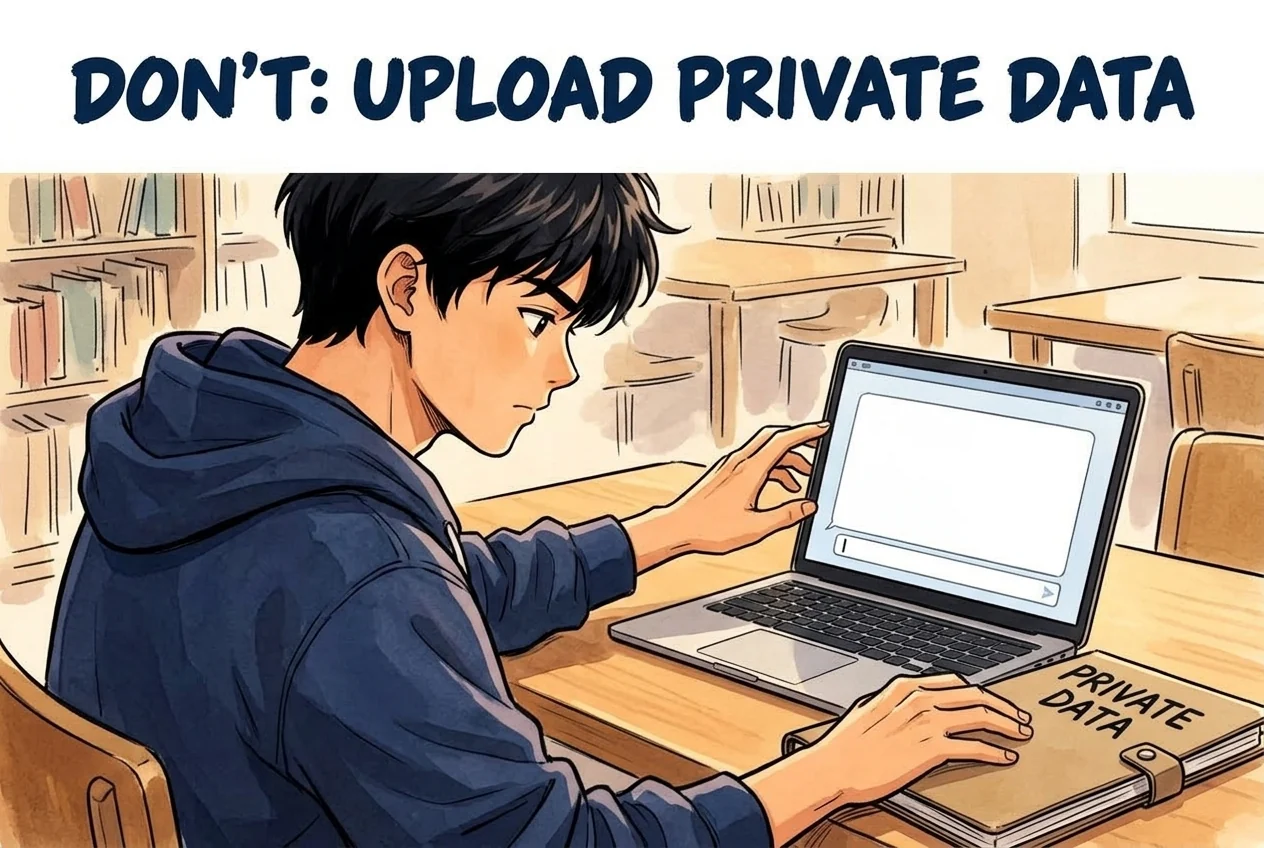
负责使用提示要求核实输出、保护隐私并按教师/院系要求披露。不输入学生数据、密码或保密大学内容;不确定时询问教师、导师或 IT 团队。
适用范围: students · Scope is limited to the cited official source and stated conditions; this is a local candidate, not a complete university rule set.
Responsible-use tips require checking outputs, protecting privacy and following instructor/department attribution. Do not enter student data, passwords or confidential University content; consult the instructor, supervisor or IT team if unsure.
适用范围: students · university
These quick tips apply to all users. They will help you use AI tools effectively while protecting privacy and supporting URI’s academic and ethical standards.
Be Specific: Clear prompts produce more helpful results. Include your role, task, and goal.
Check Accuracy: Always verify facts and sources. AI may give incorrect or biased information.
Work Iteratively: Use AI like a collaborator. Ask for drafts, options, or revisions, and then apply your judgment.
Protect Privacy: Do not enter student data, passwords, or confidential university content.
Cite If Needed: If AI contributes to your work, follow citation or attribution guidelines provided by your instructor or department.
Need help getting started with AI? Visit the Generative AI at URI page, review the Ethical Use of AI Guidelines, or talk to your instructor, supervisor, or IT support team.查看官方来源 ↗采集日期: 2026-10-08 · 25–31
SHA-256: 16d919797f1b51f5b881ab401e20aa729b667f83dc6cfe5f752d8b1c0bcf46c6
本站解读
学术诚信程序中,学生有 Conduct Advisor 权利。教师通知学生并向指定 Deans 及 Dean of Students 发正式通知;指定 Community Standards 人员书面通知学生。这属于一般诚信程序。
适用范围: students · Scope is limited to the cited official source and stated conditions; this is a local candidate, not a complete university rule set.
In academic-honesty proceedings students have a right to a Conduct Advisor. Instructors notify the student and send formal notices to the stated Deans and Dean of Students; the designated Community Standards officer notifies the student in writing. These are general honesty procedures.
适用范围: students · university
Academic Honesty Procedures
Under the direction of Faculty Senate and guidelines outlined in the University Manual, the Dean of Students Office and the University Student Conduct System are charged with monitoring, tracking, and enforcing Academic Honesty policies. Students have the right to a Conduct Advisor during Academic Honesty proceedings. The following process applies when there is an allegation of academic dishonesty.
Notification of Academic Honesty Violations
Faculty and instructors are required to notify the student of Academic Honesty allegations. Faculty and instructors must also send formal written notice to the instructor’s College Dean, the student’s College Dean, and the Dean of Students Office. The Associate Dean of Students, Community Standards or designee notifies the student in writing of the Academic Honesty violation.查看官方来源 ↗采集日期: 2026-10-08 · 24–27
SHA-256: 7d69d32dd044fa681252f7cacda24ddd6d4affbaea5e020400377455a7b94886
本站解读
对已认定负责的学生,可令作业不及格、获教师所属 Dean 批准后令课程不及格,及/或正式纪律行动。首次且无正式纪律行动时发警告,重复案件须启动纪律行动。这些是附条件选项,不是所有 AI 使用的自动处罚。
适用范围: students · Scope is limited to the cited official source and stated conditions; this is a local candidate, not a complete university rule set.
For a student found responsible, options include failing the assignment, failing the course with the instructor’s Dean’s authorization, and/or formal conduct action. A first offence without formal conduct action receives a warning; repeated infractions require conduct action. The options are conditional, not automatic penalties for any AI use.
适用范围: students · university
Sanctions and Appeals for Academic Honesty Violations
Academic Sanctions
The instructor has three following options when sanctioning a student who has been found responsible for violating the University’s or faculty’s Academic Honesty standards.
a) The Faculty may fail the student for the assignment
b) The Faculty may fail the student for the course, with authorization from the instructor’s College Dean; and/or
c) The Faculty may request formal Student Conduct action. This request may be made in lieu of or in addition to a grade adjustment.
review student handbook
Conduct Sanctions
If it is a first offense and no formal conduct action is requested, students are sent a formal and official warning letter. Repeat infractions require conduct action is initiated against the student. Conduct action on an allegation of academic dishonesty may be requested by the instructor’s College Dean or by the instructor with a statement from the instructor’s College Dean. Appeals of formal conduct action will be followed in accordance with the Student Handbook appeals process.查看官方来源 ↗采集日期: 2026-10-08 · 32–40
SHA-256: 7d69d32dd044fa681252f7cacda24ddd6d4affbaea5e020400377455a7b94886
本站解读
Manual 8.27 区分作业层级作弊/抄袭申诉至教师所属 Dean(最终)与课程不及格申诉至 Provost(最终)。正式纪律行动另走路线,疑案课程退课须 Dean 批准。本段未建立统一数值学术诚信申诉期限。
适用范围: students · Scope is limited to the cited official source and stated conditions; this is a local candidate, not a complete university rule set.
Manual 8.27 separates assignment-level cheating/plagiarism appeals to the instructor’s Dean (final) from course-failure appeals to the Provost (final). Formal conduct action is a separate route, and dropping an accused course requires the Dean’s permission. No universal numeric academic-honesty appeal deadline is established here.
适用范围: students · university
8.27.17 Instructors shall have the explicit duty to take action in known cases of cheating or plagiarism. The instructor shall have the right to fail a student on the assignment on which the instructor has determined that a student has cheated or plagiarized. The circumstances of this failure shall be reported to the student’s academic dean, the instructor’s dean, and the Dean of Students Office. The student may appeal the matter to the instructor’s dean, and the decision by the dean shall be expeditious and final. #09-10–12 #October 20, 2022 Informational Report #25-26-CBUM-03
8.27.18 If the violation warrants more severe censure, the instructor may recommend additional action to the instructor’s dean. Upon this recommendation the dean may authorize the instructor to fail the student in the course. The student or instructor may appeal the dean’s decision to the Provost and Vice President for Academic Affairs whose decision on the appeal shall be final.
8.27.19 Either the instructor, the instructor’s dean or the student’s dean may request conduct action (see 9.21.10 9.23.31) on an allegation against a student for cheating or plagiarism. Any of the conduct sanctions listed in sections 9.22.10 – 9.22.18 may be imposed after a finding of guilty. If the request comes from an instructor it shall be accompanied by a statement of position from the instructor’s dean (see 9.20.10 and 9.21.10). #January 27, 2022 Informational Report
8.27.20 Students accused of academic dishonesty within the drop period may be denied the opportunity to drop the course. This requires permission from the instructor’s dean. If the accusation is not upheld in an appeal, the student will be given the same options available before the end of the drop period without penalty. #04-05–32
8.27.21 Any record of scholastic integrity infractions where actions have been taken (i.e., assignment of an “F” on an assignment and notification of the student’s dean, dean’s authorization to assign an “F” for the course, referral to the University Board on Student Conduct) will be forwarded to the Dean of Students Office. A cumulative file will be maintained in that office. The Dean of Students shall notify the student’s dean of subsequent infractions and may initiate conduct action against the student. #04-05–32 #October 20, 2022 Informational Report
8.27.22. All course content (including but not limited to syllabi, outlines, presentation slides, lectures, lesson plans, class activities, exams, and assignments) created or facilitated by instructors shall be considered the instructors’ intellectual property. Course content shall not be recorded, distributed, shared in any public domain or third party website, or sold without prior written consent of the instructor. #15-16-30, #20-21-42查看官方来源 ↗采集日期: 2026-10-08 · 143–148
SHA-256: 14a98e94f5fe9b8d9a0cdcacd32e6b152e96dd4bd1239f39f0ab27e7ea470095
本站解读
URI Copilot Chat 服务页称师生可用 URI Microsoft 365 账号登录,并区分现有聊天与该页称尚未提供的 Word/PowerPoint/Excel 高级集成。访问权不覆盖课程许可,本轮未独立实测账号。
适用范围: students · Scope is limited to the cited official source and stated conditions; this is a local candidate, not a complete university rule set.
URI’s Copilot Chat service page says faculty, staff and students can sign in with the URI Microsoft 365 account. It distinguishes the available chat from advanced Word/PowerPoint/Excel integrations, which the page says are not available. Access does not override course permission, and no independent account test was performed.
适用范围: students · university
Microsoft 365 Copilot Chat is a generative artificial intelligence (AI) service from Microsoft that helps you ask questions, summarize information, draft and revise content, analyze uploaded files, and brainstorm ideas. Copilot Chat is available to URI faculty, staff, and students through URI’s Microsoft 365 environment.
While this provides access to a useful set of AI prompting capabilities, please note that more advanced features of Microsoft Copilot, such as integration across Microsoft tools like Word, PowerPoint, and Excel, are not available at this time.
Executive Lead
Robert Viens
Technical Lead
Mark Oliver
moliver@uri.edu
Support Team
ITS Community Services
Tier 2 Support
About the Service:
Features
AI assistance: Ask questions and get conversational responses to help you research, learn, and work through ideas.
Writing and summarization: Draft, rewrite, summarize, and refine content.
File analysis: Upload supported files to summarize information, ask questions about their contents, or identify key points.
Web information: Use information from the public web to support research and other tasks.
Microsoft 365 access: Use Copilot Chat through supported Microsoft 365 experiences available with your URI account.
Access
Microsoft 365 Copilot Chat is available to URI faculty, staff, and students.
Sign in to Microsoft 365 Copilot with your URI Microsoft 365 account to get started.查看官方来源 ↗采集日期: 2026-10-08 · 22–41
SHA-256: 1a9065d1c46c1f75e039c18ac0b3b761c30f0cee6e706ba771121449b92a1ea9
本站解读
URI 将负责 AI 指导标为初步指南,要求隐私/授权合规及 AI 工具可访问性。学生按教师政策,研究者就敏感/专有数据咨询院系。工具可访问性标准不是纪律听证调整规则。
适用范围: students · Scope is limited to the cited official source and stated conditions; this is a local candidate, not a complete university rule set.
URI labels its responsible-AI guidance preliminary. It calls for privacy/licensing compliance and accessible AI tools; students follow instructor policies and researchers consult their department about sensitive/proprietary data. AI-tool accessibility standards are not a disciplinary-hearing adjustment rule.
适用范围: students · university
Please note that this is preliminary guidance.
URI Data Classification Schema and Guidelines
Details the classification and management of data, including restricted and sensitive information, relevant to AI practices.
Guidelines for the Secure and Ethical Use of Artificial Intelligence
Provides comprehensive guidance on AI transparency, accountability, and compliance with accessibility, privacy, and intellectual property standards.
Guidelines and Standards
To ensure the secure and ethical use of AI, URI enforces the following standards:
Data Security and Privacy: Follow URI’s Data Classification Guidelines to avoid exposing restricted or sensitive information.
Accessibility: Ensure all AI tools comply with Web Content Accessibility Guidelines (WCAG) and the Americans with Disabilities Act (ADA).
Prohibited Data Use: Avoid inputting private or restricted data, such as Personally Identifiable Information (PII) or patient records, into public AI tools like ChatGPT.
Data Handling Awareness: Be cautious when using AI platforms, as data entered may be transmitted to third-party servers.
Disabling Data Logging: Where possible, disable history and logging features to prevent information from being stored or used for AI training without consent.
Intellectual Property Compliance: Respect copyrights and ensure proper protections when using AI systems. Do not input confidential data or licensed library content (e.g., online journals, e-books, and databases) into AI tools unless permitted by licensing agreements and institutional policies.
Education and Training
URI provides ongoing opportunities to learn about secure and ethical AI practices:
Workshops and Seminars: Attend sessions on responsible AI use tailored for faculty, staff, and students.
Training Materials: Access documents and guidelines like the AI Use Guidelines to deepen understanding.
Accessibility Resources: Learn how to make AI tools and outputs more inclusive through URI’s accessibility programs.
Understanding AI Functionality: Before using any AI platform, take the time to understand how it works, what data it collects, and how it handles that data. Awareness of these factors helps ensure responsible and secure use of AI tools.
Additional Guidelines
Educators: Incorporate URI’s guidelines into course design, clearly communicate acceptable AI use to students, and disclose when AI was used to create course materials.
Students: Follow instructors’ AI policies, properly attribute AI-generated content, and avoid using AI in ways that breach URI’s Student Code of Conduct.
Researchers: Consult with your department and comply with regulations when using AI tools in research, particularly for handling sensitive or proprietary data.查看官方来源 ↗采集日期: 2026-10-08 · 35–57
SHA-256: 2a71dfbf1ba620010cbce97a609966ed98f0ba34d014608eb19531ea1f2e246f
已发布的来源补充。英文摘要与原语言引文和已审核记录分开展示。这里列出可能的程序与结果,不是使用 AI 的自动处罚;现行适用性尚未独立确认,请核对来源的适用范围和版本。
按所存原文核对;不是官方译文
哈希仅用于核对所存内容,不证明现行有效性或不可篡改。这些主题不表示每个学生都会经历的流程。
能获取工具不等于获准在作业中使用。请同时核对任务规则、适用人员和数据限制。
存档工具记录;当前获取方式请核对官方来源。 以下获取说明与证据引用保留原文语言。
University of Rhode Island provides or institutionally supports Adobe Firefly.
Use the URI Adobe access instructions.
Free.
University of Rhode Island provides or institutionally supports Microsoft 365 Copilot Chat.
Use the URI Microsoft 365 account.
No individual price is stated.
原文引用
All faculty, staff, and students at URI have access to the base level of this tool through the Microsoft 365 suite原文引用
URI ITS points users to URI-supported AI tools such as LibreChat and Microsoft Copilot, and its Generative AI service page says role-based service search displays AI-related tools vetted for use at URI.原文引用
Start with URI-Supported Tools - LibreChat: Use a variety of LLMs with secure options - Microsoft Copilot: Integrated into Word, Outlook, Excel - URI Libraries GenAI Resources: Learn how to use AI in research and writing原文引用
URI ITS points users to URI-supported AI tools such as LibreChat and Microsoft Copilot, and its Generative AI service page says role-based service search displays AI-related tools vetted for use at URI.Reviewed record
8 条已审核条款
Academic Integrity
标准化值: ai_use_acknowledgement_citation_check_professor_formal_citation_for_direct_output
原始证据
证据 1If you use generative AI in your work, you should include a formal acknowledgement or citation, just as you would if you were citing a human author or artist. Before using AI on a course assignment or project, be sure to check with your professor!
Academic Integrity
标准化值: students_follow_instructor_ai_policy_attribute_ai_content_avoid_code_breach
原始证据
证据 1Students: Follow instructors’ AI policies, properly attribute AI-generated content, and avoid using AI in ways that breach URI’s Student Code of Conduct.
教学
标准化值: educators_communicate_course_ai_expectations_optional_syllabus_statements
原始证据
证据 1Educators: Incorporate URI’s guidelines into course design, clearly communicate acceptable AI use to students, and disclose when AI was used to create course materials.
原始证据
证据 2The recommended syllabus information includes new, optional AI syllabus statements vetted by members of URI’s AI Coordination Working Group.
隐私
标准化值: avoid_private_restricted_data_public_ai_tools_follow_data_classification
原始证据
证据 1Data Security and Privacy: Follow URI’s Data Classification Guidelines to avoid exposing restricted or sensitive information. Prohibited Data Use: Avoid inputting private or restricted data, such as Personally Identifiable Information (PII) or patient records, into public AI tools like ChatGPT.
Ai Tool Treatment
标准化值: {"tool":"adobe_firefly","rawToolName":"Adobe Firefly","description":"University of Rhode Island provides or institutionally supports Adobe Firefly.","howToObtain":"Use the URI Adobe access instructions.","costToUser":"Free.","availability":"allowed","endorsementType":"institutionally_licensed_or_procured"}
原始证据
证据 1URI faculty have free access to the Adobe Firefly AI image generator bot
本地化显示 only
URI faculty have free access to the Adobe Firefly AI image generator bot
Ai Tool Treatment
标准化值: {"tool":"microsoft_copilot","rawToolName":"Microsoft 365 Copilot Chat","description":"University of Rhode Island provides or institutionally supports Microsoft 365 Copilot Chat.","howToObtain":"Use the URI Microsoft 365 account.","costToUser":"No individual price is stated.","availability":"allowed","endorsementType":"institutionally_licensed_or_procured"}
原始证据
证据 1All faculty, staff, and students at URI have access to the base level of this tool through the Microsoft 365 suite
本地化显示 only
All faculty, staff, and students at URI have access to the base level of this tool through the Microsoft 365 suite
Ai Tool Treatment
标准化值: supported_tools_librechat_microsoft_copilot_vetted_role_based_service_search
原始证据
证据 1Want to Try It? Start with URI-Supported Tools - LibreChat: Use a variety of LLMs with secure options - Microsoft Copilot: Integrated into Word, Outlook, Excel - URI Libraries GenAI Resources: Learn how to use AI in research and writing
原始证据
证据 2You can easily explore approved Generative AI (GenAI) tools available to you based on your role at the University of Rhode Island. Within your role, use the search bar to type “AI.” This will display service pages for AI-related tools vetted for use at URI.
Source Status
标准化值: no_university_wide_coursework_policy_as_of_2025_07_with_optional_syllabus_statements
原始证据
证据 1As of July 2025, the University of Rhode Island does not have a university-wide policy governing the use of generative AI in coursework.
Source record
8 个来源
web.uri.edu
web.uri.edu
its.uri.edu
its.uri.edu
its.uri.edu
its.uri.edu
uri.libguides.com
its.uri.edu
Citation: University AI Policy Tracker. "University of Rhode Island AI Policy Tracker record." Last checked July 19, 2026. https://eduaipolicy.org/universities/university-of-rhode-island
Original university source language remains canonical. This tracker is not an official university statement.
打开变更日志Saved from University AI Policy Tracker. This record summarizes the cited sources; it is not an official university statement or assessment permission. Source and review dates are listed above. Hashes identify retained content, not authorization.