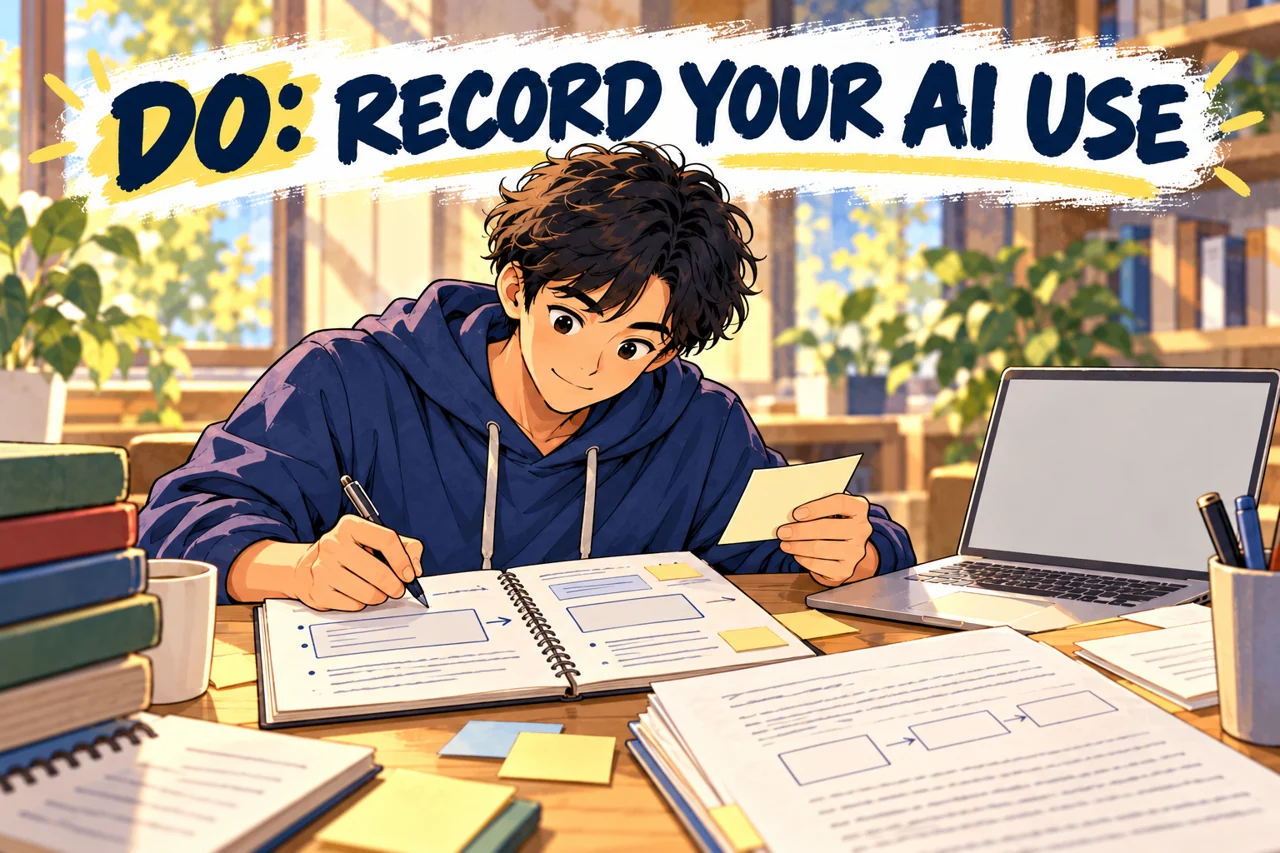
Do
- Discuss the specific use with your teacher or supervisor first.
- Use the disclosure form appropriate to this task and context.
- Identify your actual faculty/programme disciplinary rules if questioned.
Plzen, Czechia
Student guide · Task rules and procedure
UWB supports responsible AI under task and faculty rules. Record permitted help and keep non-public data out. The University-account platform is a public test announced for April 2026. Linked 2017 University disciplinary rules exclude faculty-run programmes, which use faculty rules; their dated clock is not universal.
A complete student policy summary is not available yet; see the collected claims and sources.
UWB supports responsible AI under task and faculty rules. Record permitted help and keep non-public data out. The University-account platform is a public test announced for April 2026. Linked 2017 University disciplinary rules exclude faculty-run programmes, which use faculty rules; their dated clock is not universal.

Supplement collected: 2026-10-08 · Current applicability not independently confirmed
Site interpretation
UWB’s FAQ supports AI subject to internal/course rules and prior discussion of the method with the teacher/supervisor. Some tasks prohibit it and that prohibition must be respected. Verify outputs against recommended materials and retain responsibility for your studies.
Scope: students · Scope is limited to the cited official source and stated conditions; this is a local candidate, not a complete university rule set.
Scope: students · university
What are the main principles of using AI?
The principles defined in the UWB Code of Ethics apply generally to the use of AI.
Transparency – always openly state which AI tools you have used to process/fulfil your study obligations.
Conscientiousness – Be conscientious, and work with the full range of available and recommended study materials and supports. Create your own study materials based on your experience from lectures and exercises. Openly discuss topics with your teachers.
Responsibility – the responsibility for your studies is always yours alone. If you use any AI tools, verify and check their outputs.
Minimizing dependence on AI – in order to be able to work with AI correctly and evaluate its outputs, you need to acquire sufficient knowledge and skills in the given area. Do not accept AI outputs uncritically.
Security – pay attention to the protection of personal data. Never use AI to process personal data or to work with it in any other way. Consistently anonymize it. If you work with data that is protected by law or contract, do not use it when using AI.
Collaboration – consult with the teacher about the use of AI, work together on the outputs, respect the rules given by the teacher for a specific task.
Respect – if the use of AI tools is not allowed for a given task, respect this prohibition. Be interested in internal regulations and standards, as well as rules for completing subjects.
FREQUENTLY ASKED QUESTIONS FROM STUDENTS
Artificial Intelligence usage quotes
Can I use AI while studying?
We generally support the use of AI tools, in accordance with the main principles. Be interested in the internal standards of the components, and the rules for completing the subjects. Such use may be prohibited for some activities/assignments/syllabi. Respect this prohibition.
If you want to use AI as one of the teaching resources, always verify the relevance of the outputs. AI can be used as a signpost for basic orientation in a given issue. Work with the knowledge of basic terminology from relevant sources, and compare the outputs from AI with teaching resources guaranteed or recommended by UWB.
You can find some tips for using AI here:
https://ai.e-bezpeci.cz/,
https://aireaktor.ujep.cz/category/clanky/,
https://aidetem.cz/tipy-na-aplikace-umele-inteligence-dle-ucelu-uziti/,
https://prg.ai/,
https://aidetem.cz/obecny-uvod-do-umele-inteligence/,
https://aidetem.cz/metodiky/.
Can I use AI to process ongoing assignments, seminar papers, term papers, qualification theses, or exams?
Yes, but always after discussion with the teacher/supervisor. The method of using AI should be discussed with the teacher/supervisor. In some cases, the use of AI may be prohibited. Please ensure that sources are cited correctly when using AI.View official source ↗Collected: 2026-10-08 · 15–37
SHA-256: 718255dcf084b7601369c308712324dc837f5723b1786b27e4bd38cc22764e3a
Site interpretation
When AI is permitted, possible attribution forms include a general declaration, citation, appendix/methodology description and prompts/outputs. The specific assignment and context determine what must be shown; ask the teacher if unsure. This is not one compulsory University-wide template.
Scope: students · Scope is limited to the cited official source and stated conditions; this is a local candidate, not a complete university rule set.
Scope: students · university
How can I properly describe the use of AI?
If the use of AI is permitted, follow the terms and conditions of the service provider. Depending on the type of AI application used, how it is used, and industry practices, referencing can be resolved as follows:
general declaration of use,
direct reference, according to the selected citation standard,
description of the use of AI in the appendix of the thesis, or in the part describing the methodology of the thesis,
overview of prompts and outputs of the AI tool.
This topic is addressed in more detail, for example, in the Recommendations for the use of Artificial Intelligence tools in fulfilling study obligations study, prepared by Masaryk University.
Below, you can see the text prepared by the staff of the University Library of West Bohemia, which lists the possibilities of citations using artificial intelligence.
Citations using Artificial Intelligence
Can I use AI outputs from a copyright perspective? Can I use AI outputs for work/theses?
AI is not considered an author under Czech law, but works with sources that can be protected by law. Therefore, consistently verify AI outputs and, if you are not sure, search for primary sources and use them. Indicate your work with AI.
It is possible to use it for processing a work/thesis presentation?
Here too, AI can help, especially in terms of formality. However, its outputs must always be checked. The presentation must meet the requirements of the teacher/examiner.
Which tools must be shown, and which are no longer required to be shown?
The answer to this question depends on the specific assignment and context of the work. Therefore, always respect the rules for completing the assigned assignment. If you are unsure, contact your teacher and discuss the use of a specific AI tool with them.View official source ↗Collected: 2026-10-08 · 38–52
SHA-256: 718255dcf084b7601369c308712324dc837f5723b1786b27e4bd38cc22764e3a
Site interpretation
The FAQ limits AI input to freely available data and excludes non-public personal data and internal company/authority documents. It specifically advises against uploading internal collaborator data for a thesis because control and legal protections may be lost.
Scope: students · Scope is limited to the cited official source and stated conditions; this is a local candidate, not a complete university rule set.
Scope: students · university
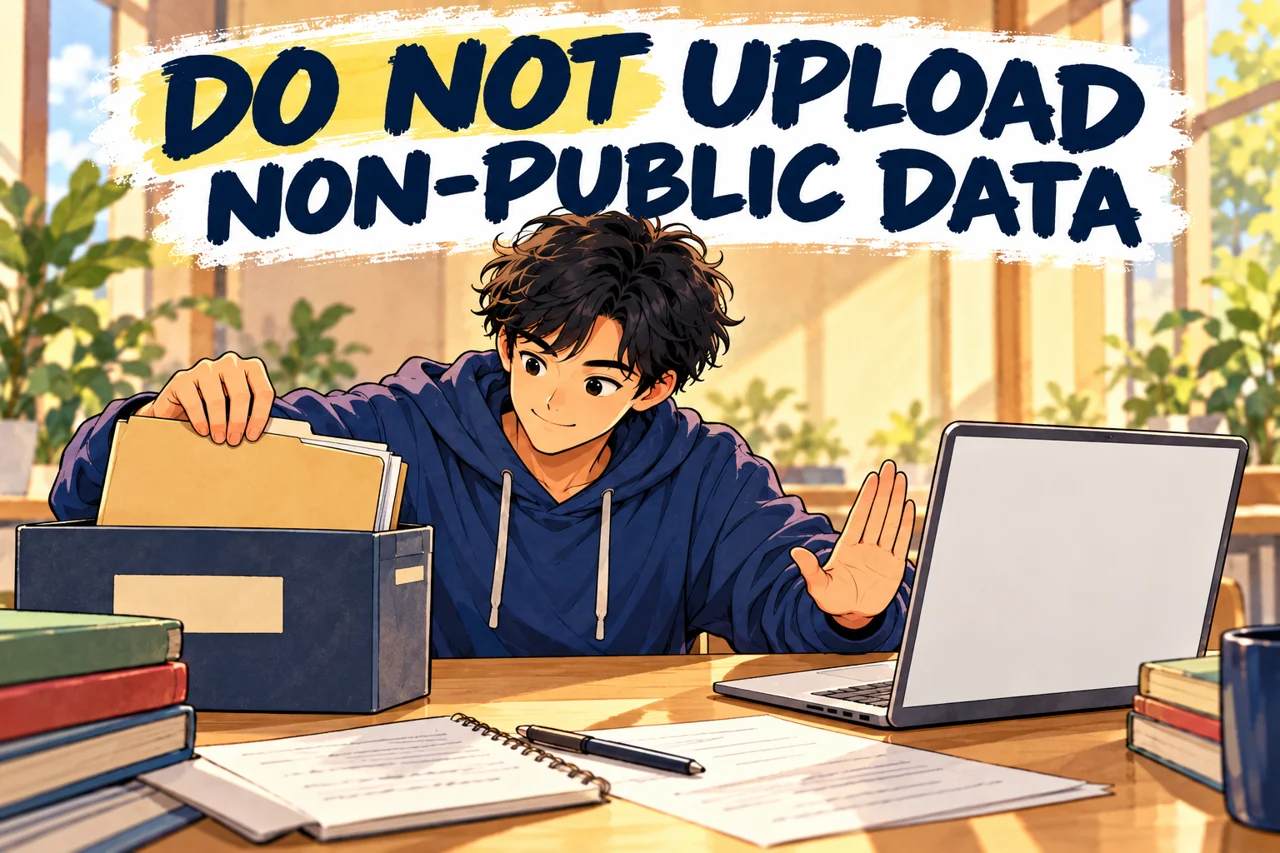
What data can I use to work with AI?
For working with AI, it is possible to use data that is freely available. Therefore, personal data, internal documents of companies, authorities, etc. that are not freely accessible and not intended for publication cannot be used.
How to verify that I am getting an answer to my question – how do I verify AI output?
Verify outputs with study materials and literature related to the topic of the question. Consult, discuss the issue with experts, and evaluate the relevance of the outputs.
What are the risks of using AI? What should I be careful about when using AI?
When using any AI tool, the most important thing is to realize that the student is always responsible for fulfilling their study obligations. At the same time, it is important to remember that each AI tool contains rules under which it is operated, and these must also be followed. Risks can be seen, in particular, in the following areas:
– copyright infringement (when processing data, it may not always be clear what the AI is drawing from, whether it is a compilation of works by different authors),
– violation of the right to personal data protection, invasion of privacy (never use personal data as a source of information for working with AI),
– limited ability to research and analyse, creativity and originality (AI cannot think for you and lacks the extended ability to analyse data, creative thinking, and critical evaluation),
– lack of control over the result of the assignment (for individual AI tools, the way in which the tool works and how it processes and evaluates the assigned topic may not be sufficiently described, therefore the result may be misleading and needs to be verified).
Can I use AI in the following way: upload data from the company (internal data, in principle not public) with which I am collaborating on a qualification thesis, and have AI work with it?
No, we definitely do not recommend such use. Internal and non-public data may be protected by trade secrets or other legal protections, and by entering it into an AI, you lose control over the processing.View official source ↗Collected: 2026-10-08 · 53–64
SHA-256: 718255dcf084b7601369c308712324dc837f5723b1786b27e4bd38cc22764e3a
Site interpretation
The institution’s linked Czech disciplinary regulation, registered 11 April 2017, governs programmes implemented by UWB itself; programmes implemented by individual faculties use faculty disciplinary rules. The Rector decides on the University Committee’s proposal. This dated document cannot supply a universal faculty procedure or AI-specific sanction.
Scope: students · 2017 regulation currently linked in official accreditation index; legal currency beyond that link not independently established. Faculty routes are distinct.
Scope: students · university
Článek 1
(1) Disciplinární řád Západočeské univerzity v Plzni (dále jen „řád“) upravuje postavení Disciplinární komise
Západočeské univerzity v Plzni (dále jen „ZČU“), projednávání disciplinárních přestupků studentů
akreditovaných studijních programů uskutečňovaných ZČU (dále jen „student“) a ukládání sankcí za jejich
spáchání. Pro studenty akreditovaných studijních programů uskutečňovaných jednotlivými fakultami platí
disciplinární řády těchto fakult.
(2) Disciplinárním přestupkem je zaviněné porušení povinností stanovených právními předpisy nebo
vnitřními předpisy ZČU nebo jejích součástí.
(3) Disciplinární pravomoc nad studentem náleží rektorovi.
(4) O uložení sankce za disciplinární přestupek studenta rozhoduje rektor na návrh Disciplinární komise
ZČU.
(5) Pokud jsou všichni studenti ZČU zapsáni na jejích fakultách, Disciplinární komise ZČU se nezřizuje.View official source ↗Collected: 2026-10-08 · 28–39
SHA-256: 45acdd086581f772ae40b60db2dee490279beb8a19f353ac3312a12b1aa5190b
Site interpretation
For that 2017 University-level route, proceedings start by informing the student of the Rector’s proposal. Written hearing invitation arrives at least seven days beforehand; the student can be heard, respond to evidence and submit evidence. Unexcused absence after proper notice permits proceeding without the student. Do not extend this to every faculty.
Institution · Required when using this procedure
At least this many days before the hearing. Check the source summary and original text for the starting point, scope and exceptions.
Scope: students · Dated 2017 University-level procedure only; current faculty-specific procedures not all captured.
Scope: students · university
Článek 3
(1) Disciplinární řízení zahajuje Disciplinární komise ZČU na návrh rektora. Návrh obsahuje popis skutku,
popřípadě navrhované důkazy, o které se opírá, jakož i zdůvodnění, proč je ve skutku spatřován disciplinární
přestupek. Disciplinární řízení je zahájeno seznámením studenta s návrhem.
(2) Disciplinární komise ZČU jedná za přítomnosti studenta. K jednání Disciplinární komise ZČU je student
včas pozván, písemné pozvání je doručeno studentovi nejpozději 7 dní před stanoveným termínem jednání
Disciplinární komise ZČU. V nepřítomnosti studenta lze jednání konat pouze v případě, že se k němu nedostaví
bez omluvy, ačkoli byl řádně pozván. Jednání se účastní nejméně polovina členů Disciplinární komise ZČU,
zpravidla včetně jejího předsedy. Jednání Disciplinární komise ZČU je ústní a neveřejné. Jednání o návrzích na
uložení sankce a zastavení disciplinárního řízení se účastní pouze členové Disciplinární komise ZČU.
(3) Disciplinární komise ZČU vychází ze zjištěného stavu věcí, o kterém nejsou důvodné pochybnosti.
Student, jehož disciplinární přestupek se projednává, má právo být vyslechnut a je mu dána možnost vyjádřit se
ke všem předloženým důkazům a předložit důkazy na podporu svých tvrzení.
(4) O návrhu sankce nebo návrhu na zastavení disciplinárního řízení rozhoduje Disciplinární komise ZČU
většinou hlasů všech svých členů. V případě rovnosti hlasů rozhoduje hlas předsedy. Rektor nemůže uložit
přísnější sankci, než navrhla Disciplinární komise ZČU.
(5) Vyjde-li najevo, že nejde o disciplinární přestupek, nebo pokud se nepodaří prokázat, že disciplinární
přestupek spáchal student, nebo jestliže osoba přestala být studentem, rektor řízení zastaví.View official source ↗Collected: 2026-10-08 · 78–95
SHA-256: 45acdd086581f772ae40b60db2dee490279beb8a19f353ac3312a12b1aa5190b
Site interpretation
The linked 2017 University-level regulation requires a reasoned written decision with appeal instruction, delivered to the student. It specifies appeal to the Rector within 30 days of delivery, with suspensive effect. This is a dated, scope-limited record; no current faculty-wide appeal clock is inferred.
Student · Required when using this procedure
Within the stated period. Check the source summary and original text for the starting point, scope and exceptions.
Scope: students · 2017 University-level regulation; faculty-specific and later legal changes not independently resolved. No calendar calculation.
Scope: students · university
Článek 4
(1) Rozhodnutí rektora ve věci disciplinárního přestupku musí být vyhotoveno písemně, musí obsahovat
odůvodnění a poučení o možnosti podat odvolání a musí být studentovi doručeno do vlastních rukou.
(2) Student může do 30 dnů ode dne, kdy mu bylo rozhodnutí podle odstavce 1 doručeno, podat proti
rozhodnutí odvolání. Odvolání se podává rektorovi. Rektor přezkoumává soulad napadeného rozhodnutí
a disciplinárního řízení, které vydání rozhodnutí předcházelo, s právními předpisy a vnitřními předpisy vysoké
školy a fakulty.
(3) Odvolání má vždy odkladný účinek.View official source ↗Collected: 2026-10-08 · 100–107
SHA-256: 45acdd086581f772ae40b60db2dee490279beb8a19f353ac3312a12b1aa5190b
Site interpretation
The library announces a University-account AI platform at chatbot.zcu.cz from 13 April 2026 for all students/employees in public testing mode. CIV/FAV plan continuing development and emphasise data protection. This is an attributed public test, not a verified stable production service, individual account test or assessment authorization.
Scope: students · Scope is limited to the cited official source and stated conditions; this is a local candidate, not a complete university rule set.
Scope: students · university
UWB’s New AI Platform for Students and Staff
As of Monday, April 13, 2026, the new AI platform will be available, providing unified access to modern artificial intelligence tools.
CIV is launching the platform in cooperation with FAV and is available to all students and employees in public testing mode via the chatbot.zcu.cz service (login with a university account). Basic information, instructions and recommendations for use are available on the CIV HelpDesk.
What the platform brings
The AI platform offers users simple, clear access to advanced AI tools for their studies, teaching, and everyday work.
The platform allows, for example:
work with various modern language models in one place
combine the outputs of multiple models and compare their responses
work with documents and data
use AI when writing texts, analysing information or programming
use specialised assistants for specific areas
The platform also includes the UWB assistant, which helps students with orientation in study matters, university systems, or administrative processes.
An important principle of the platform is the emphasis on data protection - the tools used work in a mode that meets the needs of the university environment.
Open development and cooperation
The platform is now available in public testing mode and will continue to develop. Its goal is to become a natural part of the UWB digital environment and, in the long term, support both the study process and the university's administrative and management agendas.
In cooperation with FAV/KIV and other partners, CIV will gradually expand its functions, prepare new specialised assistants, and explore other ways to use it across the university. An important role in this process is also played by the users themselves - students and employees, who can contribute with their experiences and suggestions to ensure that the platform best meets real needs.View official source ↗Collected: 2026-10-08 · 50–65
SHA-256: 91b2baca4aebf66c62f8f7710f1c7389523d754af777c1c4a86abd9311c83229
Published source-based additions. English summaries and original-language quotations are shown separately from the reviewed record. These are possible processes and outcomes, not automatic penalties for AI use. Present applicability has not been independently confirmed; check the source scope and version.
Source-text comparison; not an official translation
Hashes allow comparison of saved content; they do not certify current validity or immutability. These topics are not a mandatory sequence.
Tool access is not permission to use AI in an assessment. Check your assignment rules, eligible users and data restrictions.
Archived tool record; consult the official source for current access.
University of West Bohemia provides or institutionally supports Google Gemini.
Use the university Google Workspace licence.
No individual price is stated.
University of West Bohemia provides or institutionally supports Microsoft Copilot.
Use the university Microsoft Office 365 licence.
No individual price is stated.
Original quotation
Employees and students at the University of West Bohemia in Pilsen have standard access to artificial intelligence tools, through Microsoft Office 365 and Google Workspace licensesReviewed record
2 reviewed claims
Ai Tool Treatment
Normalized value: {"tool":"gemini","rawToolName":"Google Gemini","description":"University of West Bohemia provides or institutionally supports Google Gemini.","howToObtain":"Use the university Google Workspace licence.","costToUser":"No individual price is stated.","availability":"allowed","endorsementType":"institutionally_licensed_or_procured"}
Original evidence
Evidence 1Google Workspace includes the Gemini tool
Localized display only
Google Workspace includes the Gemini tool
Ai Tool Treatment
Normalized value: {"tool":"microsoft_copilot","rawToolName":"Microsoft Copilot","description":"University of West Bohemia provides or institutionally supports Microsoft Copilot.","howToObtain":"Use the university Microsoft Office 365 licence.","costToUser":"No individual price is stated.","availability":"allowed","endorsementType":"institutionally_licensed_or_procured"}
Original evidence
Evidence 1Employees and students at the University of West Bohemia in Pilsen have standard access to artificial intelligence tools, through Microsoft Office 365 and Google Workspace licenses
Localized display only
Employees and students at the University of West Bohemia in Pilsen have standard access to artificial intelligence tools, through Microsoft Office 365 and Google Workspace licenses
Original evidence
Evidence 2Copilot tool
Localized display only
Copilot tool
Source record
1 source
aiweb.zcu.cz
Citation: University AI Policy Tracker. "University of West Bohemia AI Policy Tracker record." Last checked July 19, 2026. https://eduaipolicy.org/universities/university-of-west-bohemia
Original university source language remains canonical. This tracker is not an official university statement.
Open change logSaved from University AI Policy Tracker. This record summarizes the cited sources; it is not an official university statement or assessment permission. Source and review dates are listed above. Hashes identify retained content, not authorization.