Do
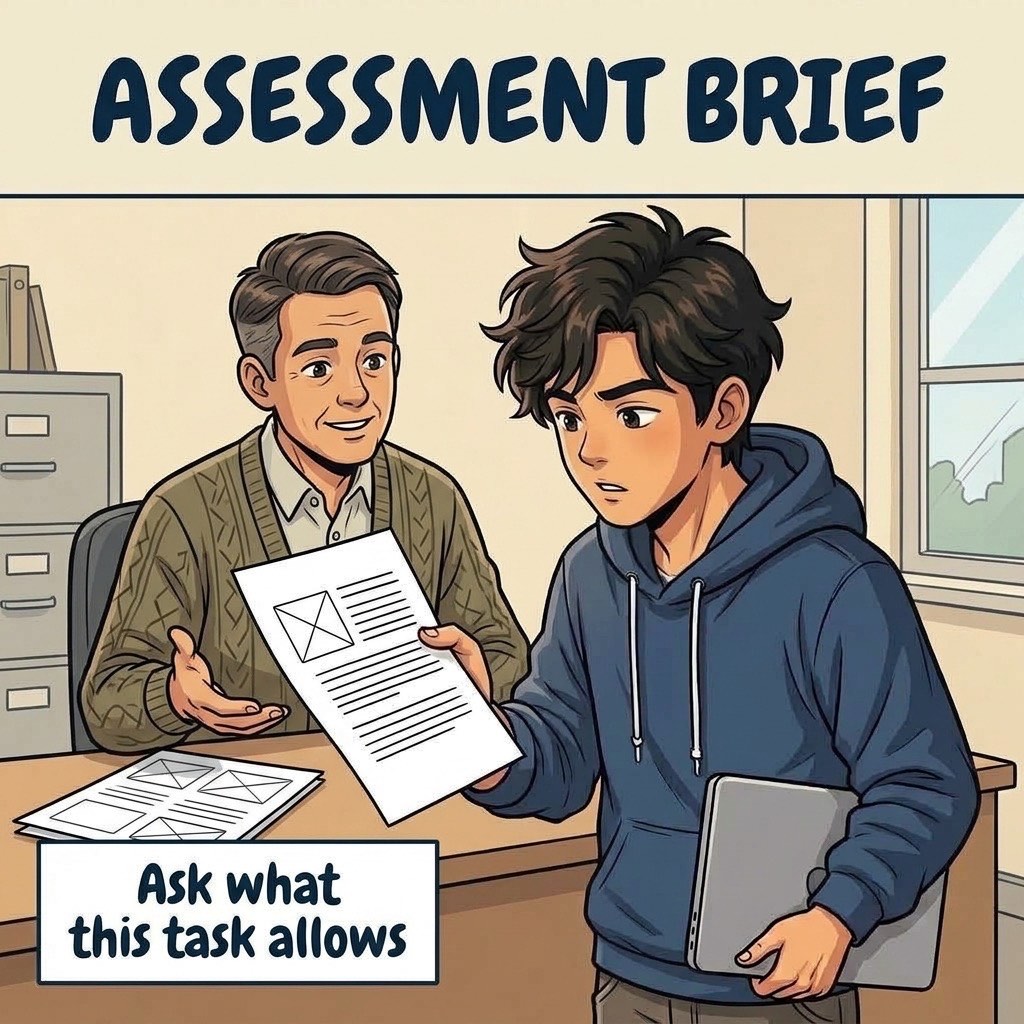
- Read the Module Team’s assessment-specific AI guidance.
- For formal discussion, review the allegation/material and consider a companion.
- Submit the B2.1 appeal on time with a full statement and available evidence.

Guildford, United Kingdom
Student guide · Task rules and procedure
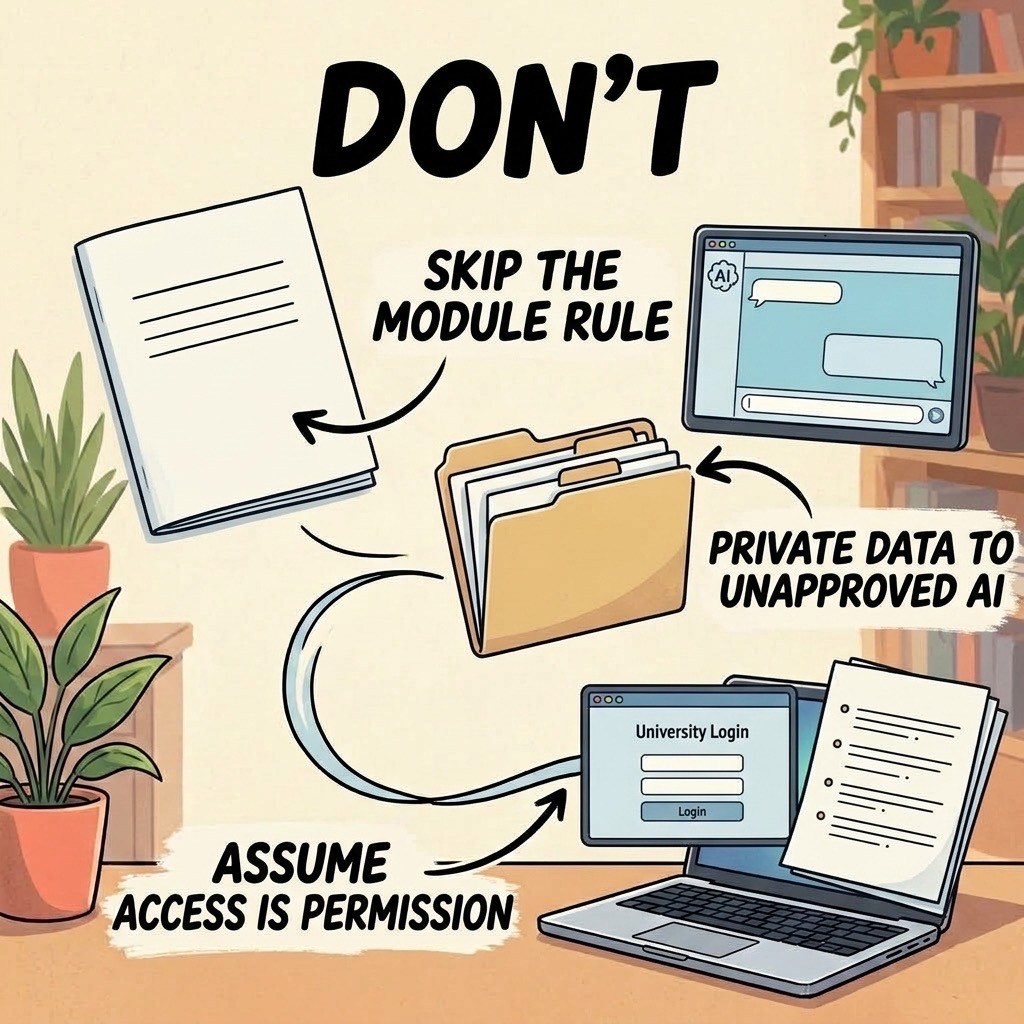
MyAISurrey access does not grant assessment permission. Current 2026/27 B2 covers disclosure, authorship and language-learning restrictions. Its formal discussion differs from a Panel hearing; B2.1 controls misconduct appeals, pending evidence and adjustments. The overarching GenAI procedure has its own employee/work scope.
A complete student policy summary is not available yet; see the collected claims and sources.
MyAISurrey access does not grant assessment permission. Current 2026/27 B2 covers disclosure, authorship and language-learning restrictions. Its formal discussion differs from a Panel hearing; B2.1 controls misconduct appeals, pending evidence and adjustments. The overarching GenAI procedure has its own employee/work scope.

Common situations

Supplement collected: 2026-10-08 · Current applicability not independently confirmed
Site interpretation
The December 2025 overarching GenAI procedure bars personal, confidential and commercially sensitive information from internal/external GenAI unless IT Services approves the tools for the relevant security/compliance requirements. It also calls for clear labels/references where applicable. The scope lists employees and related University work; students’ assessment rules are checked separately in B2.
Scope: employees, contractors, visiting researchers and University-related work within the stated procedure · Scope is limited to the cited official source and stated conditions; this is a local candidate, not a complete university rule set.
Scope: employees, contractors, visiting researchers and University-related work within the stated procedure · university
4.4. Considered – avoid inputting sensitive data into unapproved tools; assess bias and
accuracy risks.
4.4.1. Protect Information: To reduce the risk of data breaches and misuse, personal,
confidential, and commercially sensitive information (including Intellectual
Property) must NOT be entered into GenAI tools—internal or external— unless
they are approved by IT Services and meet the organisation’s security and
compliance requirements.
4.4.2. Mindful input: Being cautious about what you input into GenAI tools is crucial
because GenAI generates responses based on its training data, which may not
always be accurate or appropriate.
4.4.3. Bias awareness: Recognising and mitigating biases in GenAI models helps
prevent discrimination and ensures fair outcomes.
4.5. Transparent – Clearly label and reference GenAI-generated content where
applicable.
4.5.1. Transparency: About the use of GenAI fosters trust and accountability.
4.5.2. Referencing GenAI: Clearly labelling GenAI-generated content helps users
understand the source and context of the information.View official source ↗Collected: 2026-10-08 · 97–113
SHA-256: 83a8b85cab9a091749c6da41671e8945b95df4a37123120ddd88747ca713695d
2. Scope and Exceptions to the Procedure
2.1. This applies to:
2.1.1. All University of Surrey employees, subsidiaries, contractors, visiting
researchers and temporary employees
2.1.2. All GenAI use for university related work, teaching, research and
administration
2.1.3. The design, development, or deployment of GenAI enabled products or
services within the University context
2.2. This is the overarching procedure on GenAI at the University. Other AI related
guidelines, support information, training material are produced from time to time
and are available on the AI page on SURREYNET Artificial intelligence at Surrey |
SurreynetView official source ↗Collected: 2026-10-08 · 54–65
SHA-256: 83a8b85cab9a091749c6da41671e8945b95df4a37123120ddd88747ca713695d
Site interpretation
In current 2026/27 B2, passing off AI-generated work as original and failing to declare third-party/GenAI assistance are misconduct examples. Module Teams communicate assessment-specific guidance. Proofreading/language assistance has a distinct restriction where written-language proficiency is a learning outcome, excluding dictionaries, thesauruses and spell-checkers as stated.
Scope: students · Student regulations 2026/27 effective 21 September 2026 replace previous student-regulation versions; assessment-specific guidance controls.
Scope: students · university
(vi) passing off work as original that may have been generated by Artificial
Intelligence. This could be, but is not limited to, text, images, music or code.
Other forms of academic misconduct
20. Other forms of academic misconduct include, but are not limited to:
(i) failure to declare third party assistance, including from generative Artificial
Intelligence, in the presentation of assessed work (other than assistance by a
department of the University), including language, syntax, spelling and layout or
failure to provide the draft material submitted to the third party to proof-read
and/or correct. Guidance on the appropriate use of generative Artificial
Intelligence for specific assessments will be communicated by the Module Team;
(ii) assistance in the completion of assessed work from third parties, including from
generative Artificial Intelligence, through proof-reading and correcting English or
a target language (not including use by the student of dictionaries, thesauruses
and spell-checkers) where the learning outcomes for a module include a specific
requirement to demonstrate facility with written English or a target language;
(iii) fabricating results from laboratory or other work or misrepresenting data;
(iv) introducing unauthorised textual materials into an assessment venue or ancillary
area such as cloakroom or toilets. This can include not only notes clearly
relevant to the assessment but any form of written material, either on paper or on
a student’s body;
(v) having an unauthorised mechanical or electronic device on one’s person within
an assessment venue or ancillary area, such as a cloakroom or toilets. Where
such devices, including mobile phones and smart watches, are permitted to be
brought into an assessment venue, they must be switched off and placed in the
container provided for this purpose. The container must then be placed on the
floor in full view of the invigilators before the start of the assessment and for the
duration of the assessment;
(vi) passing off the work of others as your own during an online assessment,
including content and/or writing produced by generative Artificial Intelligence.
(vii) accessing unauthorised online material/web pages during an online assessment.View official source ↗Collected: 2026-10-08 · 345–374
SHA-256: b642850f027e275614aa23d34bf840cee3f0ceba161ca4cd77dc506da07331f2
Site interpretation
The B2 formal discussion gives five University working days’ notice, the allegation, potential outcomes and relevant material. A friend or Students’ Union official may accompany the student; exceptional earlier meetings need written agreement. Students can explain their approach and special circumstances; unjustified absence permits a finding on available information. This is distinct from an Academic Misconduct Panel hearing.
Institution · Required when using this procedure
At least this many days before the hearing. Check the source summary and original text for the starting point, scope and exceptions.
Scope: students · Scope is limited to the cited official source and stated conditions; this is a local candidate, not a complete university rule set.
Scope: students · university
35. The student receives five University working days’ notice of the formal discussion and
is invited to submit any representations in relation to the concerns, including evidence
of special circumstances. The student is also informed of the support provided by the
Surrey Students’ Union and that they can be accompanied by a friend or an official of
the Surrey Students’ Union at the discussion. The letter outlines the nature of the
allegation and the potential outcomes of the formal discussion. A copy of all relevant
material is also provided to the student in advance of the meeting. In exceptional
circumstances and with written agreement of the student, the formal discussion may
take place earlier than five University working days.
36. The formal discussion is also attended by the Module Leader or, in the case of
dissertations, by the first marker. If these persons are unavailable, they can nominate
another member of the module team to attend. The student and the AIOs will receive
details of the allegation and the supporting evidence (e.g. a Turnitin®/Authorship
Investigate report), where relevant. AIOs will not be informed of any previous findings
of either poor academic practice or academic misconduct until after they have made
their decision and, if relevant, are determining the penalty. The only other exception is
when the student misleads the AIOs in relation to any previous findings. If this occurs,
the Academic Administration team will correct any inaccurate information.
37. Where a student is unable to attend the meeting on the specified date and time, they
can request an alternative provided there are valid reasons supported by appropriate
evidence. The formal discussion can take place in person or online or by telephone.
5 The AIOs should not have a close relationship with the student (or students) and should not have
been involved in previously proven misconduct allegations against the student.
9
38. The formal discussion provides an opportunity for the student to explain how they
approached the assessment task and for the student to be shown how the suspected
academic misconduct has been identified. In cases of suspected collusion,
consideration will be given as to whether the assessment instructions were sufficiently
clear as to whether the work was to be undertaken singly or collectively. In cases of
possible academic misconduct in group work, consideration will be given as to whether
the group work was designed to produce a single piece of work with a mark in
common for all members of the group or whether discrete elements were produced by
individual members.
39. The student is also given the opportunity to raise any previously undisclosed special
circumstances.
40. Should a student choose to waive their right for a formal discussion to take place, they
must notify the University of their decision in writing (via email). If the student does not
attend the formal discussion and there are no valid reasons for non-attendance, the
AIOs will reach a finding based on the information available to them.View official source ↗Collected: 2026-10-08 · 565–607
SHA-256: b642850f027e275614aa23d34bf840cee3f0ceba161ca4cd77dc506da07331f2
Site interpretation
B2’s proven-misconduct table separates first assessment attempts from reassessments and first, second, severe or third instances. Standard first cases give zero for the unit of assessment, with different reassessment entitlements; severe/third cases can terminate registration. Decision makers classify severity in context on balance of probabilities. No AI-detector score establishes these outcomes automatically.
Scope: students · Scope is limited to the cited official source and stated conditions; this is a local candidate, not a complete university rule set.
Scope: students · university
Penalties for proven cases of academic misconduct
Table 1: Penalties that an Academic Integrity Officer, the Academic
Administration team and an Academic Misconduct Panel instructs a Board of
Examiners to apply 1213
Instances of Scale of penalties where academic Scale of penalties where academic
academic misconduct is found to have taken misconduct is found to have taken
misconduct place during a first assessment attempt place during a reassessment attempt
First instance Standard cases: Standard cases:
Mark of zero for the unit of assessment. Mark of zero for the unit of assessment.
If the module is failed – reassessment is If the module is failed – no further
allowed. Reassessment penalty is applied reassessment is allowed unless the
to the re-assessed unit(s) of assessment. student is entitled to a third attempt.
Regulations for taught programmes
apply.
Serious cases:
Mark of zero for the unit of assessment
Serious cases:
12 Decisions as to whether misconduct should be categorised as standard, serious, or severe are made at the sole discretion of
the AIO(s), AMP or Academic Administration staff members. They will consider the facts of the case alongside relevant,
contextual evidence and make a determination on the balance of probabilities.
13 Findings of misconduct made within the previous six calendar years, including during separate
registration periods, will normally be considered when penalties are applied.
16
AND Mark of zero for the unit of assessment
If the module is passed overall – the AND
module mark is capped at the pass mark.
If the module is passed overall – the
module mark is capped at the pass
mark.
If the module is failed – reassessment is
allowed. Reassessment penalty is applied
to the re-assessed unit(s) of assessment.
If the module is failed – no further
In cases, where following the
reassessment is allowed unless the
reassessment attempt, the module is
student is entitled to a third attempt.
passed, the module mark is capped at the
Regulations for taught programmes
pass mark.
apply.
Second instance Mark of zero for the unit of assessment Mark of zero for the unit of assessment
AND AND
If the module is passed overall – the If the module is passed overall – the
module mark is capped at zero and module mark is capped at zero and
module credits are awarded (for credit module credits are awarded (for credit
bearing modules). bearing modules).
If the module is failed – reassessment is If the module is failed – no further
allowed. Reassessment penalty is applied reassessment is allowed unless the
to the re-assessed unit(s) of assessment. student is entitled to a third attempt.
In cases, where following the The module mark is capped at zero.
reassessment attempt, the module is No module credits are awarded.
passed, the module mark is capped at Regulations for taught programmes
zero and module credits are awarded (for apply.
credit bearing modules).
Third instances and Termination of registration. Regulations Termination of registration.
severe cases for taught programmes apply Regulations for taught programmes
applyView official source ↗Collected: 2026-10-08 · 946–1016
SHA-256: b642850f027e275614aa23d34bf840cee3f0ceba161ca4cd77dc506da07331f2
Site interpretation
B2.1 requires an academic-misconduct findings/outcome appeal to OSCAR online within 10 University working days of notification of the decision. Submit a complete statement and available evidence on time even if some evidence is pending; request a reasoned evidence extension when submitting. Late appeals require reasons and independent evidence and are not automatically accepted.
Student · Required when using this procedure
Within the stated period. Check the source summary and original text for the starting point, scope and exceptions.
Scope: students · Scope is limited to the cited official source and stated conditions; this is a local candidate, not a complete university rule set.
Scope: students · university
Review by an OSCAR Case Manager
17. A student wishing to appeal against the findings or outcome of an academic
misconduct process, is required to do so within 10 University working days of being
notified of the decision. Appeals should be submitted to OSCAR on-line and in
accordance with published requirements as to the format, content and length of
submission. Further details are available on the OSCAR web pages. If the appeal is
received on time, it will be assigned to a Case Manager. If a student is unable to
provide all supporting evidence by the appeal submission deadline (for example, if
they are awaiting receipt of a medical letter), then they are still required to submit their
appeal within the 10 University working day timeframe (including a complete
supporting statement and any available evidence) but may request an extension in
respect of the submission of any pending evidence. Such requests should explain the
reason the extension is required and be made by email to OSCAR at the time of the
appeal submission.
18. If an appeal is received after the 10 University working days deadline the student will
be asked to provide reasons and accompanying independent supporting evidence as
to why the appeal is late. The reasons and supporting evidence will be considered by
an OSCAR Case Manager to determine whether the reasons are valid. Consultation
may take place with other members of staff in complex or unusual cases, and this will
be recorded. A decision on the validity of the reasons will normally be made within 20
University working days of receiving the final submission of information from the
student. If the reasons are not deemed valid, the appeal will not be considered and the
student will be offered a Completion of Procedures letter. 1 If there are valid reasons,
the appeal will be accepted and assigned to a Case Manager.View official source ↗Collected: 2026-10-08 · 170–193
SHA-256: b491302e1dffdab6a741b842aef088a471f7b6d3345f20842fb766211919cab0
Site interpretation
B2.1 grounds include failure to follow regulations with due care, bias, relevant new evidence with valid reasons for not providing it earlier, and unreasonable/disproportionate decision or penalty. A challenge requiring only academic expert opinion is excluded as academic judgement. General assessment appeals must not replace this misconduct route.
Scope: students · Scope is limited to the cited official source and stated conditions; this is a local candidate, not a complete university rule set.
Scope: students · university
Grounds for making an appeal
9. When making an appeal the student is required to show that they have evidence to
demonstrate that one or more of the following grounds apply:
• that staff or bodies have failed to follow regulations and/or procedures or have
failed to follow them with due care
• that staff or bodies have shown bias or prejudice towards the student in the way
they have made the relevant decision
• that relevant new evidence has become available that should be considered and
there are valid reasons why it was not provided earlier
• that the decision was unreasonable and/or the penalty imposed was not
proportionate in all of the circumstances
10. Where new evidence is raised, further investigations may need to be carried out which
may require the appeal to be delayed pending the outcome of these investigations and
to give the student an opportunity to consider any new information obtained.
Circumstances in which the University will not consider an appeal
11. An appeal against a decision where only the opinion of academic expert(s) will suffice
is deemed to be a challenge to academic judgement and will not be considered.View official source ↗Collected: 2026-10-08 · 112–128
SHA-256: b491302e1dffdab6a741b842aef088a471f7b6d3345f20842fb766211919cab0
Site interpretation
Surrey’s student page says MyAISurrey is available to all Surrey students with equitable access to major language models, including ChatGPT. Students must remain in control and use AI to assist rather than replace authorship. This public service statement is not an individual account test or blanket assessment permission.
Scope: students · Scope is limited to the cited official source and stated conditions; this is a local candidate, not a complete university rule set.
Scope: students · university
My AI Surrey, that provides equitable access to major Large Language Models (LLMs), like ChatGPT, for all Surrey students.
My AI Surrey will help to empower you to harness AI, learning to use the tools effectively and graduate with the capabilities for AI-enabled problem solving that the employment market demands.
My AI Surrey is a university-supported space enabling you to explore and use AI with confidence by providing you with access to Large Language Models (LLMs) inside a secure Surrey environment.
My AI Surrey is still in development. We recognise this is a rapidly evolving space and more and different tools will be coming over the next few weeks and months, but we wanted to provide equitable access to major LLMs as soon as possible.
Visit My AI Surrey
Using AI in your studies
Generative AI tools may be used to support your studies, but they may only be used to support, not replace, your authorship.
All submitted work must be your own intellectual output.
It is important to remember that:
AI-generated information may be inaccurate or fabricated (including false references and DOIs);
all outputs must be critically evaluated and verified against authoritative academic sources;
presenting AI-generated content as original work, without acknowledgment, may constitute academic misconduct.
In summary, while AI tools may help you, you must always remain in control of your submitted work.View official source ↗Collected: 2026-10-08 · 201–213
SHA-256: d48cafb4a33e2f3862e520ef8088761a05fdf4ae2aef80a88f10ad49091cd172
Site interpretation
B2.1 provides reasonable process adjustments, including response-deadline extensions, on relevant third-party evidence of need. Rare exceptional changes may address substantial unfairness or health/disability risk. Students bear the burden to show appeal grounds and decisions use balance of probability.
Scope: students · Scope is limited to the cited official source and stated conditions; this is a local candidate, not a complete university rule set.
Scope: students · university
Reasonable adjustments
4. Reasonable adjustments to the processes within these Regulations, including the
extending of deadlines for student responses, will be made upon the production by the
student of relevant third party evidence which demonstrates the need for those
adjustments.
Exceptional circumstances
5. In exceptional circumstances it may be appropriate to amend the procedures set out in
these Regulations, for example, where strict application of the Regulations would
result in substantial unfairness to a student or a student is in some way at risk because
of health or disability. Such cases will be rare and each will be treated on their own
merits.
Burden of proof
6. When making an appeal it is for the student to show that one or more of the grounds
listed in regulation 9 below apply.
Standard of proof
7. The standard of proof is that of the balance of probability; that it is more likely than not
that something was or was not the case.View official source ↗Collected: 2026-10-08 · 74–90
SHA-256: b491302e1dffdab6a741b842aef088a471f7b6d3345f20842fb766211919cab0
Published source-based additions. English summaries and original-language quotations are shown separately from the reviewed record. These are possible processes and outcomes, not automatic penalties for AI use. Present applicability has not been independently confirmed; check the source scope and version.
Source-text comparison; not an official translation
Hashes allow comparison of saved content; they do not certify current validity or immutability. These topics are not a mandatory sequence.
Tool access is not permission to use AI in an assessment. Check your assignment rules, eligible users and data restrictions.
Archived tool record; consult the official source for current access.
University of Surrey supports My AI Surrey, a secure portal providing students access to major LLMs including ChatGPT.
Use the My AI Surrey portal as a Surrey student.
Not specified by the cited source.
Original quotation
My AI Surrey provides equitable access to major Large Language Models, like ChatGPT, for all Surrey students. My AI Surrey is a university-supported space enabling students to use AI tools.Reviewed record
5 reviewed claims
Academic Integrity
Normalized value: students_should_check_assessment_specific_ai_permissions
Original evidence
Evidence 1If you are thinking of using generative artificial intelligence (AI) tools, such as ChatGPT, Copilot, Gemini, etc., in your work, the University has produced guidelines for students on responsible use of generative AI (Gen AI). It is important to read and familiarise yourself with these guidelines. In addition, always check your Assessment Briefs or consult your Module Leaders about the levels of AI use permitted for any specific assessment.
Privacy
Normalized value: sensitive_data_requires_it_approved_genai_tools
Original evidence
Evidence 1To reduce the risk of data breaches and misuse, personal, confidential, and commercially sensitive information (including Intellectual Property) must NOT be entered into GenAI tools--internal or external--unless they are approved by IT Services and meet the organisation's security and compliance requirements.
Research
Normalized value: qda_genai_use_requires_participant_transparency_and_consent_guidance
Original evidence
Evidence 1If you intend to use Generative AI for any aspect of qualitative data analysis, you must be upfront about it with participants and seek their consent for you using their data in this way.
Ai Tool Treatment
Normalized value: {"tool":"institutional_ai_service","rawToolName":"My AI Surrey","description":"University of Surrey supports My AI Surrey, a secure portal providing students access to major LLMs including ChatGPT.","howToObtain":"Use the My AI Surrey portal as a Surrey student.","costToUser":"Not specified by the cited source.","availability":"allowed","endorsementType":"officially_endorsed"}
Original evidence
Evidence 1My AI Surrey provides equitable access to major Large Language Models, like ChatGPT, for all Surrey students. My AI Surrey is a university-supported space enabling students to use AI tools.
Localized display only
My AI Surrey provides equitable access to major Large Language Models, like ChatGPT, for all Surrey students. My AI Surrey is a university-supported space enabling students to use AI tools.
Ai Tool Treatment
Normalized value: central_genai_procedure_requires_user_familiarity
Original evidence
Evidence 1This procedure sets out how GenAI tools may be used within the University to support teaching, research, and operations, while protecting information, complying with legal and regulatory requirements, and maintaining academic and professional integrity. All users must read and understand this procedure before engaging with any form of GenAI during University work.
Source record
4 sources
surrey.ac.uk
surrey.ac.uk
my.surrey.ac.uk
help.surrey.ac.uk
Citation: University AI Policy Tracker. "University of Surrey AI Policy Tracker record." Last checked July 19, 2026. https://eduaipolicy.org/universities/university-of-surrey
Original university source language remains canonical. This tracker is not an official university statement.
Open change logSaved from University AI Policy Tracker. This record summarizes the cited sources; it is not an official university statement or assessment permission. Source and review dates are listed above. Hashes identify retained content, not authorization.