Do
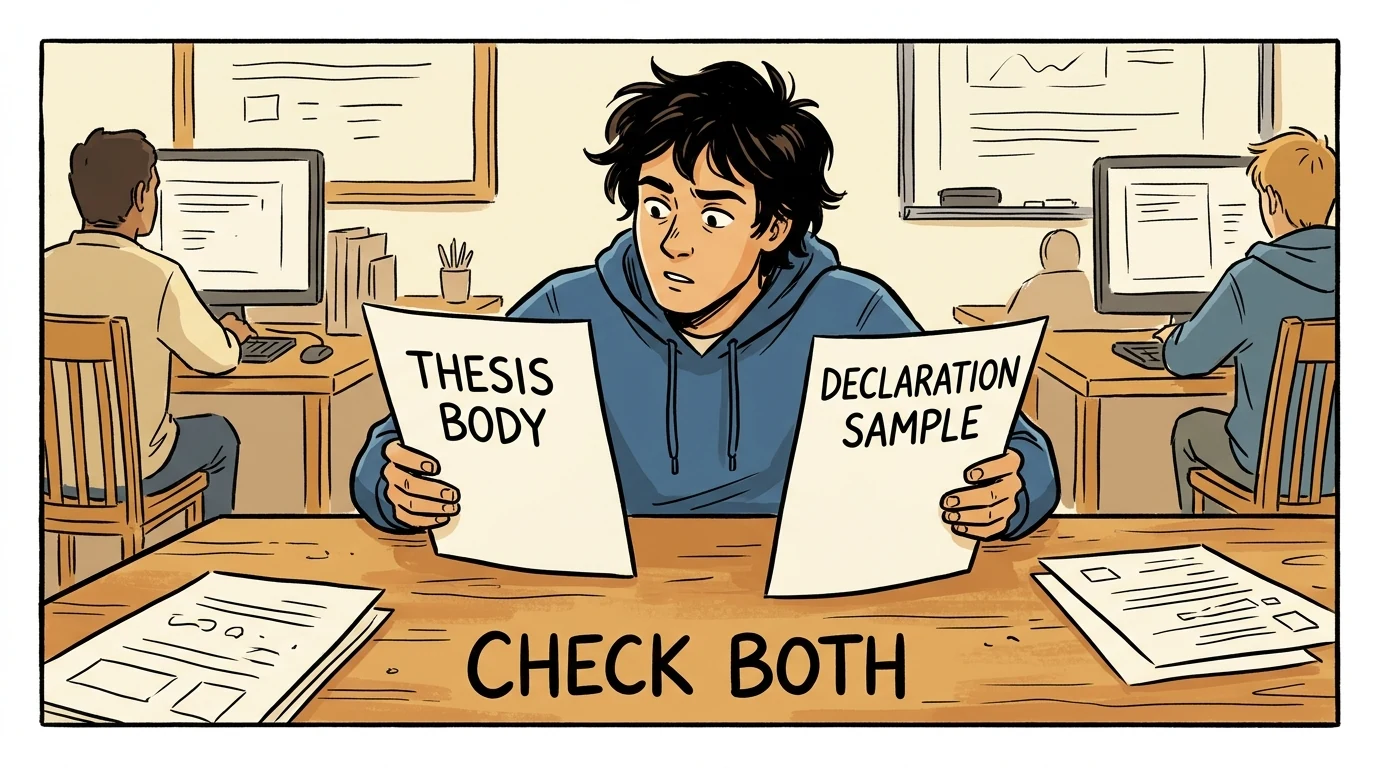
- Thesis: include the separate GenAI declaration.
- Check sample examples against the main restrictions.
- Ask which disciplinary version applies to your case.
Kuala Lumpur, Malaysia
Student guide · Task scope and procedure
The May 2026 thesis guide requires a separate AI declaration, advises against replacing critical academic work, and prohibits sensitive data in third-party tools. Appendix examples do not waive those restrictions. The postgraduate scholarly-work rule has its own conditions. General plagiarism/exam support and the old 2016 SDB appeal document are not certified current AI procedures.
A complete student policy summary is not available yet; see the collected claims and sources.
The May 2026 thesis guide requires a separate AI declaration, advises against replacing critical academic work, and prohibits sensitive data in third-party tools. Appendix examples do not waive those restrictions. The postgraduate scholarly-work rule has its own conditions. General plagiarism/exam support and the old 2016 SDB appeal document are not certified current AI procedures.
Supplement collected: 2026-10-08 · Current applicability not independently confirmed
Site interpretation
UCSI’s thesis/dissertation guide (11 May 2026 Rev.04 footer) requires a separate GenAI declaration page. AI should not bypass learning or replace original research, data interpretation or argument development, and confidential/sensitive data must not enter third-party tools. The body points to a separate GenAI teaching/learning guideline not acquired here.
Scope: Students in the cited programme/course/stage only · Only the captured source, version, audience and conditions; no exhaustive currency certification.
Scope: Students in the cited programme/course/stage only · university
3.2.5 Declaration for the Use of Generative Artificial Intelligence (AI) in Thesis/
Dissertation
Disclosure of the use of generative artificial intelligence tools in the preparation of
thesis/dissertation must be made by the candidates. This declaration ensures transparency,
academic integrity, and accountability in the use of emerging technologies. The declaration
must be placed in a separate page under the heading titled " Declaration for the Use of
Generative AI in Thesis/ Dissertation” (Refer to APPENDIX 4).
Generative AI tools should not be used to bypass learning or replace critical academic
tasks such as original research, data interpretation, or argument development. Confidential or
sensitive data must not be entered into any third-party AI tools to safeguard privacy and data
security. Candidates should refer to “Guideline for Generative AI Tools Usage in Teaching
and Learning” of UCSI University in preparation of thesis/dissertation.View official source ↗Collected: 2026-10-08 · 618–631
SHA-256: 5b862ba2d718fc39b045e504182a662fd951e8a8f519f2a6f142d01acb5a8e17
Site interpretation
Appendix 4’s sample declaration includes examples such as initial drafts and data analysis, while the main text says AI should not replace critical academic tasks. The sample is not treated as blanket permission to outsource those tasks; the body, applicable policy and supervisor’s directions still need checking.
Scope: Students in the cited programme/course/stage only · Only the captured source, version, audience and conditions; no exhaustive currency certification.
Scope: Students in the cited programme/course/stage only · university
APPENDIX 4
EXAMPLE OF DECLARATION FOR THE USE OF GENERATIVE AI IN
THESIS/DISSERTATION
2.5 cm
3.5 cm
DECLARATION OF DECLARATION FOR THE USE OF 2.5 cm
GENERATIVE ARTIFICIAL INTELLIGENCE (AI) IN
THESIS/DISSERTATION
2 spaces
In accordance with the guidelines for responsible AI use at UCSI
University, I hereby declare that I have utilized generative AI tools
during the preparation of this thesis. The tools used include
[NAME OF TOOL/SERVICE], which were employed for
1 line spacing
[SPECIFY PURPOSE, e.g., enhance language clarity, generate
initial drafts, or assist with data analysis]
All content generated by this tool has been thoroughly reviewed
and edited by me to ensure its accuracy, originality, and
compliance with academic standards. I take full responsibility for
the content of this thesis and confirm that the use of AI tools has
been transparently documented.View official source ↗Collected: 2026-10-08 · 1344–1368
SHA-256: 5b862ba2d718fc39b045e504182a662fd951e8a8f519f2a6f142d01acb5a8e17
Generative AI tools should not be used to bypass learning or replace critical academic
tasks such as original research, data interpretation, or argument development. Confidential or
sensitive data must not be entered into any third-party AI tools to safeguard privacy and data
security. Candidates should refer to “Guideline for Generative AI Tools Usage in Teaching
and Learning” of UCSI University in preparation of thesis/dissertation.View official source ↗Collected: 2026-10-08 · 627–631
SHA-256: 5b862ba2d718fc39b045e504182a662fd951e8a8f519f2a6f142d01acb5a8e17
Site interpretation
The postgraduate handbook permits GenAI for publications and scholarly work only in compliance with UCSI Academic Integrity and AI policies. Students remain responsible for originality, accuracy, integrity and authenticity, with no plagiarism, fabrication or falsification. This does not establish a universal undergraduate assessment permission.
Scope: Postgraduate scholarly authors · Only the captured source, version, audience and conditions; no exhaustive currency certification.
Scope: Postgraduate scholarly authors · university
The use of generative Artificial Intelligence (AI) in the preparation of publications and other scholarly work
is permitted only when it complies with the UCSI University Academic Integrity Policy and Artificial
Intelligence (AI) Policy. Postgraduate students remain fully responsible for the originality, accuracy,
integrity and authenticity of all submitted work, and the use of generative AI must not result in plagiarism,
fabrication, falsification, or any other form of academic misconduct.View official source ↗Collected: 2026-10-08 · 1512–1516
SHA-256: 5fcbbef2c27e5d3e74964b0551a40ab46e763ecc5517f0aa3729c8e769b89906
Site interpretation
The library’s Turnitin guide tells academics to request an instructor account and students to use a lecturer’s Class ID/enrolment key with UCSI email. It establishes a plagiarism/citation support route, not an AI detector deployment or numerical verdict.
Scope: Students in the cited programme/course/stage only · Only the captured source, version, audience and conditions; no exhaustive currency certification.
Scope: Students in the cited programme/course/stage only · university
Turnitin Guideline
Turnitin is a valuable academic tool provided by the Tan Sri Musa Mohamad Library to uphold integrity and originality in academic work. It is used to detect plagiarism, ensure proper citation practices, and encourage students to produce authentic content.
Contact Tan Sri Musa Mohamad Library for the Turnitin instructor account (Academician). A student account can be created using your lecturer's Class ID and enrollment key. Please use the UCSI email for the Turnitin account.View official source ↗Collected: 2026-10-08 · 50–52
SHA-256: 6e05e961f60624ade2fdb3001e4493a815e1de2539f3f4953d2467e79938940a
Site interpretation
For the undergraduate handbook’s coursework-plagiarism category, the lecturer gathers evidence, confirms it with the named faculty committee and schedules a student meeting to explain the allegation and obtain a response. The 5%–25% numbers describe coursework weighting, not a plagiarism threshold. This is not a complete AI investigation procedure.
Scope: Students in the cited programme/course/stage only · Only the captured source, version, audience and conditions; no exhaustive currency certification.
Scope: Students in the cited programme/course/stage only · university
14.1 Plagiarism in Course Work Components
The course work components are taken to mean any take-home written assignments between
the percentages of 5% to 25%. If sufficient evidence of plagiarism is found in a student’s work,
the following procedure shall take place:
1) The lecturer/examiner of that piece of work is to gather the evidence for documentation;
2) Confirmation with the Dean or Deputy Dean of Faculties, Director of the
Centre/Institute and member of Centres/Faculties/Institutes/Schools that the piece of
work does indeed contain plagiarized work. These “members” will form the immediate
committee to address this incident until the matter is resolved;
3) Request for you to attend a scheduled meeting with the lecturer/examiner, the Dean or
Deputy Dean and members of Centres/Faculties/Institutes/Schools. This is to be
completed within three (3) days from the date of discovery and with the meeting agenda
extended to you. Failure to be present at the meeting may add on penalty to the case,
unless proven that the absenteeism is due to extenuating circumstances;
4) During the meeting, you will be explained on the allegation of plagiarism and requested
to clarify and respond. The Committee would allow you to admit the offence and where
possible, resolve the matter informally.View official source ↗Collected: 2026-10-08 · 2514–2532
SHA-256: c2ed21820177f2fc23b53a6238bf6af8a1b8f0b0eca7444277128dec4104b77f
Site interpretation
The undergraduate disability-exam guidance asks students to contact the Faculty by semester week 8 or eight weeks before final exams, whichever is earlier, with evidence for case-by-case reasonable adjustments. This general exam support is not AI permission or a disciplinary-hearing accommodation rule.
Scope: Students in the cited programme/course/stage only · Only the captured source, version, audience and conditions; no exhaustive currency certification.
Scope: Students in the cited programme/course/stage only · university
13.14 Exam guidelines for students with disabilities
Disabled students, including but not limited to those with a chronic medical or mental health condition,
autism, sensory or mobility impairment, or learning difference (such as dyslexia) should contact the
Faculty no later than the 8th week of the semester or 8 weeks before the start of the final exam period,
whichever is earlier, to allow adequate time for a needs assessment, and for lecturers to make reasonable
adjustments to a student's teaching and assessment. Students are asked for evidence of disability and a
diagnostic assessment containing recommendations for examinations support to inform and speed the
process of implementing support.
The Faculty is required to make a case-by-case assessment of students’ disability-related support needs
in relation to programme requirements. For this reason, there can be no fixed inventory of
standard/allowable adjustments, as all adjustments which do not compromise genuine competence
standards, and which the Faculty may reasonably be capable within its institutional resource of
providing, must be available. Where implementing the adjustments a disabled student requires mayView official source ↗Collected: 2026-10-08 · 2318–2332
SHA-256: c2ed21820177f2fc23b53a6238bf6af8a1b8f0b0eca7444277128dec4104b77f
Site interpretation
The 2016 SDB policy makes penalties dependent on seriousness and permits combinations, including reprimand, probation, withheld/revoked awards and failing grades in the specified contexts. It is general student discipline, not an AI-specific automatic sanction. No current AI tariff is established.
Scope: Students in the cited programme/course/stage only · Only the captured source, version, audience and conditions; no exhaustive currency certification.
Scope: Students in the cited programme/course/stage only · university
7.0 PENALTIES
7.1 Degrees of Student Discipline
Penalties vary according to the seriousness of the offence. A student found guilty
of misconduct may be liable to any one or a combination of the following
punishments:
7.1.1 Reprimand
A written reprimand from the Chairperson of SDB to the student.
7.1.2 Probation
Further violations will result in severe disciplinary action and can
include conditions related to the misconduct, such as counselling,
educational seminars, or unpaid work assignments. Failure to meet the
condition(s) shall be considered as an additional violation.
7.1.3 Disciplinary Probation
Student is required to comply with specified terms and conditions that
include not engaging in further conduct in violation of these clauses, and
can include conditions related to the misconduct, such as to attend
counselling, educational seminars, or unpaid work assignments. Failure
to meet the condition(s) shall be considered as an additional
violation.
7.1.4 Withholding of grades or official transcript or degree, or denial of
Degree.
May be imposed for scholastic dishonesty.
7.1.5 Revocation or withdrawal of Degree
May be imposed when the violation involves scholastic dishonesty or
otherwise calls into question the integrity of the work required for the
Degree.
7.1.6 Failing grade for an examination or assignment or course
and/or cancellation of all or any portion of prior course credit.
May be imposed for breach of Examination Rules.View official source ↗Collected: 2026-10-08 · 319–347
SHA-256: f9980a9bf33e3bf07624a61c22c3fc4d27c62b77f45fec9c4fcdea0050866b29
Site interpretation
The separately published SDB Policy V11 revised 8 April 2016 allows the complainant and/or accused student written appeal to the Vice Chancellor within 14 days from the date the SDB decision is made; the VC informs the final decision within 30 days, without an explicit start in that sentence. Both day types are unspecified. Its continued public availability does not certify that this old version governs a current case.
Student · Required when using this procedure
Within the stated period. Check the source summary and original text for the starting point, scope and exceptions.
Institution · Required when using this procedure
Within the stated period · Starting point not specified. Check the source summary and original text for the starting point, scope and exceptions.
Scope: Students in the cited programme/course/stage only · Only the captured source, version, audience and conditions; no exhaustive currency certification.
Scope: Students in the cited programme/course/stage only · university
5.2.3 Appeal Process
a) The student(s), complainant and/or accused may appeal the decision of the
SDB, in writing, to the University’s Vice Chancellor.
b) All appeals must be submitted in writing to the VC within fourteen (14) days
from the date the decision of the SDB is made.
c) Failure to appeal within the above time frame renders the SDB’s decision final.
Page 5
SAA/SDB Policy V11
REV_ 08042016
d) The appeal must be made in writing and must state the reasons why the
SDB’s decision is believed to be inappropriate.
e) Appeals can be based on, but are not restricted to, the following:
i) Procedural irregularity on the part of the SDB;
ii) Insufficient evidence to warrant the actions taken;
iii) Lack of due process or discrimination including racism, sexism, etc.;
iv) The sanction will have unforeseen consequences for the student(s) that
are harsher than intended; and
v) That new and substantial evidence, previously unavailable to the SDB,
bears importantly in the student’s favour.
f) The VC will review all information regarding the student’s appeal and will
inform the student in writing of the final decision within 30 days.
g) The VC may require a separate hearing in order to make a decision on the
appeal.
h) The decision of the VC is final.View official source ↗Collected: 2026-10-08 · 251–276
SHA-256: f9980a9bf33e3bf07624a61c22c3fc4d27c62b77f45fec9c4fcdea0050866b29
Published source-based additions. English summaries and original-language quotations are shown separately from the reviewed record. These are possible processes and outcomes, not automatic penalties for AI use. Present applicability has not been independently confirmed; check the source scope and version.
Source-text comparison; not an official translation
Hashes allow comparison of saved content; they do not certify current validity or immutability. These topics are not a mandatory sequence.
Tool access is not permission to use AI in an assessment. Check your assignment rules, eligible users and data restrictions.
Archived tool record; consult the official source for current access.
Original quotation
For thesis and dissertation preparation, UCSI's postgraduate guidelines advise that generative AI tools should not be used to bypass learning or replace original research, data interpretation, or argument development.Original quotation
Generative AI tools should not be used to bypass learning or replace critical academic tasks such as original research, data interpretation, or argument development.Reviewed record
7 reviewed claims
Academic Integrity
Normalized value: postgraduate_thesis_genai_disclosure_required
Original evidence
Evidence 1Disclosure of the use of generative artificial intelligence tools in the preparation of thesis/dissertation must be made by the candidates.
Academic Integrity
Normalized value: library_turnitin_plagiarism_detection_tool
Original evidence
Evidence 1Turnitin is a valuable academic tool provided by the Tan Sri Musa Mohamad Library to uphold integrity and originality in academic work. It is used to detect plagiarism, ensure proper citation practices, and encourage students to produce authentic content.
Academic Integrity
Normalized value: postgraduate_exam_electronic_devices_prohibited
Original evidence
Evidence 1Prohibited Items... Electronic devices (smart watch, Bluetooth hand-free)... Open book exams are meant for open book format, but do not cover access for internet or computer devices.
Academic Integrity
Normalized value: postgraduate_repeated_plagiarism_penalties
Original evidence
Evidence 1Where a student is found to have committed the plagiarism offence again... The penalty for such level of plagiarism, if proven with documented evidence is automatic Fail grade in that module... When a student is caught plagiarizing after the third time... Your study at UCSI University will be terminated.
Academic Integrity
Normalized value: undergraduate_exam_electronic_devices_prohibited
Original evidence
Evidence 1To understand and comply with all the rules, regulations, procedures and guidelines stated in the Student Handbook... Prohibited Items... Electronic devices... Open book exams are meant for open book format, but do not cover access for internet or computer devices.
Privacy
Normalized value: postgraduate_thesis_sensitive_data_must_not_be_entered_into_third_party_ai_tools
Original evidence
Evidence 1Confidential or sensitive data must not be entered into any third-party AI tools to safeguard privacy and data security.
Ai Tool Treatment
Normalized value: postgraduate_thesis_genai_should_not_replace_core_academic_tasks
Original evidence
Evidence 1Generative AI tools should not be used to bypass learning or replace critical academic tasks such as original research, data interpretation, or argument development.
Source record
4 sources
ucsiuniversity.edu.my
ucsiuniversity.edu.my
ucsiuniversity.edu.my
lib.ucsiuniversity.edu.my
Citation: University AI Policy Tracker. "UCSI University AI Policy Tracker record." Last checked May 16, 2026. https://eduaipolicy.org/universities/ucsi-university
Original university source language remains canonical. This tracker is not an official university statement.
Open change logSaved from University AI Policy Tracker. This record summarizes the cited sources; it is not an official university statement or assessment permission. Source and review dates are listed above. Hashes identify retained content, not authorization.