Wel doen
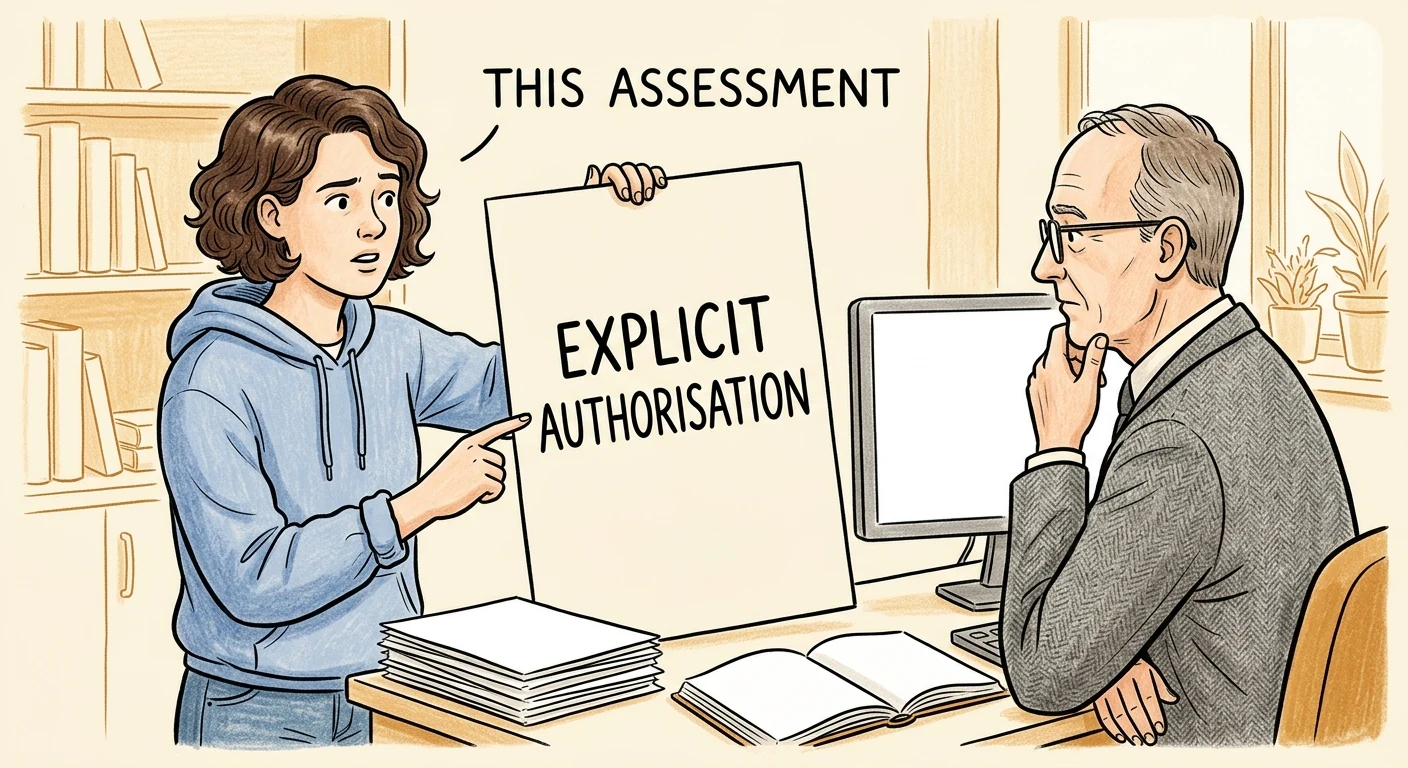
- Confirm explicit permission for this assessment.
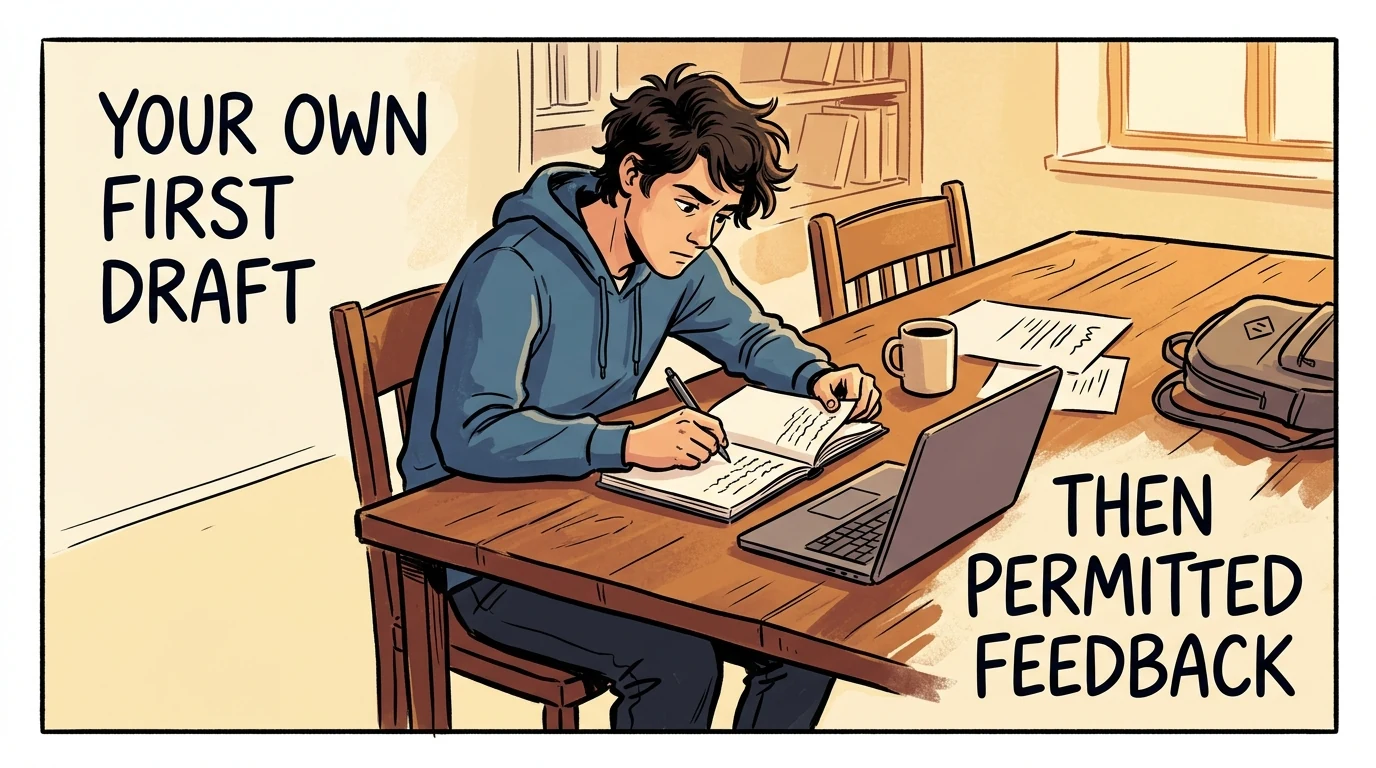
- Start independently before permitted AI feedback.
- Ask about documented disability accommodations.
Colombo, Sri Lanka
Student guide · Task scope and procedure
Assessment AI is prohibited unless explicitly authorised for the particular activity. Acknowledgment does not permit an AI-developed first draft. Permitted feedback follows independent effort; documented disability exceptions have specific conditions. Authorities may check a suspected submission, while the Examinations Committee determines any punishment. Staff research and marking provisions have separate audiences.
De onderstaande richtlijnen zijn in het Engels; officiële bewijsstukken behouden hun oorspronkelijke taal.
Er is nog geen volledige samenvatting van de studentenregels; bekijk de verzamelde uitspraken en bronnen.
Assessment AI is prohibited unless explicitly authorised for the particular activity. Acknowledgment does not permit an AI-developed first draft. Permitted feedback follows independent effort; documented disability exceptions have specific conditions. Authorities may check a suspected submission, while the Examinations Committee determines any punishment. Staff research and marking provisions have separate audiences.

Aanvulling verzameld: 2026-10-08 · Huidige toepasselijkheid niet onafhankelijk bevestigd
Samenvatting momenteel beschikbaar in het Engels
Interpretatie van de site
The University of Colombo GenAI policy prohibits AI in all listed assessment forms unless the particular activity/question/assignment explicitly authorises it; absent permission it is not permitted. Unauthorised summative use is cheating/examination offence. Documented disability accommodations may permit examination AI under applicable UGC/University/CDREP rules.
Reikwijdte: Students in the cited programme/course/stage only · Only the captured source, version, audience and conditions; no exhaustive currency certification.
Detectiebewijs · Ondersteuning en aanpassingen
Reikwijdte: Students in the cited programme/course/stage only · university
Non-permitted/prohibited use of AI and punitive consequences
1. Using AI tools in all assessments (summative, formative, self-assessment, continuous
assessments, in-class assessments, final assessments, etc.) is not permitted, unless
instructions explicitly authorise such use in a particular academic
activity/question/assignment. In the absence of such permission to use AI tools, it should
be considered that the use of AI is not permitted.
2. Using AI tools in summative assessment without authorisation is considered cheating and
tantamount to an examination offence similar to the use of unauthorized material at an
examination. The use of AI tools within examinations may be permitted as a reasonable
accommodation for students with documented disabilities in accordance with the UGC
regulations, regulations of the Centre for Disability Research Education and Practice,
University of Colombo, or any other applicable university policy.Bekijk officiële bron ↗Verzameld: 2026-10-08 · 193–204
SHA-256: 5c88c16103c9a390a008c59f51aaa5a11bec5c0dbdc5cd29e127d343e49b1e1a
Policy on the Use of Generative Artificial Intelligence in Academic and
Administrative Activities
University of ColomboBekijk officiële bron ↗Verzameld: 2026-10-08 · 1–3
SHA-256: 5c88c16103c9a390a008c59f51aaa5a11bec5c0dbdc5cd29e127d343e49b1e1a
Interpretatie van de site
For the policy’s conditionally permitted learning tasks, students first work independently or develop a workable idea, then may seek AI feedback/refinement after their own first draft. Disability-related AI use needs supervision or legitimate lecturer/supervisor instructions aligned with CDREP guidance. These clauses do not override the explicit assessment-permission rule.
Reikwijdte: Students in the cited programme/course/stage only · Only the captured source, version, audience and conditions; no exhaustive currency certification.
Detectiebewijs · Ondersteuning en aanpassingen
Reikwijdte: Students in the cited programme/course/stage only · university
Permitted use with conditions and limitations
The following conditions apply for any learning task requiring critical thinking, problem solving or
creativity, and directly linked to a learning outcome in the curriculum. Use of AI in these tasks must
be consistent with other sections of the Part I.
• Students must first attempt the task on their own or have a workable idea regarding
producing their own draft or solution, before obtaining assistance from AI.
• Once the first draft is developed independently, the students may consult a GenAI tool to
get feedback or suggestions, to compare their solution, or refine the draft.
• At all times, the students remain responsible for the work and must ensure that AI output
is critically reviewed, edited and matched to their own thinking.
Permitted use of AI tools by students with disabilities (e.g., visually impaired, hearing impaired,
neurodivergent, etc.)
Terminology, which refers to ‘students with disabilities’ or ‘persons with disabilities’ is used in this
context based on the United Nations Inclusion Strategy launched in 2019, reflecting a person first
and rights-based approach.
• Use of AI tools by students with disabilities shall be allowed with supervision or legitimate
instructions from the relevant lecturer/supervisor/instructor and in alignment with
guidelines provided by the Centre for Disability Research Education and Practice, University
of Colombo.Bekijk officiële bron ↗Verzameld: 2026-10-08 · 158–178
SHA-256: 5c88c16103c9a390a008c59f51aaa5a11bec5c0dbdc5cd29e127d343e49b1e1a
Interpretatie van de site
The staff research section calls for responsible use consistent with publisher guidelines. University grant proposals must acknowledge the extent of AI use; undisclosed or unacceptable use can lead to rejection by the evaluation panel. These staff publication/grant/promotion provisions are not student coursework permissions.
Reikwijdte: Part II staff research · Only the captured source, version, audience and conditions; no exhaustive currency certification.
Detectiebewijs · Ondersteuning en aanpassingen
Reikwijdte: University staff researchers · university
Use of AI in research
1. Staff of the University of Colombo are advised to adhere to the guidelines provided by
publishers if using AI, and to use AI in a responsible manner to ensure academic integrity
in publishing their research. Unethical or misuses of AI in publications would tarnish the
credibility of the staff member himself/herself and the name of the University indirectly.
2. If Editorial Boards of journals / research conferences/ symposia affiliated to the University
of Colombo find a misuse of AI in research papers submitted, the paper will be rejected or
referred back to the authors to revise as per the comments of the editorial board.
3. Staff should not prepare research/project proposals for competitive grants of the University
without acknowledging the extent of using AI. If the panel of evaluators observe that AI has
been used without acknowledgement or the level of AI usage is unacceptable, the proposal
will be rejected.
4. If a selection committee finds a publication enclosed in a promotion application of a staff
member has used AI in an unethical manner, the selection committee will disallow the
marks claimed for the particular publication.Bekijk officiële bron ↗Verzameld: 2026-10-08 · 281–295
SHA-256: 5c88c16103c9a390a008c59f51aaa5a11bec5c0dbdc5cd29e127d343e49b1e1a
Interpretatie van de site
Students must not upload sensitive/confidential/identifying information or University/lecturer materials to external tools/platforms. Non-permitted AI incidents go through Head and Rector/Dean/Director to Deputy Registrar/Examinations and then the Examinations Committee to determine any punishment. A report is not an automatic punishment.
Reikwijdte: Students in the cited programme/course/stage only · Only the captured source, version, audience and conditions; no exhaustive currency certification.
Detectiebewijs · Ondersteuning en aanpassingen
Reikwijdte: Students in the cited programme/course/stage only · university
7. Data protection, privacy, and confidentiality: Sharing with/uploading of sensitive or
confidential information to an AI tool or any online sharing platform is strictly prohibited.
5
Students must never input, upload, or share sensitive, confidential, or personally
identifiable information (PII) into any AI tool or online platform. This includes patient
information, student or staff records, or any data protected by ethical or legal obligations*
Such conduct may violate the ethical principle of confidentiality, personal data protection
laws, and institutional ethics policies, and may be treated as a serious professional
misconduct issue. Uploading, sharing, or distributing lecture notes, examination papers, or
any other material containing university or lecturer information to any external platform or
service, for any purpose, is strictly prohibited.
8. In an incident of any non-permitted/prohibited use of AI, academic staff members shall
report it to the Deputy Registrar/Examinations of the University through the Head of the
Department and Rector/Dean/Director of the Campus/Faculty/Institute. The Deputy
Registrar/Examinations shall submit the reported incident to the Examinations Committee
of the University to determine the punishment, if any.Bekijk officiële bron ↗Verzameld: 2026-10-08 · 230–246
SHA-256: 5c88c16103c9a390a008c59f51aaa5a11bec5c0dbdc5cd29e127d343e49b1e1a
Interpretatie van de site
The policy lists ChatGPT, Copilot, Gemini, DeepSeek, Claude, research assistants, humanisers and coding tools as examples defining GenAI scope. Listing them does not establish University licences, student access, fees or approved confidential-data handling.
Reikwijdte: Students in the cited programme/course/stage only · Only the captured source, version, audience and conditions; no exhaustive currency certification.
Detectiebewijs · Ondersteuning en aanpassingen
Reikwijdte: Students in the cited programme/course/stage only · university
Scope
This policy applies to the use of generative AI (GenAI) tools in academic and administrative
activities. GenAI is broadly defined as “systems that possess the ability to process data in a way
that resembles human intelligence” such as resembling human reasoning, learning, or creativity.
For the purpose of this policy, GenAI tools include but are not limited to the following categories
and examples.
• Conversational and text-generating tools: e.g., ChatGPT, Microsoft Copilot, Google Gemini,
DeepSeek, AlphaProof, AI Claude, AI co-scientist, etc.
• Image, audio or video generation tools: e.g., Sora, Runway, Leonardo, Veo 3.1 AI, SunoAI,
Grok AI etc.
• Automated writing and editing assistants: e.g., Grammarly with AI features, etc.
• Research support tools: e.g., Perplexity AI, ResearchRabbit, Scite LLC, Inciteful, Jenni AI,
SciSpace AI, Thesis AI, etc.
• Paraphrasing and content humanizer tools: e.g., WriteHuman, Ai Rephraser (Grammarly),
Sider AI, Humanize AI, etc.
• Code generation and programming assistant tools: e.g., GitHub Copilot, etc.
• AI tools that enhance accessibility for students with disabilities: visually impaired students
in reading documents, accessing audio descriptions e.g., Envision AI, Saathi, Insta ReaderBekijk officiële bron ↗Verzameld: 2026-10-08 · 26–43
SHA-256: 5c88c16103c9a390a008c59f51aaa5a11bec5c0dbdc5cd29e127d343e49b1e1a
Interpretatie van de site
Staff may not use AI to mark/grade student work, generate evaluative feedback or contribute to summative decisions unless the tool has institutional review, rigorous validation, quality assurance and meaningful human oversight. The clause is conditional, not a categorical statement that AI never participates in assessment.
Reikwijdte: Academic staff involved in assessment · Only the captured source, version, audience and conditions; no exhaustive currency certification.
Detectiebewijs · Ondersteuning en aanpassingen
Reikwijdte: Academic staff involved in assessment · university
Non-permitted use of AI in teaching
1. Assessment and feedback
AI tools must not be used to mark or grade student works, generate evaluative feedback,
or contribute to summative assessment decisions. AI systems/tools may only be used in
assessment processes where the tool has undergone institutional review, rigorous
validation and quality assurance, and where meaningful human oversight is maintained.
Assessment decisions must remain fully human-led unless these checks are in place.Bekijk officiële bron ↗Verzameld: 2026-10-08 · 270–276
SHA-256: 5c88c16103c9a390a008c59f51aaa5a11bec5c0dbdc5cd29e127d343e49b1e1a
Interpretatie van de site
AI-developed first drafts of assignments/project reports, even acknowledged, and prohibited paraphrasing count as plagiarism and may lead to cancellation of assignment marks. Humanising to disguise AI origin is intentional academic deception; in suspected cases authorities may submit the assignment for idiolect/lexicon AI detection without prior student permission. No detector score is made conclusive proof.
Reikwijdte: Students in the cited programme/course/stage only · Only the captured source, version, audience and conditions; no exhaustive currency certification.
Reikwijdte: Students in the cited programme/course/stage only · university
4. Producing an AI-developed first draft for assignments or project report (even with due
acknowledgement) and/or paraphrasing (see Section 5 below) is considered plagiarism and
is not permitted. Such actions may entail punitive consequences of cancelling the marks of
the assignment. All written works must originate from the student’s own intellectual effort,
with AI used only for permitted refinement, clarification, or feedback as outlined in the
Sections of “permitted use of AI” in this policy. Permission could be granted to use AI tools
for students with disabilities to use text to speech, text to image, text to audio / video
format for the use of assessments.
5. Paraphrasing AI generated contents manually or with the use of Humaniser tools to
‘humanise’ them, in order to prevent identification of AI generated content or disguise its
origin constitutes intentional academic deception and may entail punitive consequences.
In a suspected case, authorities may use the submitted assignment of the student to put
through suitable AI detectors for idiolect and lexicon analysis without the prior permission
of the student.Bekijk officiële bron ↗Verzameld: 2026-10-08 · 210–223
SHA-256: 5c88c16103c9a390a008c59f51aaa5a11bec5c0dbdc5cd29e127d343e49b1e1a
Gepubliceerde brongebaseerde aanvullingen. Engelse samenvattingen en oorspronkelijke citaten staan los van het beoordeelde dossier. Mogelijke procedures en uitkomsten zijn geen automatische straffen voor AI. De huidige toepasselijkheid is niet onafhankelijk bevestigd; controleer de bronreikwijdte en versie.
Vergeleken met opgeslagen tekst; geen officiële vertaling
Hashes maken vergelijking van opgeslagen teksten mogelijk; ze bevestigen geen actuele geldigheid of onveranderlijkheid. De onderwerpen vormen geen verplichte volgorde.
Toegang is geen toestemming voor gebruik bij een beoordeling. Controleer opdrachtregels, toegelaten gebruikers en databeperkingen.
Gearchiveerd record; raadpleeg de officiële bron voor actuele toegang. Toegangsgegevens en citaten blijven in de oorspronkelijke taal.
Oorspronkelijk citaat
University of Colombo states that its generative AI policy applies to the use of GenAI tools in academic and administrative activities.Oorspronkelijk citaat
The policy states that it applies to GenAI tools in academic and administrative activities.Reviewed record
Beoordeelde uitspraken: 6
Academic Integrity
Genormaliseerde waarde: Unauthorized AI use in assessments is prohibited and may be treated as cheating.
Oorspronkelijk bewijs
Bewijs 1Using AI tools in all assessments (summative, formative, self-assessment, continuous assessments, in-class assessments, final assessments, etc.) is not permitted, unless instructions explicitly authorise such use in a particular academic activity/question/assignment. In the absence of such permission to use AI tools, it should be considered that the use of AI is not permitted. Using AI tools in summative assessment without authorisation is considered cheating and tantamount to an examination offence similar to the use of unauthorized material at an examination.
Gelokaliseerde weergave only
AI use in assessments is prohibited unless explicitly authorized, and unauthorized summative-assessment AI use is treated as cheating.
Academic Integrity
Genormaliseerde waarde: Users remain responsible and must verify AI-generated content before incorporation.
Oorspronkelijk bewijs
Bewijs 1Students and staff remain fully responsible for the accuracy, originality, quality and integrity of all completed works, regardless of whether AI tools were used or not. AI can assist their works, but it cannot replace their own critical analysis and intellectual contribution. Students and staff are required to review, fact-check, and edit any AI-generated content before incorporating it into academic or administrative works.
Gelokaliseerde weergave only
Students and staff remain responsible for AI-assisted work and must review, fact-check, and edit AI-generated content before use.
Academic Integrity
Genormaliseerde waarde: Student AI use beyond specified no-declaration uses requires acknowledgement and student-owned intellectual work.
Oorspronkelijk bewijs
Bewijs 1If students use AI for the purposes beyond those specified in 1 - 2 above, they must explicitly acknowledge such use of AI in their work. The declaration should include a short description as to how the tool was used, name and version of the AI system used, the scope or purpose of use, preferably with the AI prompt or type of input provided. In all instances, the original intellectual work, analysis, interpretation, and synthesis must be carried out by the student.
Gelokaliseerde weergave only
Student AI use beyond specified no-declaration uses must be acknowledged, and original intellectual work must remain the student's own.
Onderwijs
Genormaliseerde waarde: AI marking or evaluative feedback requires institutional review, validation, QA, and human oversight.
Oorspronkelijk bewijs
Bewijs 1AI tools must not be used to mark or grade student works, generate evaluative feedback, or contribute to summative assessment decisions. AI systems/tools may only be used in assessment processes where the tool has undergone institutional review, rigorous validation and quality assurance, and where meaningful human oversight is maintained. Assessment decisions must remain fully human-led unless these checks are in place.
Gelokaliseerde weergave only
AI marking, feedback, or summative assessment support is not allowed unless institutional review, validation, quality assurance, and human oversight are in place.
Privacy
Genormaliseerde waarde: Sensitive, confidential, or personally identifiable information must not be uploaded or shared into AI tools.
Oorspronkelijk bewijs
Bewijs 1Sharing with/uploading of sensitive or confidential information to an AI tool or any online sharing platform is strictly prohibited. Students must never input, upload, or share sensitive, confidential, or personally identifiable information (PII) into any AI tool or online platform. Staff must never input, upload, or share sensitive, confidential, or personally identifiable information (PII) into any AI tool or online platform.
Gelokaliseerde weergave only
Students and staff must not upload or share sensitive, confidential, or personally identifiable information into AI tools or online platforms.
Ai Tool Treatment
Genormaliseerde waarde: GenAI policy applies to academic and administrative activities.
Oorspronkelijk bewijs
Bewijs 1This policy applies to the use of generative AI (GenAI) tools in academic and administrative activities. GenAI is broadly defined as "systems that possess the ability to process data in a way that resembles human intelligence" such as resembling human reasoning, learning, or creativity.
Gelokaliseerde weergave only
The policy states that it applies to GenAI tools in academic and administrative activities.
Source record
Bronnen: 3
cmb.ac.lk
science.cmb.ac.lk
science.cmb.ac.lk
Citation: University AI Policy Tracker. "University of Colombo AI Policy Tracker record." Last checked May 23, 2026. https://eduaipolicy.org/universities/university-of-colombo
Original university source language remains canonical. This tracker is not an official university statement.
Wijzigingslogboek openenSaved from University AI Policy Tracker. This record summarizes the cited sources; it is not an official university statement or assessment permission. Source and review dates are listed above. Hashes identify retained content, not authorization.