Wel doen
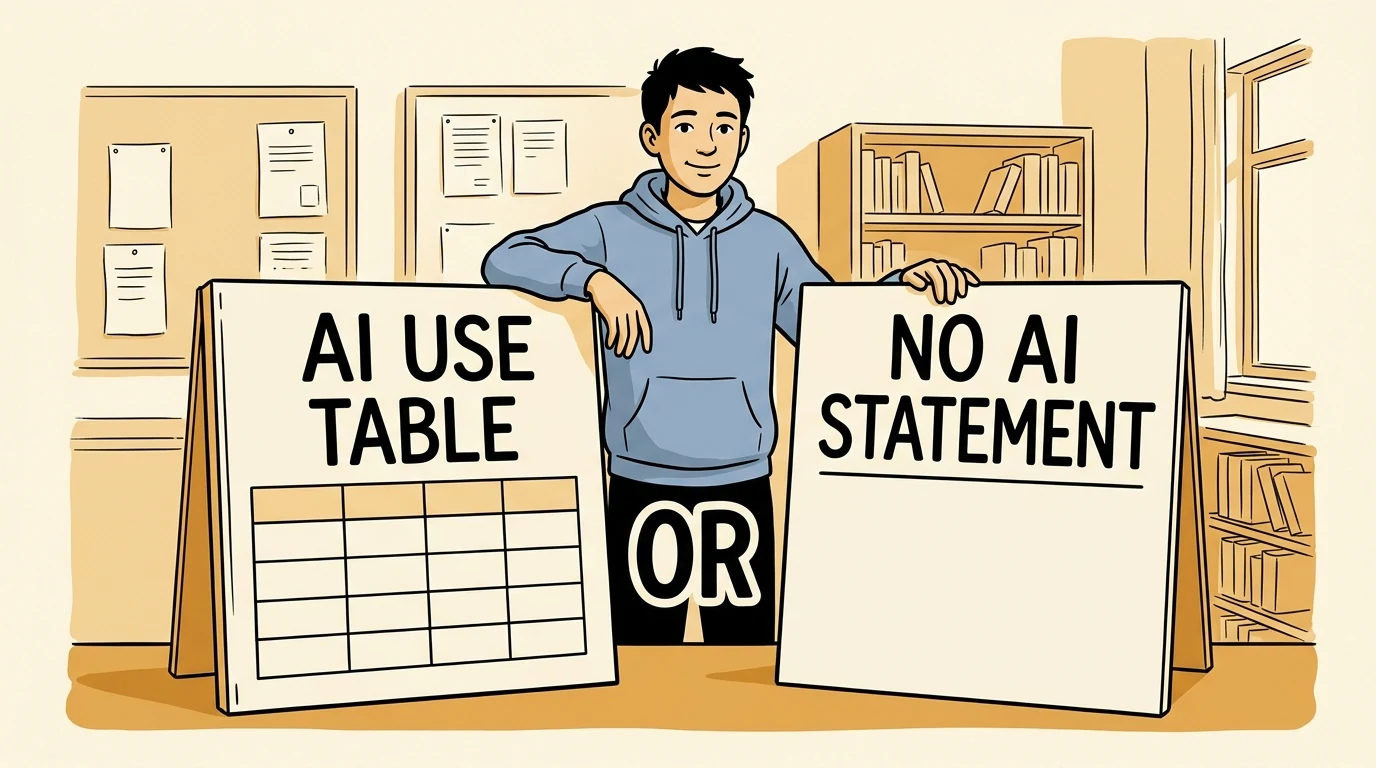
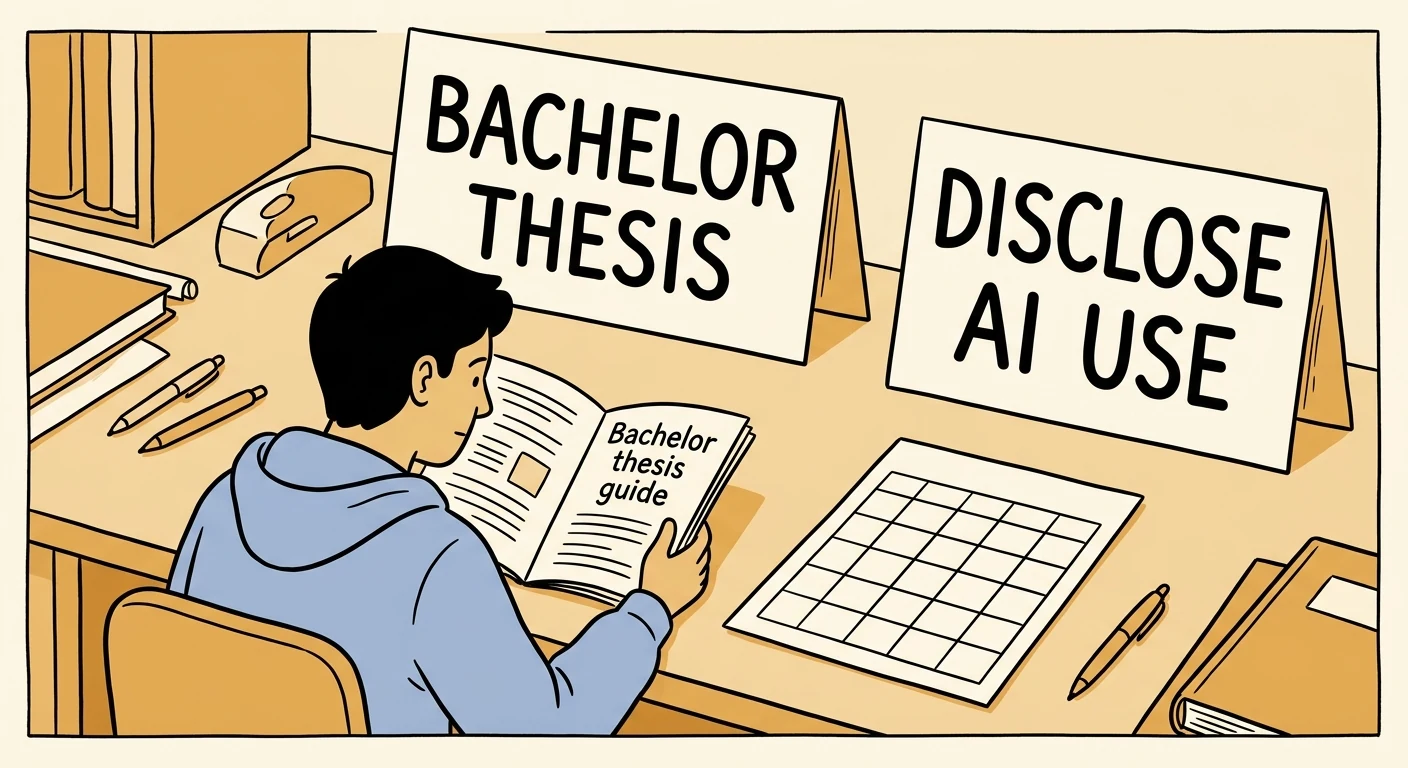
- Bachelor thesis: use the table or the no-AI statement.
- Verify outputs and consult your supervisor.
- Complete the required plagiarism check before submission.
Bolzano, Italy
Student guide · Task scope and procedure
Economics and Management Bachelor theses require an AI tools/purposes/sections table after references, or a no-AI statement if none were used. LM-63 Public Policy has its own attribution and critical-engagement wording. Supervisor advice and pre-submission Turnitin checking do not establish an AI detection score or campus-wide permission. Other MSc documents remained unavailable.
De onderstaande richtlijnen zijn in het Engels; officiële bewijsstukken behouden hun oorspronkelijke taal.
Er is nog geen volledige samenvatting van de studentenregels; bekijk de verzamelde uitspraken en bronnen.
Economics and Management Bachelor theses require an AI tools/purposes/sections table after references, or a no-AI statement if none were used. LM-63 Public Policy has its own attribution and critical-engagement wording. Supervisor advice and pre-submission Turnitin checking do not establish an AI detection score or campus-wide permission. Other MSc documents remained unavailable.
Aanvulling verzameld: 2026-10-08 · Huidige toepasselijkheid niet onafhankelijk bevestigd
Samenvatting momenteel beschikbaar in het Engels
Interpretatie van de site
The Economics and Management Bachelor thesis guidelines dated by the 21 January 2026 filename allow AI aids with a table immediately after references identifying tools, purposes and thesis sections, including basic proofreading/translation tools. If none were used, the specified no-AI statement replaces the table. This is a Bachelor-thesis rule, not general campus permission.
Reikwijdte: Economics and Management Bachelor thesis · Only the captured source, version, audience and conditions; no exhaustive currency certification.
Detectiebewijs · Ondersteuning en aanpassingen
Reikwijdte: Students in the cited programme/course/stage only · faculty_programme
§ AI and plagiarism
The use of AI tools in writing the Bachelor’s thesis is allowed but must be transparently
disclosed. Specifically, students who utilize AI tools must include a table titled “Use of Artificial
Intelligence (AI) Tools in Preparing the Thesis” immediately after the list of references. This
table should specify which AI tools were used, for what purpose, and for which sections of the
thesis.
Students are required to disclose AI tools utilized throughout their thesis work:
a) Advanced AI tools (i.e., based on “Large Language Models” or LLMs). This includes AI-driven
literature search platforms (e.g., Consensus, Elicit) used for reviewing academic sources, AI-
assisted tools for developing research questions or conducting data analysis, and generative AI
applications (e.g., ChatGPT) used in the writing process.
b) Basic AI tools that primarily assist for proofreading, grammar checks and translations, (e.g.,
DeepL, Google Translate).
If multiple tools were employed, all should be reported consistently. When uncertain about which
tools to disclose, it is advisable to err on the side of over-reporting rather than omission.
If you have not used AI tools in the sense described above, you must include the following
statement instead of the table: “I herewith declare that no AI tools were used in preparing the
thesis.”Bekijk officiële bron ↗Verzameld: 2026-10-08 · 412–430
SHA-256: 2484b81b3063cb12bec20889b1f3446077f7d51a538e67dee9836f55a86a436d
Interpretatie van de site
The LM-63 Public Policy thesis guide encourages AI with clear extent/nature attribution and critical validation, while AI must not replace the student’s analysis, interpretation or synthesis. It refers plagiarism sanctions to separate degree-exam regulations. This programme wording is kept distinct from Bachelor declaration placement and from other MSc documents that could not be acquired.
Reikwijdte: LM-63 Public Policy master thesis · Only the captured source, version, audience and conditions; no exhaustive currency certification.
Detectiebewijs · Ondersteuning en aanpassingen
Reikwijdte: Students in the cited programme/course/stage only · programme
6-PLAGIARISM AND AI
Do not copy from other sources, as sanctions will be applied in cases of plagiarism. Please refer to
the Regulation on Degree Exams for more details.
You are encouraged to use AI in writing your thesis while adhering to academic and
ethical principles including:
• Clarity of Usage and Attribution: Clearly state the extent and nature of AI tools used in
your dissertation. This includes specifying whether AI was used for data analysis, literature
review, content generation, or any other aspect of the research. Properly attribute any AI-
generated content or data according to academic citation standards.
• Originality and Critical Engagement: Ensure that your work remains original and that
you critically engage with AI-generated content. AI should not replace your own analysis,
interpretation, or synthesis of information. Acknowledge the limitations of AI tools.
Understand that AI may not always provide accurate or contextually relevant information,
and you should be prepared to interpret and validate the results.
Discuss your use of AI tools with your thesis supervisor. They can provide guidance on
acceptable practices and help ensure that your approach aligns with disciplinary
standards.Bekijk officiële bron ↗Verzameld: 2026-10-08 · 159–178
SHA-256: 4df2161467c4880e63fb62a8176c438a1b66ca8d64f42d00e057166b52a02574
Interpretatie van de site
The Bachelor thesis guide keeps students responsible for outputs and original thinking, recommends discussing uncertainty with the supervisor, and requires a Turnitin plagiarism check before final manuscript submission as part of final examination. It gives no AI detector score or automatic AI guilt threshold.
Reikwijdte: Economics and Management Bachelor thesis · Only the captured source, version, audience and conditions; no exhaustive currency certification.
Detectiebewijs · Ondersteuning en aanpassingen
Reikwijdte: Students in the cited programme/course/stage only · faculty_programme
Note that when using AI, you should be aware that the results produced may not be of the
desired quality. For example, translation or writing AI tools may use unconventional or
8
erroneous expressions, or research AI tools may have difficulty distinguishing between peer-
reviewed journal articles in reputable journals and “grey literature”. Moreover, generative AI
applications may generate entirely inaccurate statements or results (“hallucinate”). Therefore,
pay particular attention to the risk of including text that comes from other sources and which
would thereby be considered plagiarism without proper source references.
While the use of AI-based aids is permitted, it is important to recognize that they serve only as
a tool: students remain fully responsible for evaluating their outputs, determining their
appropriate application, and maintaining a high level of critical reflection throughout all stages
of your work. Your supervisor can provide valuable guidance in evaluating the appropriate and
acceptable use of AI tools.
It is highly recommended that you discuss any questions or uncertainties regarding
AI utilization with your supervisor to ensure responsible and effective integration
into your work.
Finally, the plagiarism check via Turnitin® is a mandatory part of your final examination and
needs to be done before handing in the final manuscript of the thesis. The complete procedure
is outlined in the Students’ manual here.Bekijk officiële bron ↗Verzameld: 2026-10-08 · 431–451
SHA-256: 2484b81b3063cb12bec20889b1f3446077f7d51a538e67dee9836f55a86a436d
Interpretatie van de site
The library offers Turnitin for checking the originality of one’s own text against online sources and explains intentional and unintentional plagiarism. That plagiarism-checking service does not establish AI detection, an AI probability threshold or institutional licences for generation tools.
Reikwijdte: Students in the cited programme/course/stage only · Only the captured source, version, audience and conditions; no exhaustive currency certification.
Reikwijdte: Students in the cited programme/course/stage only · university
Plagiarism
You commit plagiarism if you do not give proper credit to the text, concept, research results etc. of another author or if you use a text incorrectly e.g. if a paraphrase does not contain a reference to the source or if it changes or distorts its meaning or if a reference is incomplete or erroneous. The most common reason for committing plagiarism is that students want to obtain good results with as little effort as possible. In many cases, however, plagiarism is committed unintentionally.
Plagiarism Checkup
With Turnitin® The Library offers a useful tool for checking the originality of one’s own texts by comparing them to a variety of online sources.
Contact us for free access
Plagiarism - Glossary
Little glossary of plagiarism
Unintentional plagiarism
This occurs when writers have little knowledge about dealing with sources and bibliographic data or when they are unable to detect the source’s origin, especially when using Internet sources.
Intentional plagiarism
This is defined theft of someone else’s intellectual property, also called intellectual theft. There are various types of intentional plagiarism. These are two of the most common types: a text is created by mixing (copy/paste) passages from two or more sources, thus making it impossible to identify their origin or the writer does not clearly indicate where a direct quotation starts or ends.Bekijk officiële bron ↗Verzameld: 2026-10-08 · 195–205
SHA-256: fc6dbeac04984cf0337ea9d2bec3531c834acd259923fdef879e7467cde4aa28
Gepubliceerde brongebaseerde aanvullingen. Engelse samenvattingen en oorspronkelijke citaten staan los van het beoordeelde dossier. Mogelijke procedures en uitkomsten zijn geen automatische straffen voor AI. De huidige toepasselijkheid is niet onafhankelijk bevestigd; controleer de bronreikwijdte en versie.
Vergeleken met opgeslagen tekst; geen officiële vertaling
Hashes maken vergelijking van opgeslagen teksten mogelijk; ze bevestigen geen actuele geldigheid of onveranderlijkheid. De onderwerpen vormen geen verplichte volgorde.
Toegang is geen toestemming voor gebruik bij een beoordeling. Controleer opdrachtregels, toegelaten gebruikers en databeperkingen.
Gearchiveerd record; raadpleeg de officiële bron voor actuele toegang. Toegangsgegevens en citaten blijven in de oorspronkelijke taal.
Oorspronkelijk citaat
The MSc Accounting and Finance master thesis guidelines allow AI tools in writing a master's thesis but require disclosure of advanced AI tools used, while stating that basic proofreading, grammar-checking, and translation tools do not need to be reported.Oorspronkelijk citaat
The use of AI tools in writing the Master’s thesis is allowed but must be transparently disclosed.Oorspronkelijk citaat
Specifically, students who utilize AI tools must include a table titled “Use of Artificial Intelligence (AI) Tools in Preparing the Thesis” immediately after the list of references.Oorspronkelijk citaat
The Faculty of Economics and Management bachelor thesis guidelines allow AI tools in writing a bachelor's thesis, but require students who use them to disclose the tools, purposes, and thesis sections in a table after the references.Oorspronkelijk citaat
The use of AI tools in writing the Bachelor’s thesis is allowed but must be transparently disclosed.Oorspronkelijk citaat
Specifically, students who utilize AI tools must include a table titled “Use of Artificial Intelligence (AI) Tools in Preparing the Thesis” immediately after the list of references.Reviewed record
Beoordeelde uitspraken: 5
Academic Integrity
Genormaliseerde waarde: student_responsibility_and_turnitin_for_msc_accounting_finance_thesis
Oorspronkelijk bewijs
Bewijs 1Moreover, generative AI applications may generate entirely inaccurate statements or results (“hallucinate”). Therefore, pay particular attention to the risk of including text that comes from other sources... The plagiarism check via Turnitin® is a mandatory part of your final examination.
Academic Integrity
Genormaliseerde waarde: student_responsibility_and_turnitin_for_faculty_bachelor_thesis
Oorspronkelijk bewijs
Bewijs 1While the use of AI-based aids is permitted, it is important to recognize that they serve only as a tool: students remain fully responsible for evaluating their outputs... Finally, the plagiarism check via Turnitin® is a mandatory part of your final examination.
Academic Integrity
Genormaliseerde waarde: plagiarism_definition_and_turnitin_originality_check
Oorspronkelijk bewijs
Bewijs 1You commit plagiarism if you do not give proper credit to the text, concept, research results etc. of another author or if you use a text incorrectly... With Turnitin® The Library offers a useful tool for checking the originality of one’s own texts.
Ai Tool Treatment
Genormaliseerde waarde: allowed_with_advanced_ai_disclosure_for_msc_accounting_finance_thesis
Oorspronkelijk bewijs
Bewijs 1The use of AI tools in writing the Master’s thesis is allowed but must be transparently disclosed. Specifically, students who utilize AI tools must include a table titled “Use of Artificial Intelligence (AI) Tools in Preparing the Thesis” immediately after the list of references.
Ai Tool Treatment
Genormaliseerde waarde: allowed_with_disclosure_for_faculty_bachelor_thesis
Oorspronkelijk bewijs
Bewijs 1The use of AI tools in writing the Bachelor’s thesis is allowed but must be transparently disclosed. Specifically, students who utilize AI tools must include a table titled “Use of Artificial Intelligence (AI) Tools in Preparing the Thesis” immediately after the list of references.
Source record
Bronnen: 3
unibz.it
guide.unibz.it
guide.unibz.it
Citation: University AI Policy Tracker. "Free University of Bozen-Bolzano AI Policy Tracker record." Last checked May 17, 2026. https://eduaipolicy.org/universities/free-university-of-bozen-bolzano
Original university source language remains canonical. This tracker is not an official university statement.
Wijzigingslogboek openenSaved from University AI Policy Tracker. This record summarizes the cited sources; it is not an official university statement or assessment permission. Source and review dates are listed above. Hashes identify retained content, not authorization.