Qué hacer
- Check the tier and stricter local instructions.
- Declare permitted use under the brief.
- Use the correct appeal stage and lateness evidence.

Liverpool, United Kingdom
Student guide · Task scope and procedure
August 2026 AI tiers distinguish invigilated defaults, local restrictions and support plans. Appendix L/F processes and staff Copilot trials have separate scope and unresolved version labels.
La guía siguiente está en inglés; las pruebas oficiales conservan su idioma original.
Aún no hay un resumen completo de las normas para estudiantes; consulta las afirmaciones y fuentes recopiladas.
August 2026 AI tiers distinguish invigilated defaults, local restrictions and support plans. Appendix L/F processes and staff Copilot trials have separate scope and unresolved version labels.

Complemento recopilado: 2026-10-08 · Aplicabilidad actual no confirmada de forma independiente
Resumen disponible actualmente en inglés
Interpretación del sitio
The August 2026 v1.1 policy sets an institutional baseline; approved programme, department and professional requirements may be stricter. Where an assessment tier is not stated, Tier 2 is the default except invigilated exams, which default to Tier 1. Students must follow the actual assessment requirements; going beyond them would normally constitute misconduct.
Ámbito: Students and staff in learning, teaching and assessment · Only the captured source, version, audience and conditions; no exhaustive currency certification.
Ámbito: Students and staff in learning, teaching and assessment · university
Purpose
This policy sets out the University of Liverpool’s requirements for the use of generative artificial intelligence (GenAI) in learning, teaching and assessment.
It establishes a clear institutional baseline for responsible use, transparency, academic integrity, accessibility, data protection, copyright and governance, while supporting AI literacy and assessment design that prepares students for further study, work and global citizenship in an AI enabled world.
Scope
This policy applies to all students and staff engaged in learning, teaching, and assessment.
It should be read alongside the Code of Practice on Assessment (including the Academic Integrity Policy), the University’s data protection and accessibility requirements, and any approved programme, School, Department or Professional, Statutory and Regulatory Body requirements that are more restrictive.
The appropriate use of GenAI varies by discipline and professional context. Schools, Departments, programme teams and relevant PSRBs may set more restrictive expectations than this institutional baseline, and where such requirements exist, they must be followed.
Medical, clinical and other professionally regulated programmes may have additional obligations, including Fitness to Practice, patient safety and PSRB requirements. In these contexts, programme teams must ensure that generative AI use and tier decisions remain consistent with those obligations.
Principles
Generative artificial intelligence (GenAI) must not replace a student’s own thinking or work or be used in ways that misrepresent what the student can do.
Use of GenAI must be lawful, ethical, inclusive, and proportionate. Students must understand that GenAI outputs may be inaccurate, biased, incomplete, or misleading, and must always exercise critical judgement.
The University will support students and staff to develop GenAI literacy so that GenAI can be used critically, effectively, ethically, and transparently in academic work and professional practice, including the ability to select appropriate tools and agents for specific learning, teaching, assessment, and professional tasks.
Students must declare or acknowledge use where required by the assessment, local guidance or University requirements.
Assessment requirements
All assessments must state clearly whether, and to what extent, generative artificial intelligence (GenAI) may be used.
When setting these requirements, staff will use the University’s approved tiered framework for GenAI permissions in assessment (Table 1: 4.7).
Where the applicable GenAI tier is not explicitly stated for an assessment, the default permission will be Tier 2, except for invigilated exams, which will default to Tier 1, in line with the approved framework.
For each assessment, Canvas (or an equivalent alternative where Canvas is not used) will clearly state the applicable permissions-framework tier and any associated permissions or restrictions, so students understand what is permitted, restricted, or prohibited
Students must satisfy the requirements set for each assessment. Use of GenAI beyond the stated requirements would normally constitute academic misconduct. Ver fuente oficial ↗Recopilado: 2026-10-08 · 33–52
SHA-256: d7e13a6397e57b238694d4a03cbb6ad75002047a3310ac72d031c4565bcd004c
Interpretación del sitio
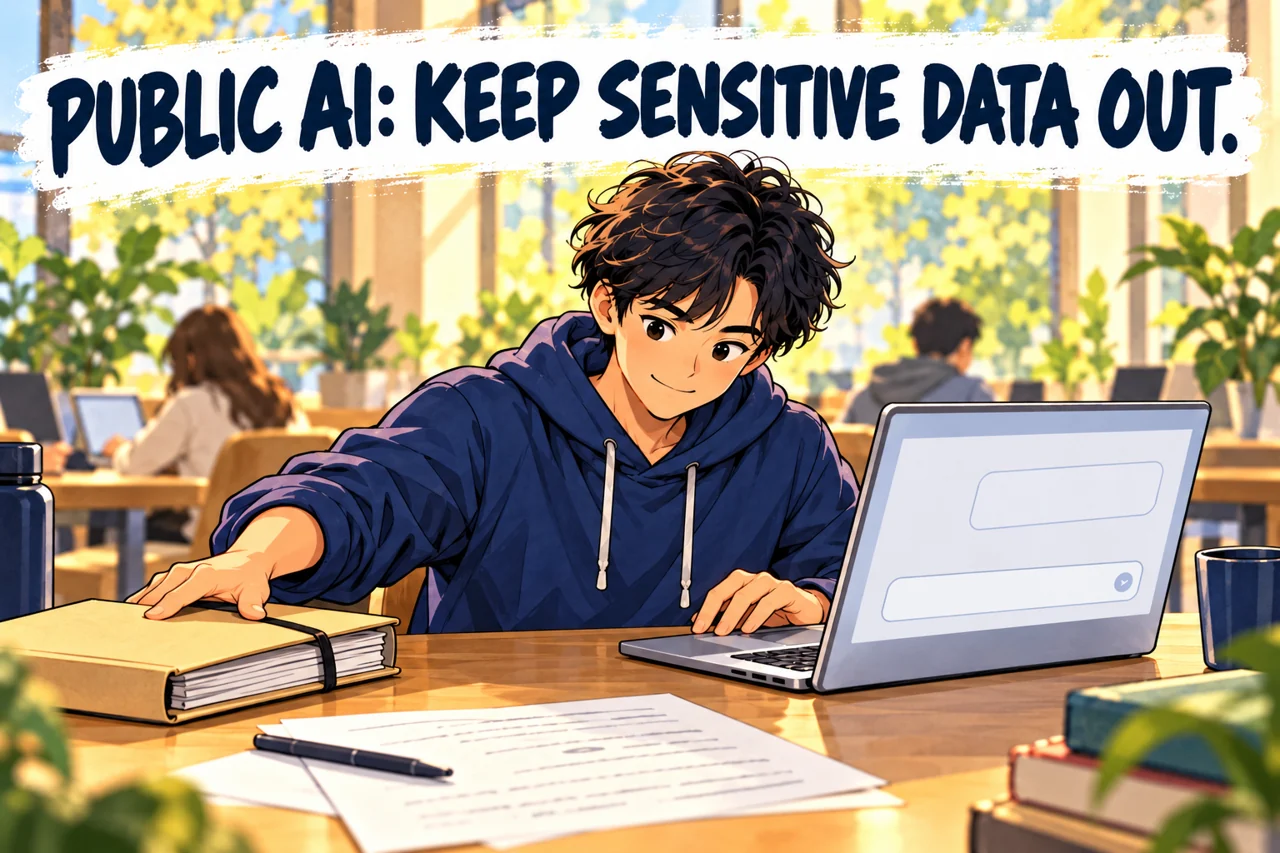
Personal, sensitive, confidential, unpublished or restricted information must not enter public/consumer AI. University-data activity must use approved environments with University credentials; approval does not waive copyright, licence or professional obligations. Research and thesis activity also follows research-integrity and ethics guidance.
Ámbito: Students and staff handling University-related information · Only the captured source, version, audience and conditions; no exhaustive currency certification.
Ámbito: Students and staff handling University-related information · university
Data protection and confidentiality
Any use of generative AI must comply with UK General Data Protection Regulation (GDPR) and the University’s data protection requirements. Personal, sensitive, confidential, unpublished or otherwise restricted information must not be entered into public or consumer AI tools.
Where proposed use involves University data, personal data or system integration, students must follow the University’s approved security, procurement and data protection processes, including completion of a Data Protection Impact Assessment where required.
Research and thesis activity must also comply with the University’s research integrity, ethics and generative artificial intelligence-in-research guidance, including requirements on research data governance.
Copyright and intellectual property
Materials that are copyrighted, licensed, unpublished, or otherwise protected must not be uploaded to generative AI tools without appropriate permission, licence, or other lawful basis. This includes teaching materials, student work, unpublished research outputs, and subscription content.
Use of University-approved systems does not remove the requirement to comply with copyright, licensing, contractual or professional obligations.
Accessibility and inclusive practice
The University will take an inclusive approach to learning, teaching and assessment and will make reasonable adjustments where required for students with a disability, in line with institutional policy and the Equality Act 2010.
Some students with a disability may use assistive technologies, including tools with AI-enabled functions, as part of approved reasonable adjustments.
The use of AI-enabled assistive technologies must remain consistent with assessment conditions, including the applicable GenAI tier, and with the University’s academic integrity requirements.
In designing teaching and assessment, unnecessary barriers should be reduced through inclusive design, clear expectations, and proportionate support.
Use of University approved AI tools’
For any University-related activity that involves University data, only University-approved AI environments must be used, and they must be accessed via University credentials with the appropriate institutional protections enabled.
AI-enabled tools must not be procured, adopted or integrated for University purposes outside approved University processes.Ver fuente oficial ↗Recopilado: 2026-10-08 · 81–98
SHA-256: d7e13a6397e57b238694d4a03cbb6ad75002047a3310ac72d031c4565bcd004c
Interpretación del sitio
Appendix L classifies assessment output produced with GenAI contrary to the stated guidance as dishonest use. Its footnote says citation does not cure a use that an assignment forbids. The captured file says 2026–27 in its heading while its approval footer says September 2025 for AY 2025–26; these labels are retained rather than certifying a reconciled version.
Ámbito: Taught assessment under Appendix L; invigilated assessment and research have separate scope · Only the captured source, version, audience and conditions; no exhaustive currency certification.
Ámbito: Taught assessment under Appendix L; invigilated assessment and research have separate scope · university
3.5 Submission of Assessment Tasks Generated by Artificial Intelligence
This dishonest practice occurs when a student presents assessment tasks (or
parts thereof) that have been generated or completed by Generative Artificial
Intelligence (GAI) software contrary to the guidance on using GAI: 1
Each assignment brief should state whether the use of GAI is in line with the
1
generic University position and where it is not, provide specific requirements of
that assignment. If the use of GAI is not permitted within an assignment but the
student uses it to produce work and then cites it, this is a case of acknowledged
by unacceptable use as per 5.3.Ver fuente oficial ↗Recopilado: 2026-10-08 · 169–184
SHA-256: f65c8936eff992f9eb6d92a6f783a5f6d8539175d64d1c86c13b0624e530d361
Approved by Senate chair’s action September 2025; for AY 2025-26
CODE OF PRACTICE ON ASSESSMENT – APPENDIX L Academic Integrity Policy 2026-
27Ver fuente oficial ↗Recopilado: 2026-10-08 · 188–191
SHA-256: f65c8936eff992f9eb6d92a6f783a5f6d8539175d64d1c86c13b0624e530d361
Interpretación del sitio
Tier 1 prohibits GenAI including basic grammar tools, except an approved support plan. Its row says approved assistive technology need not be declared by the student. Tier 2 is restricted contextual assistance; Tier 3 is a scaffold for specified stages; Tier 4 makes AI integral. Records, reflection and disclosure depend on the tier and brief, not one universal full-log rule.
Ámbito: Students governed by the assessment tier and approved support plan · Only the captured source, version, audience and conditions; no exhaustive currency certification.
Ámbito: Students governed by the assessment tier and approved support plan · university
1
Prohibited: No AI use
No GenAI use (including basic tools such as grammar checkers), unless required under an approved student support plan. Enforced via supervision or controlled conditions. Aims to test unaided skills and knowledge.
Must declare GenAI use in line with local guidance and the assessment brief. A record of approved adjustments for students with a support plan will be available to staff, and students will not need to declare the use of assistive technology.
2
Contextual support: Limited / Assistive use
GenAI is permitted in restricted and specified ways (e.g. for planning, editing, or support tasks only). GenAI is not central to demonstrating core learning outcomes; it is a tool to aid learning.
Must declare GenAI use in line with local guidance and the assessment brief.
3
Structural scaffold: exploratory/ critical use
In addition to Tier 2, GenAI use is broadly allowed and encouraged for specific stages or tasks. Students actively engage with AI (for example, generate, critique, iterate, refine) to build AI literacy without making AI the primary producer.
Assessment guidance to include what evidence is required, e.g. could include a record of key AI interactions (such as a summary account of how AI was used, prompts, outputs, edits); critically evaluate AI contributions and cite or attribute use where appropriate.
4
Integrated: Integral / Embedded use
In addition to Tiers 2 and 3, GenAI is a required or core element of the assessment. AI use is expected to achieve the learning outcomes with a focus on responsible, effective and ethical application.
Assessment guidance to include what evidence is required, e.g. could include full transparency (for example, documenting process and prompts); reflect on ethical implications, biases, and accuracy; and demonstrate how human input adds value. Ver fuente oficial ↗Recopilado: 2026-10-08 · 60–76
SHA-256: d7e13a6397e57b238694d4a03cbb6ad75002047a3310ac72d031c4565bcd004c
Interpretación del sitio
The AIO has up to ten working days from being informed of an allegation to notify the student. The student has five working days to respond, with no explicit starting event in that sentence; non-engagement does not stop investigation. Meeting notice is normally at least three working days, with one non-involved friend and Guild advice/wellbeing support. These are separate notice and response stages, not appeal periods.
Institución · Obligatorio en este procedimiento
Dentro del plazo indicado. Compruebe el inicio, el ámbito y las excepciones en el resumen y el original.
Estudiante · Obligatorio en este procedimiento
Dentro del plazo indicado · Inicio del plazo no especificado. Compruebe el inicio, el ámbito y las excepciones en el resumen y el original.
Ámbito: Students and AIO in the cited investigation · Only the captured source, version, audience and conditions; no exhaustive currency certification.
Ámbito: Students and AIO in the cited investigation · university
4.7 When the Academic Integrity Officer is informed of an allegation, they will
commence their investigation and will have up to 10 working days from this point
to notify the student(s) of the investigation, including details of the alleged
offence. The notification will include an invitation to the student(s) to contribute to
the investigation by providing a written explanation of the circumstances
surrounding the allegation and any representations they wish to make. The
student will have 5 working days to respond. If a student chooses not to engage
with the investigation, the investigation will proceed and a decision will be made
based on the evidence available.
4.8 The Academic Integrity Officer may hold a meeting with the student(s). The
student(s) should be given sufficient notice of any meeting, normally a minimum
of three working days. The student(s) is entitled to be accompanied at any
meeting by one other person (not party to the matters under investigation) acting
as their friend. The Guild of Students Advice Centre (Liverpool Guild) has trained
advisors who can provide this support and students are encouraged to use them.
The student will also be provided with contact details of the University’s Advice
and Guidance Team so they know how to access wellbeing support should they
feel they need it.Ver fuente oficial ↗Recopilado: 2026-10-08 · 350–368
SHA-256: f65c8936eff992f9eb6d92a6f783a5f6d8539175d64d1c86c13b0624e530d361
Interpretación del sitio
The Copilot page distinguishes a staff paid M365 proof-of-concept trial running April–November 2026 from free standalone Copilot Chat, with an explicit staff access instruction. It does not establish a student integrated licence or permission to use AI in an assessment. No account was tested.
Ámbito: University staff in the named Copilot trials and access instructions · Only the captured source, version, audience and conditions; no exhaustive currency certification.
Ámbito: University staff in the named Copilot trials and access instructions · university
Our M365 Copilot Proof of Concept trials
As part of the Liverpool 2031 vision and our wider digital transformation programme, the University has been working with Microsoft to explore how Copilot could add value for staff and academic activity.
First PoC (October 2025 – January 2026)
Our initial PoC involved colleagues from Education, Professional Services and Research. Participants were given paid Copilot licences for three months to test how the tool could support productivity, simplify workflows and enhance academic work.
Second PoC (April 2026 – November 2026)
Building on what we learned, a second, extended M365 Copilot PoC is now underway. This trial continues our exploration of Copilot, taking forward insights from the first PoC and testing the tool in more depth and across a more targeted range of use cases.
Feedback from this phase will help shape future decisions about AI tools, guidance and targeted pilots across the University.
To find out more about the M365 Copilot PoC trials, please contact copilot@liverpool.ac.uk.
Did you know?
You don’t need a full paid licence to start using Copilot today. Copilot Chat is available for free and can be used to ask questions, explore ideas, draft content documents, summarise text, get support with planning, brainstorming or quick research tasks.
While Copilot Chat doesn’t connect to institutional data in the same way the full M365 version does, it still offers powerful support for standalone tasks.
All University of Liverpool staff can access Copilot Chat via the icon at the top right of Microsoft Edge on your MWS device and more information can be found via our FAQ and Resource links below.Ver fuente oficial ↗Recopilado: 2026-10-08 · 478–489
SHA-256: 31909ee5b4126b4c0e7eb4d8c5b530230daaf61631ad93b0403b68de584d7cdb
Interpretación del sitio
Category 2–4 decisions may be appealed for procedural error in the investigation, under Appendix F. Its Stage One deadline is ten UK working days from formal release of results/decision; Stage Two is ten UK working days from the date of the written Stage One response. Exceptional lateness requires independent evidence and discretion; successful late acceptance is not guaranteed.
Estudiante · Obligatorio en este procedimiento
Dentro del plazo indicado. Compruebe el inicio, el ámbito y las excepciones en el resumen y el original.
Estudiante · Obligatorio en este procedimiento
Dentro del plazo indicado. Compruebe el inicio, el ámbito y las excepciones en el resumen y el original.
Ámbito: Undergraduate/taught postgraduate students in the Appendix L/F route · Only the captured source, version, audience and conditions; no exhaustive currency certification.
Ámbito: Undergraduate/taught postgraduate students in the Appendix L/F route · university
6. Right of Appeal
6.1 Students may appeal against the decision of the Board of Examiners in relation
to a Category 2, 3 or 4 decision but only on the grounds that there was a
procedural error in determining a decision in the conduct of the investigation into
the alleged offence. Students may not appeal against the decision of the Board of
Examiners other than in accordance with the Code of Practice on Assessment,
Appendix F, Assessment Appeals Procedure.Ver fuente oficial ↗Recopilado: 2026-10-08 · 693–699
SHA-256: f65c8936eff992f9eb6d92a6f783a5f6d8539175d64d1c86c13b0624e530d361
5. Time Frames
5.1. There are time frames for submitting an Assessment Appeal at each stage of
the process.
5.2. The University reserves the right to not consider appeals if they are submitted
outside of the specified time limits. Discretion to accept late appeals will only be
given where there are exceptional reasons for late submission, supported by
independent evidence. It is the responsibility of the student to provide with their
appeal submission their reasons for lateness and to provide evidence to support
these reasons. Those considering the appeal may seek advice where appropriate
from other departments and services.
5.3. The deadline for submitting the Stage One Assessment Appeal form is within
10 UK working days of the formal release of the relevant results or decision.Ver fuente oficial ↗Recopilado: 2026-10-08 · 211–224
SHA-256: f407aad811bb8dc9e7338f59b3ef4e329e442d19d80815426367bcfd770c5070
14. Stage Two Assessment Appeal
14.1. Students have a right to request a review of the Stage One decision and
findings via Stage Two of the procedures. Stage Two Appeals should be submitted
within 10 UK working days of the date of the written Stage One response.Ver fuente oficial ↗Recopilado: 2026-10-08 · 642–646
SHA-256: f407aad811bb8dc9e7338f59b3ef4e329e442d19d80815426367bcfd770c5070
Complementos publicados basados en fuentes. Los resúmenes en inglés y las citas originales se separan del registro revisado. Los procesos y resultados posibles no son sanciones automáticas por usar IA. La aplicabilidad actual no se ha confirmado de forma independiente; compruebe el ámbito y la versión de la fuente.
Comparado con el original guardado; traducción no oficial
Los hashes permiten comparar textos guardados; no certifican vigencia ni inmutabilidad. Los temas no forman una secuencia obligatoria.
El acceso no autoriza su uso en una evaluación. Comprueba las reglas de la tarea, los usuarios elegibles y las restricciones de datos.
Registro archivado; consulta la fuente oficial para el acceso actual. Los detalles de acceso y las citas conservan su idioma original.
Cita original
Copilot is provided through the University's Microsoft 365 environment, with data governance and safeguards aligned to our institutional requirements.Liverpool is running a proof-of-concept for paid Microsoft 365 Copilot licences.
Participate in the university proof-of-concept selection process.
Paid licences are issued to selected proof-of-concept participants.
Cita original
The initial proof of concept involved colleagues who were given paid Copilot licences for three months. The current extended proof of concept is testing the tool with a targeted range of use cases.Cita original
For University work, Liverpool says staff and students should use Microsoft Copilot as the endorsed generative AI chat tool, provided through the University's Microsoft 365 environment with data governance and safeguards aligned to institutional requirements.Cita original
For University work, staff and students should use Microsoft Copilot – the endorsed generative AI chat tool.Liverpool identifies Copilot as its endorsed generative AI chat tool for university work.
Use Copilot Chat through Edge or Microsoft 365 with a university account.
No cost stated for Copilot Chat.
Cita original
For University work, staff and students should use Microsoft Copilot – the endorsed generative AI chat tool. All University of Liverpool staff can access Copilot Chat.Source describes staff Copilot Chat and a paid M365 proof-of-concept, April–November2026. This does not establish student integrated access or task permission.
Staff access Chat through Edge on MWS; contact the listed Copilot team about the limited M365 trial. No account test.
Chat described as free; integrated licences belong to the trial, not a student entitlement.
Fecha de revisión del complemento:
Cita original
Our M365 Copilot Proof of Concept trials
As part of the Liverpool 2031 vision and our wider digital transformation programme, the University has been working with Microsoft to explore how Copilot could add value for staff and academic activity.
First PoC (October 2025 – January 2026)
Our initial PoC involved colleagues from Education, Professional Services and Research. Participants were given paid Copilot licences for three months to test how the tool could support productivity, simplify workflows and enhance academic work.
Second PoC (April 2026 – November 2026)
Building on what we learned, a second, extended M365 Copilot PoC is now underway. This trial continues our exploration of Cita original
Copilot, taking forward insights from the first PoC and testing the tool in more depth and across a more targeted range of use cases.
Feedback from this phase will help shape future decisions about AI tools, guidance and targeted pilots across the University.
To find out more about the M365 Copilot PoC trials, please contact copilot@liverpool.ac.uk.
Did you know?
You don’t need a full paid licence to start using Copilot today. Copilot Chat is available for free and can be used to ask questions, explore ideas, draft content documents, summarise text, get support with planning, brainstorming or quick research tasks.
While Copilot Chat doesn’t connect to institutional data in the same way the Cita original
full M365 version does, it still offers powerful support for standalone tasks.
All University of Liverpool staff can access Copilot Chat via the icon at the top right of Microsoft Edge on your MWS device and more information can be found via our FAQ and Resource links below.Reviewed record
Afirmaciones revisadas: 9
Academic Integrity
Valor normalizado: unacceptable_genai_education_uses_listed
Evidencia original
Evidencia 1Unacceptable uses of generative AI in education include copying and pasting AI-generated content directly into assessment briefs, marking rubrics, or feedback without review; using AI to generate grades or make final assessment decisions; uploading student work, personal data, or confidential information to public AI platforms without first completing a Data Protection Impact Assessment.
Enseñanza
Valor normalizado: central_lta_guidance_for_academics_and_students
Evidencia original
Evidencia 1The University of Liverpool has devised guidance to help both academics and students understand the University’s position on GenAI in teaching, learning and assessment, and to make informed decisions on when and how to use it.
Privacidad
Valor normalizado: genai_personal_data_gdpr_safeguards_required
Evidencia original
Evidencia 1Any use of generative AI must be compliant with UK General Data Protection Regulations (GDPR). No personal information should be uploaded or shared with any AI tool unless it is necessary, and appropriate safeguarding and protection measures are in place.
Investigación
Valor normalizado: responsible_research_use_transparency_accountability
Evidencia original
Evidencia 1The University expects all researchers and professional services colleagues to apply critical judgement, maintain transparency, and prioritise integrity at all times. Users remain fully accountable for all research outputs, submissions, analyses, and assessment materials - regardless of whether AI tools were used in their preparation.
Ai Tool Treatment
Valor normalizado: {"tool":"microsoft_copilot","rawToolName":"Microsoft Copilot Chat","description":"Liverpool identifies Copilot as its endorsed generative AI chat tool for university work.","howToObtain":"Use Copilot Chat through Edge or Microsoft 365 with a university account.","costToUser":"No cost stated for Copilot Chat.","availability":"allowed","endorsementType":"officially_endorsed"}
Evidencia original
Evidencia 1For University work, staff and students should use Microsoft Copilot – the endorsed generative AI chat tool. All University of Liverpool staff can access Copilot Chat.
Vista localizada only
For University work, staff and students should use Microsoft Copilot – the endorsed generative AI chat tool. All University of Liverpool staff can access Copilot Chat.
Ai Tool Treatment
Valor normalizado: {"tool":"microsoft_copilot_for_m365","rawToolName":"Microsoft 365 Copilot","description":"Liverpool is running a proof-of-concept for paid Microsoft 365 Copilot licences.","howToObtain":"Participate in the university proof-of-concept selection process.","costToUser":"Paid licences are issued to selected proof-of-concept participants.","availability":"conditionally_allowed","endorsementType":"institutionally_licensed_or_procured"}
Evidencia original
Evidencia 1The initial proof of concept involved colleagues who were given paid Copilot licences for three months. The current extended proof of concept is testing the tool with a targeted range of use cases.
Vista localizada only
The initial proof of concept involved colleagues who were given paid Copilot licences for three months. The current extended proof of concept is testing the tool with a targeted range of use cases.
Ai Tool Treatment
Valor normalizado: microsoft_copilot_endorsed_genai_chat_tool
Evidencia original
Evidencia 1For University work, staff and students should use Microsoft Copilot – the endorsed generative AI chat tool. Copilot is provided through the University's Microsoft 365 environment, with data governance and safeguards aligned to our institutional requirements.
Source Status
Valor normalizado: central_ai_guidance_hub
Evidencia original
Evidencia 1On this page, we have collated our University guidance on generative AI including golden rules, legal, security and data protection, as well as existing guidance on using AI in learning, teaching and assessment, and finally, guidance on generative AI for research.
Otro
Valor normalizado: golden_rules_support_attribution_data_accuracy
Evidencia original
Evidencia 1Use AI to support your work, but do not copy-paste outputs into assessed work, research submissions, or official documents without review and attribution. Where required, acknowledge AI use in your work. Include the tool name, version, and date of use for transparency.
Source record
Fuentes: 8
liverpool.ac.uk
liverpool.ac.uk
liverpool.ac.uk
liverpool.ac.uk
liverpool.ac.uk
liverpool.ac.uk
liverpool.ac.uk
liverpool.ac.uk
Citation: University AI Policy Tracker. "University of Liverpool AI Policy Tracker record." Last checked July 19, 2026. https://eduaipolicy.org/universities/university-of-liverpool
Original university source language remains canonical. This tracker is not an official university statement.
Abrir registro de cambiosSaved from University AI Policy Tracker. This record summarizes the cited sources; it is not an official university statement or assessment permission. Source and review dates are listed above. Hashes identify retained content, not authorization.