Wel doen
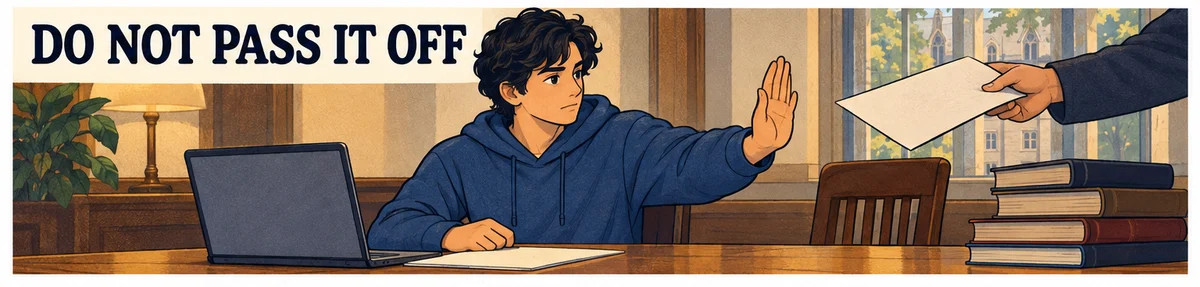
- Check whether the task requires generation or permits rewriting.
- Keep approved Studiosity wording within its source scope.
- Match the appeal to its original decision and recipient.

Hamilton, New Zealand
Student guide · Task scope and procedure
Generating and rewriting answers have different required/permitted exceptions; the approved Studiosity wording is narrow. Turnitin detection and two separate fourteen-day appeal routes do not supply blanket permission or a verdict.
De onderstaande richtlijnen zijn in het Engels; officiële bewijsstukken behouden hun oorspronkelijke taal.
Er is nog geen volledige samenvatting van de studentenregels; bekijk de verzamelde uitspraken en bronnen.
Generating and rewriting answers have different required/permitted exceptions; the approved Studiosity wording is narrow. Turnitin detection and two separate fourteen-day appeal routes do not supply blanket permission or a verdict.
Aanvulling verzameld: 2026-10-08 · Huidige toepasselijkheid niet onafhankelijk bevestigd
Samenvatting momenteel beschikbaar in het Engels
Interpretatie van de site
The paper-outline guidance distinguishes generating assignment/test answers as one’s own (exception when the task specifically requires that tool) from rewriting them (exception when instructions explicitly permit). Both clauses exclude approved Studiosity from that wording. The exceptions do not authorize any other AI tool for every task or waive originality and paper instructions.
Reikwijdte: Students following the specific paper/assessment outline · Only the captured source, version, audience and conditions; no exhaustive currency certification.
Detectiebewijs · Ondersteuning en aanpassingen
Reikwijdte: Students following the specific paper/assessment outline · university
Generation: task specifically requires tool; rewriting: instructions explicitly permit; approved Studiosity excluded from both clauses.
Generative AI and Education: University of Waikato’s position
Most people are aware of the ongoing discussions around the use of Generative AI in education (GenAI). This page outlines the University of Waikato’s current stance and provides links to guidance we’ve developed to support students and staff.
In the Paper Outline Tool, accessible via Moodle and available to all learners, the following guidance explains what is permitted. However, if you're unsure, always check with your paper convener or lecturer.
Cheating at the University includes, but is not limited to:
Using an AI tool (e.g., ChatGPT) to generate your assignment or test answers and submitting them as your own, unless the assignment specifically requires the use of such a tool (does not apply to Studiosity, which is an approved AI tool).
Using an AI tool (e.g., ChatGPT) to rewrite your assignment or test answers and submitting them as your own, unless explicitly permitted in the assignment instructions (does not apply to Studiosity, which is an approved AI tool).
If you're interested in learning more about how AI can be used responsibly in your studies, refer to the library guide: How To Use GenAI/ChatGPT Responsibly: A Guide to Generative AI and Best Practices (opens in a new tab).
If you are unsure what constitutes academic misconduct, or plagiarism, enrol yourself into the new Academic Integrity Course in Moodle (opens in a new tab) and work through the tasks in your own time.
This module will highlight common types of academic misconduct including the risks associated with GenAI and guide you on how to avoid getting into trouble.Bekijk officiële bron ↗Verzameld: 2026-10-08 · 320–328
SHA-256: bcc39740ef908d42b74aa1cce74c01fc3a6768ec2818e8250204f5a6e1df3c95
Interpretatie van de site
An Academic Integrity Representative decision may be appealed to the AIP Chair in writing with the prescribed fee within fourteen days after formal notification; grounds and adviser/support opportunities are stated. The Chair decision on that appeal is final. Day type is not defined in this quoted section, and this is not a universal further-appeal right.
Student · Verplicht bij deze procedure
Binnen de vermelde termijn. Controleer startpunt, reikwijdte en uitzonderingen in de samenvatting en oorspronkelijke tekst.
Reikwijdte: Students appealing an Academic Integrity Representative decision · Only the captured source, version, audience and conditions; no exhaustive currency certification.
Reikwijdte: Students appealing an Academic Integrity Representative decision · university
Provision for appeal to the Chairperson of the Academic Integrity Panel
Any party to a complaint of student misconduct (the complainant or the student who was the subject of the complaint) may appeal to the Chairperson of the Academic Integrity Panel against any decision taken by an Academic Integrity Representative or Associate Academic Integrity Representative under section 16 of these regulations
An appeal must be addressed and submitted in writing to the Chairperson of the Academic Integrity Panel, together with the prescribed fee.
An appeal must be received by the Chairperson of the Academic Integrity Panel not more than 14 days after the date on which the relevant decision was formally notified, and must include details of the grounds for the appeal.
An appeal may be made only on one or more of the following grounds:
that the process used for addressing the alleged misconduct was unfair
that the decision reached was manifestly at odds with the evidence
that the remedy imposed was manifestly at odds with the misconduct
that significant new evidence has become available that could not reasonably have been obtained and presented during the initial process and that could have a material effect on the outcome.
The Chairperson of the Academic Integrity Panel must hear the appeal as expeditiously as possible.
The appellant and the authority that made the original discipline decision
must be given the opportunity to appear and give evidence at the appeal hearing
may be accompanied by another person to act as an adviser or support person, subject to any conditions that the Chairperson of the Academic Integrity Panel may impose.
Having heard an appeal, the Chairperson of the Academic Integrity Panel may
dismiss the appeal and uphold the original decision
vary the decision with respect to the original complaint
require any appropriate and available remedy to settle the appeal.
The Chairperson of the Academic Integrity Panel may not impose a penalty that could not otherwise be imposed under these regulations by the authority that made the decision appealed against.
The outcome must be communicated to the appellant and the authority that made the original discipline decision as expeditiously as possible.
Failure to comply with a resolution negotiated or determined under this section is misconduct.
The decision of the Chairperson of the Academic Integrity Panel on an appeal is final.
At the discretion of the Chairperson of the Academic Integrity Panel, the fee for an appeal may be refunded, either in full or in part, if the appeal is decided in the appellant's favour.Bekijk officiële bron ↗Verzameld: 2026-10-08 · 739–760
SHA-256: b000d22054ce4f8c6bf39fb404d35993a029d20809413d5b1907beb0709936aa
Interpretatie van de site
The separate Student Discipline Appeals Committee route has its own fourteen-day formal-notification deadline, written/signed appeal and prescribed fee. It covers the listed original authorities but excludes an AIP decision already reviewing a Representative under section31. The same number of days does not make the recipients or rights interchangeable.
Student · Verplicht bij deze procedure
Binnen de vermelde termijn. Controleer startpunt, reikwijdte en uitzonderingen in de samenvatting en oorspronkelijke tekst.
Reikwijdte: Eligible complainants/students appealing listed original authorities · Only the captured source, version, audience and conditions; no exhaustive currency certification.
Reikwijdte: Eligible complainants/students appealing listed original authorities · university
Excludes AIP review of a representative decision under section31.
Provision for appeal to the Student Discipline Appeals Committee
Any party to a complaint of student misconduct (the complainant or the student who was the subject of the complaint) may appeal to the Student Discipline Appeals Committee, a committee of Council, against any decision made under these regulations
by the Vice-Chancellor under section 21 of these regulations
by the Chairperson of the Student Discipline Committee under section 24 of these regulations
by the Chairperson of the Academic Integrity Panel under section 25 of these regulations, unless the decision of the Panel was in response to the appeal of a decision by an Academic Integrity Representative or Associate Academic Integrity Representative under section 31 of these regulations.
by the Student Discipline Committee under section 27 of these regulations
by the Academic Integrity Panel under section 28 of these regulations.
An appeal must be addressed and submitted in writing to the Secretary to the Student Discipline Appeals Committee, together with the prescribed fee; it must include an email address and must be signed.
An appeal must be received by the Secretary to the Student Discipline Appeals Committee not more than 14 days after the date on which the relevant decision was formally notified, and must include details of the grounds for the appeal.
An appeal may be made only on one or more of the following grounds:
that the process used for addressing the alleged misconduct was unfair
that the decision reached was manifestly at odds with the evidence
that the remedy imposed was manifestly at odds with the misconduct
that significant new evidence has become available that could not reasonably have been obtained and presented during the initial process and that could have a material effect on the outcome.Bekijk officiële bron ↗Verzameld: 2026-10-08 · 761–774
SHA-256: b000d22054ce4f8c6bf39fb404d35993a029d20809413d5b1907beb0709936aa
Interpretatie van de site
The page says Turnitin GenAI-identification functionality is used from2025 and warns about external-platform upload privacy risks. It gives no accuracy calibration, score-as-proof rule or automatic sanction; detecting a flag remains separate from misconduct proceedings.
Reikwijdte: Students under the dated Turnitin/upload guidance · Only the captured source, version, audience and conditions; no exhaustive currency certification.
Reikwijdte: Students under the dated Turnitin/upload guidance · university
From 2025, the University of Waikato will be using Turnitin functionality to identify work that have been a result of GenAI use.
Uploading work to non-institutional generative AI platforms poses significant privacy and ethical risks. Such work may contain personally identifiable information, and external tools often lack safeguards aligned with privacy laws like the NZ Privacy Act (opens in a new tab).Bekijk officiële bron ↗Verzameld: 2026-10-08 · 330–331
SHA-256: bcc39740ef908d42b74aa1cce74c01fc3a6768ec2818e8250204f5a6e1df3c95
Gepubliceerde brongebaseerde aanvullingen. Engelse samenvattingen en oorspronkelijke citaten staan los van het beoordeelde dossier. Mogelijke procedures en uitkomsten zijn geen automatische straffen voor AI. De huidige toepasselijkheid is niet onafhankelijk bevestigd; controleer de bronreikwijdte en versie.
Vergeleken met opgeslagen tekst; geen officiële vertaling
Hashes maken vergelijking van opgeslagen teksten mogelijk; ze bevestigen geen actuele geldigheid of onveranderlijkheid. De onderwerpen vormen geen verplichte volgorde.
Toegang is geen toestemming voor gebruik bij een beoordeling. Controleer opdrachtregels, toegelaten gebruikers en databeperkingen.
Gearchiveerd record; raadpleeg de officiële bron voor actuele toegang. Toegangsgegevens en citaten blijven in de oorspronkelijke taal.
Oorspronkelijk citaat
The University of Waikato Library guide states that Microsoft Copilot with GPT-5 is available to all University of Waikato staff and students as a secure and reliable generative AI tool.Oorspronkelijk citaat
Microsoft Copilot with GPT-5 is available to all University of Waikato staff and students as a secure and reliable Generative AI tool.Oorspronkelijk citaat
The University Library guide says Microsoft Copilot with GPT-5 is available to all Waikato staff and students as a secure and reliable GenAI tool.GenAI guidance excludes approved Studiosity from the specified generation/rewriting clauses. This does not establish Studiosity feature permissions, a general AI allowlist or unrestricted task use.
Follow the actual paper outline and approved Studiosity instructions; no account tested.
No service fee or free account established in this passage.
Datum broncontrole aanvulling:
Oorspronkelijk citaat
Generative AI and Education: University of Waikato’s position
Most people are aware of the ongoing discussions around the use of Generative AI in education (GenAI). This page outlines the University of Waikato’s current stance and provides links to guidance we’ve developed to support students and staff.
In the Paper Outline Tool, accessible via Moodle and available to all learners, the following guidance explains what is permitted. However, if you're unsure, always check with your paper convener or lecturer.
Cheating at the University includes, but is not limited to:
Using an AI tool (e.g., ChatGPT) to generate your assignment or test answers and submitting them as your own, unless the Oorspronkelijk citaat
assignment specifically requires the use of such a tool (does not apply to Studiosity, which is an approved AI tool).
Using an AI tool (e.g., ChatGPT) to rewrite your assignment or test answers and submitting them as your own, unless explicitly permitted in the assignment instructions (does not apply to Studiosity, which is an approved AI tool).
If you're interested in learning more about how AI can be used responsibly in your studies, refer to the library guide: How To Use GenAI/ChatGPT Responsibly: A Guide to Generative AI and Best Practices (opens in a new tab).
If you are unsure what constitutes academic misconduct, or plagiarism, enrol yourself into the new Academic Integrity Course in Oorspronkelijk citaat
Moodle (opens in a new tab) and work through the tasks in your own time.
This module will highlight common types of academic misconduct including the risks associated with GenAI and guide you on how to avoid getting into trouble.Reviewed record
Beoordeelde uitspraken: 4
Academic Integrity
Genormaliseerde waarde: ai_assessment_use_limited_by_assignment_instructions
Oorspronkelijk bewijs
Bewijs 1Using an AI tool (e.g., ChatGPT) to generate your assignment or test answers and submitting them as your own, unless the assignment specifically requires the use of such a tool (does not apply to Studiosity, which is an approved AI tool).
Gelokaliseerde weergave only
The page says AI-generated assignment or test answers cannot be submitted as one's own unless the assignment specifically requires the tool, with Studiosity named as an approved AI tool exception.
Academic Integrity
Genormaliseerde waarde: acknowledge_genai_use_in_assessment
Oorspronkelijk bewijs
Bewijs 1Always acknowledge your use of generative AI tools for your assessment tasks. Your lecturer can give you advice on this.
Gelokaliseerde weergave only
Waikato tells students to acknowledge their use of generative AI tools in assessment tasks.
Privacy
Genormaliseerde waarde: non_institutional_genai_privacy_risk
Oorspronkelijk bewijs
Bewijs 1Uploading work to non-institutional generative AI platforms poses significant privacy and ethical risks. Such work may contain personally identifiable information, and external tools often lack safeguards aligned with privacy laws like the NZ Privacy Act.
Gelokaliseerde weergave only
Waikato warns that uploading work to non-institutional GenAI platforms creates privacy and ethical risks.
Ai Tool Treatment
Genormaliseerde waarde: copilot_gpt5_available_staff_students_secure_tool
Oorspronkelijk bewijs
Bewijs 1Microsoft Copilot with GPT-5 is available to all University of Waikato staff and students as a secure and reliable Generative AI tool.
Gelokaliseerde weergave only
The University Library guide says Microsoft Copilot with GPT-5 is available to all Waikato staff and students as a secure and reliable GenAI tool.
Source record
Bronnen: 4
waikato.ac.nz
waikato.ac.nz
waikato.ac.nz
libraryguides.waikato.ac.nz
Citation: University AI Policy Tracker. "University of Waikato AI Policy Tracker record." Last checked May 16, 2026. https://eduaipolicy.org/universities/university-of-waikato
Original university source language remains canonical. This tracker is not an official university statement.
Wijzigingslogboek openenSaved from University AI Policy Tracker. This record summarizes the cited sources; it is not an official university statement or assessment permission. Source and review dates are listed above. Hashes identify retained content, not authorization.