Qué hacer
- Confirm professor permission and attribution.
- Contact OAIP within the notice’s class-day period.
- Prepare with an advisor and read the evidence.
Norman, United States
Student guide · Task scope and procedure
Permission and attribution are task-specific. Admonition and full violation differ; first offences are not automatically admonitions. Grade penalties and OAIP sanctions have different roles. Contact to schedule, hearing appeal and pre-consideration submission clocks differ. SGA support is available, while the hearing advisor has a limited speaking role.
La guía siguiente está en inglés; las pruebas oficiales conservan su idioma original.
Aún no hay un resumen completo de las normas para estudiantes; consulta las afirmaciones y fuentes recopiladas.
Permission and attribution are task-specific. Admonition and full violation differ; first offences are not automatically admonitions. Grade penalties and OAIP sanctions have different roles. Contact to schedule, hearing appeal and pre-consideration submission clocks differ. SGA support is available, while the hearing advisor has a limited speaking role.
Complemento recopilado: 2026-10-08 · Aplicabilidad actual no confirmada de forma independiente
Resumen disponible actualmente en inglés
Interpretación del sitio
OU’s authenticity reminder requires submitted work to reflect the student’s understanding and effort; work originating elsewhere needs specific professor permission and proper attribution. CFE does not mandate one classroom AI approach. Course guidance and attribution must be checked together; disclosure does not override a ban.
Ámbito: Students in the cited programme/course/stage only · Only the captured source, version, audience and conditions; no exhaustive currency certification.
Pruebas de detección · Apoyo y ajustes
Ámbito: Students in the cited programme/course/stage only · university
Authenticity Reminder
The Office of Academic Integrity Programs and Integrity Council reminds students that no resource should ever be used to replace original thought or effort. Every college assignment is meant to improve a student’s understanding of the subject matter and allow a professor to assess the student’s understanding. Therefore, all academic work submitted by a student should be the product of the student's own understanding and effort. Unless specifically permitted by the professor, and clearly indicated by the student through proper attribution, it is cheating to submit any academic work that originates from another source.
From sharing notes to the emergence of the internet, generative AI tools, such as ChatGPT, join a long list of technological advancements that have significantly impacted education. When used properly, these resources can aid in a student’s understanding of a particular topic and can be celebrated for the contributions to advancing knowledge. When used improperly, any resource can undercut the purpose and value of academic work.Ver fuente oficial ↗Recopilado: 2026-10-08 · 9–11
SHA-256: 4fefcd88318f52d5edd4d28afd0e7a6dae30c8bac2a99d1975a96c74e3df2e7e
Teaching
AI raises important questions about learning goals, assessment, authorship, and academic integrity. OU does not mandate a single approach to AI in the classroom. Instead, faculty are encouraged to make intentional, discipline-appropriate choices and to communicate those choices clearly to students.
The CFE has developed a Canvas course called Generative AI at the University that “addresses key topics related to Generative AI and teaching in higher education.” This course also has example Generative AI Policy language for your syllabus. Faculty members can also schedule consultations on AI in AI in Teaching.Ver fuente oficial ↗Recopilado: 2026-10-08 · 11–13
SHA-256: a027a10ea895e83679bb7e09b2b408cef3a4ac23a3cd4a7a40b337f982c04c92
Interpretación del sitio
Admonitions are lesser warnings, not automatically every first offence; full violations follow a separate process. After notice of a full violation the student must CONTACT OAIP to schedule a meeting within ten class days of receipt, not necessarily complete the meeting within that period. Nonresponse can waive investigation/hearing/appeal rights and may lead to suspension or expulsion.
Estudiante · Obligatorio en este procedimiento
Dentro del plazo indicado. Compruebe el inicio, el ámbito y las excepciones en el resumen y el original.
Ámbito: Students in the cited programme/course/stage only · Only the captured source, version, audience and conditions; no exhaustive currency certification.
Pruebas de detección · Apoyo y ajustes
Ámbito: Students in the cited programme/course/stage only · university
Reports of academic misconduct fall into two categories: the admonition and the full violation.
An admonition is essentially a warning by the professor that may result only in a grade reduction that does not exceed the value of the assignment in question. There are no University penalties with admonitions. A first offense is not automatically treated as an admonition. Admonitions are for lesser offenses only and are not appropriate for egregious academic misconduct including, but not limited to, cumulative examinations, semester-long assignments, or for graduate-level assignments such as general examinations. Ordinarily no student should receive more than one admonition. If a student has previously received an admonition and a second admonition is reported or if the misconduct is egregious enough to be treated as a full violation, the OAIP has the authority to increase admonitions to full violations per Sec. 3.2 of the Academic Integrity Code. Admonitions are not considered an adjudication of academic misconduct and are not reportable outside of the University. However, in any subsequent academic misconduct proceeding, the admonition will establish the student’s familiarity with academic integrity standards.
A full violation can result in both a grade penalty and a University sanction. After being notified of a reported violation, students will be required to meet with the OAIP. In this meeting, the OAIP will explain to the student their rights in the process, go over what they were reported for, answer any questions they may have, and, if the student admits to the reported violation, issue a University sanction. Regardless of what University sanction is issued, all violations become a part of the student’s permanent educational record.
Every student that has been reported for either an admonition or a full violation will be sent a notification by the OAIP via email through their University email addresses.
If a student has been reported for a full violation, the student must contact the OAIP to schedule a face-to-face meeting within 10 class days of receiving notice of the reported violation. Failure to do so will result in a student waiving the rights to an investigation, a hearing, and an appeal, and may also include suspension or expulsion from the University.
Reported students otherwise eligible for graduation do not graduate until the integrity case is resolved. Reports received after graduation are subject to the same procedures provided for currently enrolled students.Ver fuente oficial ↗Recopilado: 2026-10-08 · 92–97
SHA-256: d6028492f0aac6f5e9c0055bfe37bf2921d3796cc85c72d2eee022a4d9df23c1
Interpretación del sitio
Students may contest reports, receive an investigation report/evidence, and have presumption of innocence until adjudication; hearings use a preponderance standard. Free SGA General Counsel is listed as support. A hearing advisor may accompany but may not address the panel, speak for the student or testify for the party; do not confuse preparation help with a speaking representative.
Ámbito: Students in the cited programme/course/stage only · Only the captured source, version, audience and conditions; no exhaustive currency certification.
Pruebas de detección · Apoyo y ajustes
Ámbito: Students in the cited programme/course/stage only · university
"I didn't do it!" - Contesting a report of academic misconduct
Students have the right to contest all reports of misconduct, both admonitions and violations. The first step in contesting a report is to request an investigation.
Unless and until there is an adjudication of misconduct, the student will be afforded the presumption of innocence. This includes the right to continue as a student and to take courses for which the involved course is a prerequisite, if the student's performance in that course otherwise permits.
Every student who has been reported has a right to an advisor. Free counsel is provided by SGA General Counsel, located in the Conoco Student Leadership Wing of the Oklahoma Memorial Union.
Investigations
Every student reported for violating the Academic Integrity code has the right to an investigation led by the Integrity Council. Investigations can also be requested by professors or by the OAIP. The purpose of the investigation is to gather evidence about the reported misconduct.
The investigation process begins when a student denies a report of academic misconduct. Typically, this is because they dispute some facts of the case, but is not appropriate if they contest their intent; for instance, if the professor submitted a report alleging that the student plagiarized a term paper, and the student denies that they plagiarized, they may request an investigation. However, if the student agrees that they plagiarized, but did not mean to do so, then an investigation is usually not appropriate.
What does the process look like?
The investigations process is the responsibility of Integrity Council student investigators. All parties involved in a case (i.e., reporter, alleged violator, any relevant witnesses) are given the opportunity to provide a statement and any evidence they believe to be relevant to the case. The investigators review the facts of the case, all provided statements, and any other available evidence. The investigators may reach out to involved parties to seek clarification or additional information pertaining to the facts of the case.
After evaluating all available information related to a case, the investigators are responsible for determining whether sufficient evidence exists on which a finding of responsibility could be based. If insufficient evidence exists, the investigators will dismiss the case. If sufficient evidence exists, they will recommend the case move forward to a hearing.
At this point, the student is provided with a written investigation report and all evidence associated with their case. The student may choose to accept responsibility and conclude their case, or to move forward with a hearing.
During the investigation, a student will have a grade of “N” as a temporary neutral grade until the matter is resolved.
For more detailed procedures on reporting and investigations, please see the Reporting Procedures (PDF) and Investigation Procedures (PDF).
Hearings
A hearing panel is made up of five members: three students and two faculty members. In every hearing, students are entitled to a presumption of innocence. The burden in the proceeding is not on the student to prove innocense, but on the University to establish responsibility for the alleged violation(s). Responsibility for misconduct must be established by the University using a preponderance of the evidence standard, or the case will be dismissed.
During the hearing, both the panel and the student will ordinarily have the opportunity to question all witnesses involved in the matter. The student will also have the opportunity to make a personal statement regarding the report. At the conclusion of the hearing, the panel shall deliberate and determine by a majority vote whether the student is responsible for the reported act of academic misconduct.Ver fuente oficial ↗Recopilado: 2026-10-08 · 110–125
SHA-256: d6028492f0aac6f5e9c0055bfe37bf2921d3796cc85c72d2eee022a4d9df23c1
9 Advisors. The Alleged Violator may be accompanied by one Advisor throughout the hearing.
However, the role of the Advisor will be limited to advising the alleged violator. The Advisor will
not be permitted to address the Panel or to speak for the alleged violator. The Advisor may not
testify for the party. Procedural questions by the Advisor should ordinarily be made off the
record.Ver fuente oficial ↗Recopilado: 2026-10-08 · 68–72
SHA-256: c0d0f14874405c5c10c66579342dc9ea1149ba9aa7d226065edd5411c5c63052
Interpretación del sitio
OU IT lists organisationally protected web Copilot for faculty/staff, while LibreChat is a Libraries AI Sandbox PILOT including students, staff, faculty and researchers. These audiences differ and no general free premium entitlement is inferred. The page says public generative AI is inappropriate for institutional or sensitive OU data. Tool access does not give assessment permission.
Ámbito: Students in the cited programme/course/stage only · Only the captured source, version, audience and conditions; no exhaustive currency certification.
Pruebas de detección · Apoyo y ajustes
Ámbito: Students in the cited programme/course/stage only · university
AI Related Services Available Now
Microsoft Copilot for Web
Microsoft Copilot with organizational data protection (formerly Bing Chat Enterprise) is an everyday AI companion; providing Chat GPT4 AI-powered chat for the web. Copilot is available for use by OU faculty and staff. It is the recommended way to use generative AI within the OU environment.
Gradescope
Gradescope is a feedback and assessment tool that may reduce the time associated with grading exams, homework, and other assignments. AI-assisted Grading allows instructors to automatically group similar answers and grade all the answers in each group at once. Dynamic rubrics help streamline the tedious parts of grading while increasing grading consistency.
LiteLLM
LiteLLM is an open-source API gateway and management layer for large language models. At the University of Oklahoma, LiteLLM is used as part of the AI Sandbox infrastructure to provide consistent, secure, and scalable access to multiple AI models through a single API interface. This enables researchers and developers to integrate AI capabilities directly into their own applications, scripts, and workflows.
Zoom AI Companion
Zoom AI Companion brings AI-powered post-meeting summaries, making virtual meetings more accessible and efficient across all devices. Faculty and staff have the option to activate this service for meetings they host on their OU Zoom account. Zoom Meeting Summary is available on a meeting-by-meeting basis if enabled by the meeting organizer.
MyMedia - ADA Compliant Captions
Kaltura MyMedia automatically adds AI captions to any uploaded video, but they currently do not meet the ADA-required percentage of accuracy. OU has a contract with a vendor to provide ADA-level captions. If you have a request for ADA-compliant captions, please fill out the request form from the Oklahoma Accessibility and Disability Resource Center.
Adobe Firefly
Adobe's Firefly uses generative AI and simple text prompts to create high-quality graphical outputs such as - images, text effects, and alternative color palettes. Firefly introduces the ability to make all-new content from reference images and explore various design possibilities quickly.
LibreChat
LibreChat is an open-source conversational AI interface that provides a single place to interact with multiple large language models. At the University of Oklahoma, LibreChat is deployed as part of the University Libraries’ AI Sandbox Pilot Project to give OU faculty, researchers, staff, and students secure, flexible access to generative AI tools for learning, experimentation, and research workflows.Ver fuente oficial ↗Recopilado: 2026-10-08 · 13–27
SHA-256: 4c41dadff027a7685923bb25f9475622dbaef3e99d0034513f272af2ffb23a0c
Using AI Securely
Public versions of generative AI tools are not appropriate for OU institutional or sensitive data.
View the Acceptable Use Policy for University Data.
Visit the OU safe computing page for resources and tips on being a human firewall.Ver fuente oficial ↗Recopilado: 2026-10-08 · 54–57
SHA-256: 4c41dadff027a7685923bb25f9475622dbaef3e99d0034513f272af2ffb23a0c
Interpretación del sitio
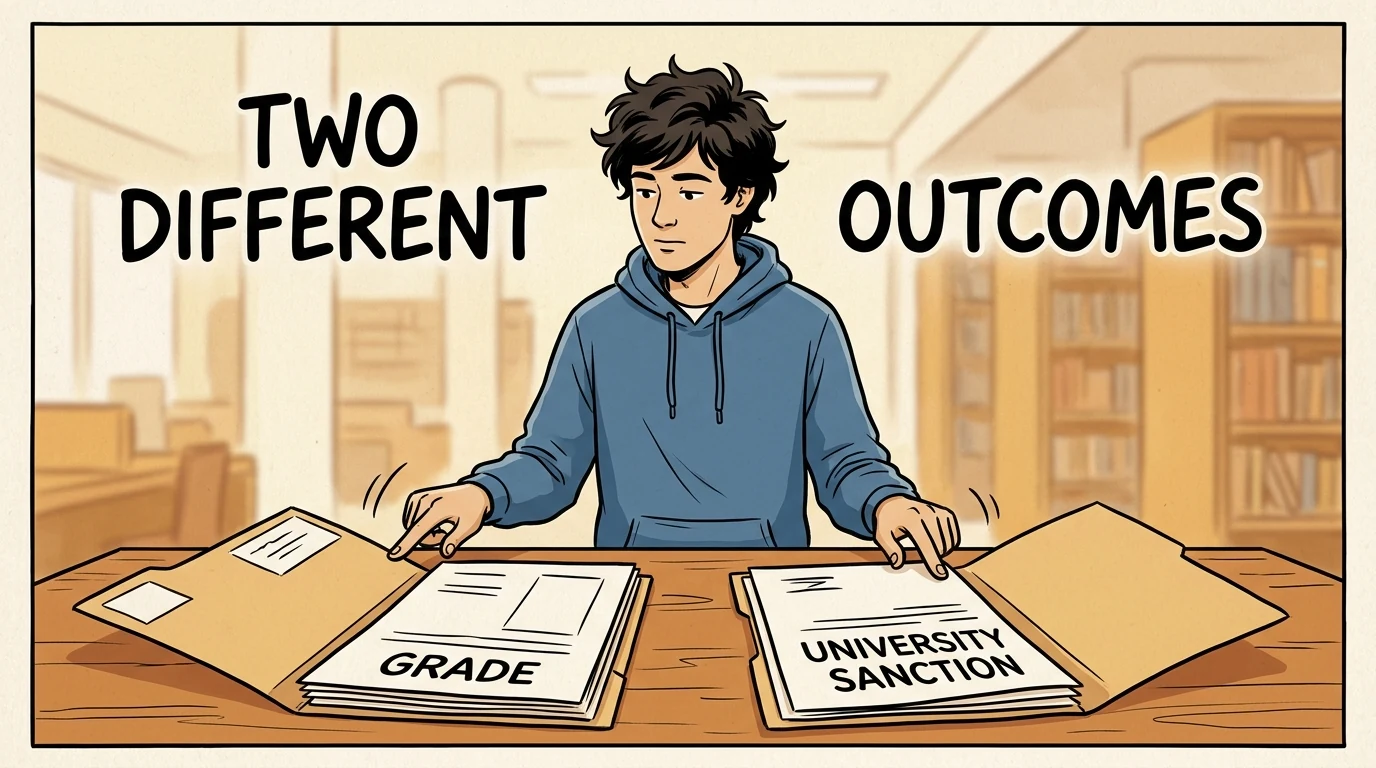
For full violations the instructor’s grade penalty and University sanction are distinct. Grade consequences can reach F in the course; University sanctions range from censure and integrity classes to suspension or expulsion for repeat or especially serious offences. Integrity classes may involve regular tuition/fees. These are conditional outcomes rather than automatic AI penalties.
Ámbito: Students in the cited programme/course/stage only · Only the captured source, version, audience and conditions; no exhaustive currency certification.
Ámbito: Students in the cited programme/course/stage only · university
What kind of penalties can result from a report of misconduct?
With admonitions, the grade penalty is limited to no credit on the assignment in question. With a full violation, there are two parts to the resulting penalty: the grade penalty and the University penalty (sanction).
The grade penalty is imposed by the instructor. With full violations, the grade penalty can range from a lower grade on the affected work to an F in the course (an F cannot be avoided by withdrawing from the course). In some cases, the professor may require extra work before the course can be completed.
The sanction is imposed separately from the grade penalty. Sanctions range from a censure (an official reprimand recorded as a note in the student's file), to classes or tutorials on integrity-related topics, to suspension, to expulsion in the case of repeat or especially bad offenses. Suspensions from the University are for an entire semester or other academic term. Suspensions and expulsions are noted on the student's transcript. At the University's discretion, transcript notations can be temporary or permanent.
There are two different remedial classes that can be assigned as University sanctions. One class is specifically geared toward writing and avoiding plagiarism. If a student is required to take this course as a sanction, the course must be completed before the academic misconduct case can be concluded. The other class is focused on understanding integrity at OU and how the principles of integrity extend into our lives. The course is focused on individual growth with the goal of preparing students to succeed in the future. Both classes are offered in lieu of suspension, meaning that if a student agrees to take the class but fails to successfully complete any aspect of the integrity training, the student may be suspended for the subsequent semester. Both classes qualify as a one-credit hour elective, and regular tuition and fees apply.
Even if it is not noted on the transcript, a violation becomes a permanent part of the student's educational record. Students intending to apply to post-graduate programs such as law school or medical school should be particularly aware of disclosure requirements for those programs.Ver fuente oficial ↗Recopilado: 2026-10-08 · 101–106
SHA-256: d6028492f0aac6f5e9c0055bfe37bf2921d3796cc85c72d2eee022a4d9df23c1
Interpretación del sitio
The written-only appeal procedure separates a hearing-responsibility appeal—fifteen class days after announcement of decision, or after discovery of new evidence—from submitting necessary forms at least seven days BEFORE consideration. It also separates responsibility, sanction reconsideration and extraordinary notation removal/expungement. Grade appeals remain the professor’s separate route. No single combined calendar deadline is calculated.
Estudiante · Obligatorio en este procedimiento
Dentro del plazo indicado. Compruebe el inicio, el ámbito y las excepciones en el resumen y el original.
Estudiante · Obligatorio en este procedimiento
Al menos este número de días antes de la audiencia. Compruebe el inicio, el ámbito y las excepciones en el resumen y el original.
Ámbito: Students in the cited programme/course/stage only · Only the captured source, version, audience and conditions; no exhaustive currency certification.
Ámbito: Students in the cited programme/course/stage only · university
4. Method of Appeal: All appeals must be made in writing by the requesting party. Only written
appeals will be considered by the panel; in person statements will not be permitted. Prior to
consideration of the request, all necessary forms must be submitted to OAIP no less than 7 days
prior to consideration of the appeal.
5. Type of Appeal: As established in section 3 (Purpose and conduct of the panel), appeals may
be based on three different general issues. They include:
1. Finding of responsibility by a Hearing Panel
a. The Appeal and Reconsideration Panel shall consider appeals after a hearing
based upon procedural irregularities so substantial to deny the student a fair
hearing; or if new and significant evidence emerges that warrants review.
i. Must be sent to OAIP after the announcement of the Hearing Panel’s
decision within 15 class days, or in the case of new evidence, within 15
class days of discovery.
ii. It shall be the Appeal and Reconsideration Panel’s responsibility to
determine whether the case should be dismissed, despite a finding of
responsibility by the Hearing Panel. If the Appeal and Reconsideration
Panel determines dismissal is appropriate, they have the authority to
recommend dismissal.Ver fuente oficial ↗Recopilado: 2026-10-08 · 66–85
SHA-256: 12ee49eb369d9da1a73a625e0cfdd6d3cffa21f2b89c24a4f6c004e31714bcfb
The Appeal and Reconsideration Panel consists of two students and a staff member from a department other than the Provost Office.
The focus of the panel is to consider appeals of:
a finding of responsibility for a report of academic misconduct by a hearing panel
reconsideration of the sanction offered by the OAIP for an acceptance of responsibility
early removal of transcript notation or expungement of the case in its entirety.
It is not the responsibility of the OAIP to determine the appropriate grade in a misconduct case; this determination is up to the professor, and can be appealed through the ordinary grade appeal process.
All appeals must be made in writing by the requesting party. Only written appeals will be considered by the Panel; in person statements will not be permitted. Prior to consideration of the request, the appeal form and any supplemental documentation must be submitted to the OAIP no less than 7 days prior to consideration of the appeal.Ver fuente oficial ↗Recopilado: 2026-10-08 · 129–135
SHA-256: d6028492f0aac6f5e9c0055bfe37bf2921d3796cc85c72d2eee022a4d9df23c1
a. The Appeal and Reconsideration Panel shall consider requests for reconsideration
of sanction in a situation where a student does not contest the alleged violation
and has accepted responsibility, but requests review of the sanctioned offered by
OAIP or after sanctioning from a Hearing Panel.
i. If a student requests reconsideration of the sanction prior to their
graduation from the University, they may not make an appeal for the same
case (for early removal of sanction) prior to their certification as a
graduate from the university.
3. Early removal of sanction
a. The Appeal and Reconsideration Panel shall consider requests for a removal of
transcript notation (for sanctions involving suspension or expulsion – neither
seminar offered through OAIP will not be removed from a student’s transcript),
reduction of the matter to an admonition, or expungement.
b. Either removal of notation or expungement are extraordinary steps that require a
showing of good cause. Good cause may include:
i. History since the incident
ii. Statement of support from a professor
iii. Potential impact of sanction on future endeavors
c. A student (or former student) may only request removal, reduction, or
expungement once in an academic year absent a material change in circumstance
that would necessitate additional review. After graduation, a former student may
only appeal on two separate occasions within the restrictions mentioned above.Ver fuente oficial ↗Recopilado: 2026-10-08 · 88–109
SHA-256: 12ee49eb369d9da1a73a625e0cfdd6d3cffa21f2b89c24a4f6c004e31714bcfb
Interpretación del sitio
The OAIP faculty guide warns of high AI-detector false positives and asks reporters to explain concretely how an assignment departs from expected work, including references and prior work. This is the office’s reporting guidance; it is not a confirmed detector deployment or an automatic score-based verdict.
Ámbito: Students in the cited programme/course/stage only · Only the captured source, version, audience and conditions; no exhaustive currency certification.
Ámbito: Students in the cited programme/course/stage only · university
Artificial Intelligence
Artificial Intelligence in higher education - detection and reporting
At this point in time, it is our understanding that there is no established Artificial Intelligence (AI) detection software. The available AI detectors have demonstrated extremely high rates of returning false positives (identifying information as AI-generated when that is not the case).
We can certainly accept cases in which the improper use of AI is of concern, but we rely on you to clarify exactly how the assignment in question departs from the expected response so that information can be conveyed to the student when they meet with our office.
What led you to initially have concerns about the assignment(s)? What in particular makes you believe the student(s) may have improperly utilized generative artificial intelligence (AI) to complete the assignment(s)?
Was the work significantly different from work the student(s) had submitted previously, or significantly different from what other students submitted/you would expect from a student in your course?
Are there points in the assignment where content is significantly more advanced or general/vague than you would expect? What aspects of the content indicate that it may be the result of generative AI?
Are links/references correctly related to the assignment content?
If you would like to discuss your concerns regarding a student submission prior to filing a report, please contact us.Ver fuente oficial ↗Recopilado: 2026-10-08 · 104–112
SHA-256: 8403fdbcce445fb89a49600841816ba69ae32cceee374edb98da3e8ae337e1ca
Complementos publicados basados en fuentes. Los resúmenes en inglés y las citas originales se separan del registro revisado. Los procesos y resultados posibles no son sanciones automáticas por usar IA. La aplicabilidad actual no se ha confirmado de forma independiente; compruebe el ámbito y la versión de la fuente.
Comparado con el original guardado; traducción no oficial
Los hashes permiten comparar textos guardados; no certifican vigencia ni inmutabilidad. Los temas no forman una secuencia obligatoria.
El acceso no autoriza su uso en una evaluación. Comprueba las reglas de la tarea, los usuarios elegibles y las restricciones de datos.
Registro archivado; consulta la fuente oficial para el acceso actual. Los detalles de acceso y las citas conservan su idioma original.
OU IT reports that a data-protected Adobe Firefly resource is available to every University of Oklahoma community member.
Use the OU IT-provided Adobe Firefly resource.
Not stated by the official report.
Cita original
OU IT identifies Adobe Firefly as a data-protected everyday-AI resource available to every OU community member.Cita original
OU identifies Microsoft Copilot with organizational data protection as available for faculty and staff and describes it as the recommended way to use generative AI within the OU environment.Cita original
Microsoft Copilot with organizational data protection (formerly Bing Chat Enterprise) is an everyday AI companion; providing Chat GPT4 AI-powered chat for the web.OU IT reports that a data-protected Microsoft Copilot chatbot is available to every University of Oklahoma community member.
Use the OU IT-provided Microsoft Copilot chatbot.
Not stated by the official report.
Cita original
OU IT identifies Microsoft Copilot chatbot as a data-protected everyday-AI resource available to every OU community member.Reviewed record
Afirmaciones revisadas: 7
Academic Integrity
Valor normalizado: disclose_cite_document_verify_ai_use
Evidencia original
Evidencia 1Citation Guidelines: when using AI tools, always disclose and cite your usage following your discipline's style guide. OU IT recommends including the AI tool in both in-text citations and reference lists, along with a description of how it was used in your methods or acknowledgments section.
Enseñanza
Valor normalizado: course_specific_ai_choices
Evidencia original
Evidencia 1AI raises important questions about learning goals, assessment, authorship, and academic integrity. OU does not mandate a single approach to AI in the classroom. Instead, faculty are encouraged to make intentional, discipline-appropriate choices and to communicate those choices clearly to students.
Privacidad
Valor normalizado: public_ai_not_for_sensitive_data
Evidencia original
Evidencia 1Public versions of generative AI tools are not appropriate for OU institutional or sensitive data.
Ai Tool Treatment
Valor normalizado: {"tool":"adobe_firefly","rawToolName":"Adobe Firefly","description":"OU IT reports that a data-protected Adobe Firefly resource is available to every University of Oklahoma community member.","howToObtain":"Use the OU IT-provided Adobe Firefly resource.","costToUser":"Not stated by the official report.","availability":"allowed","endorsementType":"institutionally_licensed_or_procured"}
Evidencia original
Evidencia 1OU IT identifies Adobe Firefly as a data-protected everyday-AI resource available to every OU community member.
Vista localizada only
OU IT identifies Adobe Firefly as a data-protected everyday-AI resource available to every OU community member.
Ai Tool Treatment
Valor normalizado: {"tool":"microsoft_copilot","rawToolName":"Microsoft Copilot chatbot","description":"OU IT reports that a data-protected Microsoft Copilot chatbot is available to every University of Oklahoma community member.","howToObtain":"Use the OU IT-provided Microsoft Copilot chatbot.","costToUser":"Not stated by the official report.","availability":"allowed","endorsementType":"institutionally_licensed_or_procured"}
Evidencia original
Evidencia 1OU IT identifies Microsoft Copilot chatbot as a data-protected everyday-AI resource available to every OU community member.
Vista localizada only
OU IT identifies Microsoft Copilot chatbot as a data-protected everyday-AI resource available to every OU community member.
Ai Tool Treatment
Valor normalizado: copilot_recommended_faculty_staff
Evidencia original
Evidencia 1Microsoft Copilot with organizational data protection (formerly Bing Chat Enterprise) is an everyday AI companion; providing Chat GPT4 AI-powered chat for the web. Copilot is available for use by OU faculty and staff. It is the recommended way to use generative AI within the OU environment.
Source Status
Valor normalizado: public_ai_policy_hub
Evidencia original
Evidencia 1OU's AI policies are intended to support responsible, ethical, and transparent use of AI across teaching, research, and operations. Faculty are encouraged to familiarize themselves with these policies, particularly when incorporating AI into coursework or research workflows.
Source record
Fuentes: 6
ou.edu
guides.ou.edu
ou.edu
ou.edu
ou.edu
ou.edu
Citation: University AI Policy Tracker. "University of Oklahoma AI Policy Tracker record." Last checked July 19, 2026. https://eduaipolicy.org/universities/university-of-oklahoma
Original university source language remains canonical. This tracker is not an official university statement.
Abrir registro de cambiosSaved from University AI Policy Tracker. This record summarizes the cited sources; it is not an official university statement or assessment permission. Source and review dates are listed above. Hashes identify retained content, not authorization.