Qué hacer
- Check course purposes and reference permitted use.
- Read permitted misconduct appeal grounds.
- Keep prompts and verify actual sources.
Edinburgh, United Kingdom
Student guide · Task scope and procedure
The March 2026 misconduct policy uses its own ten-working-day sent-letter clock. The separate academic appeal route and dated learning guide must not be merged.
La guía siguiente está en inglés; las pruebas oficiales conservan su idioma original.
Aún no hay un resumen completo de las normas para estudiantes; consulta las afirmaciones y fuentes recopiladas.
The March 2026 misconduct policy uses its own ten-working-day sent-letter clock. The separate academic appeal route and dated learning guide must not be merged.
Complemento recopilado: 2026-10-08 · Aplicabilidad actual no confirmada de forma independiente
Resumen disponible actualmente en inglés
Interpretación del sitio
The AY2023–24 student guide allows clearly identified/referenced GenAI, with a spelling/grammar exception unless a course says otherwise. It immediately requires checking actual course purposes; this dated guide is not a current blanket permission. The March2026-updated misconduct policy separately treats misuse as plagiarism or dishonest practice.
Ámbito: Students following their course instructions; dated AY2023–24 guide · Only the captured source, version, audience and conditions; no exhaustive currency certification.
Ámbito: Students following their course instructions; dated AY2023–24 guide · university
1. Use of generative artificial intelligence (GAI) is permitted provided that such use is clearly
identified and referenced. Generative AI spelling and grammar checking (e.g. MS Word,
Grammarly) does not need to be referenced unless specifically indicated within the course.
2. The use of generative AI should be referenced using the appropriate referencing format for
the piece of work.
3. Any use of artificial intelligence must align with the principles of academic integrity as
outlined by the International Centre for Academic Integrity.
4. Courses and programmes within HW may make use of generative AI where it is appropriate
to support the learning outcomes, however there is no requirement for a course orVer fuente oficial ↗Recopilado: 2026-10-08 · 19–27
SHA-256: aa9eab1b8d20c0c9b71293ef7ce361fe3f72d498e3eb91dae90d0c56837351b8
How to choose whether to use generative AI
1. If you are thinking about using generative AI (GAI) to support your learning check whether
its use is permitted on your course. Only use GAI if it is permitted on your course and only
use if for the purposes it is permitted e.g. you might be permitted to use it to research a
topic but not to help you write it up. Remember that whether it is permitted or not may be
different on each course and will be different from other institutions in which you haveVer fuente oficial ↗Recopilado: 2026-10-08 · 43–49
SHA-256: aa9eab1b8d20c0c9b71293ef7ce361fe3f72d498e3eb91dae90d0c56837351b8
• Misuse of Generative Artificial Intelligence (GenAI) Tools: any suspected misuse of
generative artificial intelligence (GenAI) will be dealt with under this policy. In most
instances misuse of GenAI would fall under the definition of plagiarism (either through
failing to appropriately reference sources (i.e. GenAI) or presenting work that is not
student’s own as if it were) but could also fall under the definition of dishonest practice
where appropriate.Ver fuente oficial ↗Recopilado: 2026-10-08 · 388–393
SHA-256: fc7a0a272ba7f9177d91e912c5f327bba0802d9ee487550c9872979c02a9a2b8
Interpretación del sitio
The dated learning guide recommends saving prompts/outputs and checking citations against trusted sources. It warns generated content can be inaccurate and should not replace the student’s own evaluation. These practices can support a learning record but are not a complete research-integrity policy, named tool entitlement or mandated disciplinary evidence package.
Ámbito: Students using the dated learning guide under course rules · Only the captured source, version, audience and conditions; no exhaustive currency certification.
Ámbito: Students using the dated learning guide under course rules · university
Top tips:
1. As you develop your prompts, reflect on what changes you are making to them and how this
is helping you to refine your understanding of the topic.
2. Keep copies of your prompts and outputs for future reference. You may need to provide
copies of them in your assignments.
3. Use generative AI that identifies where information is sourced from so that you can check
that it has used a real source, them make sure that you do check the source and make your
own assessment as to whether the source is appropriate and reliable.
How to interpret the output from generative AI
There are key factors to bear in mind when using output from generative AI:
1. Critically evaluate the content and cross-check it with trusted academic sources. (You can
get help with critical evaluation from the Skills Hub).
2. AI generated content may not be accurate (even where it includes references), the outputs
are predictions, they are not facts, and the content may be based on biased or stereotypical
perspectives.
3. Double check the accuracy of the content and the references using trusted academic
sources e.g. via the University Library to access peer-reviewed journals.
4. As you cross-check the content, look for sources that are Accurate, Current, Objective,
Relevant and Named. (Find out more about this ACORN approach from Cite Them RightVer fuente oficial ↗Recopilado: 2026-10-08 · 88–110
SHA-256: aa9eab1b8d20c0c9b71293ef7ce361fe3f72d498e3eb91dae90d0c56837351b8
Interpretación del sitio
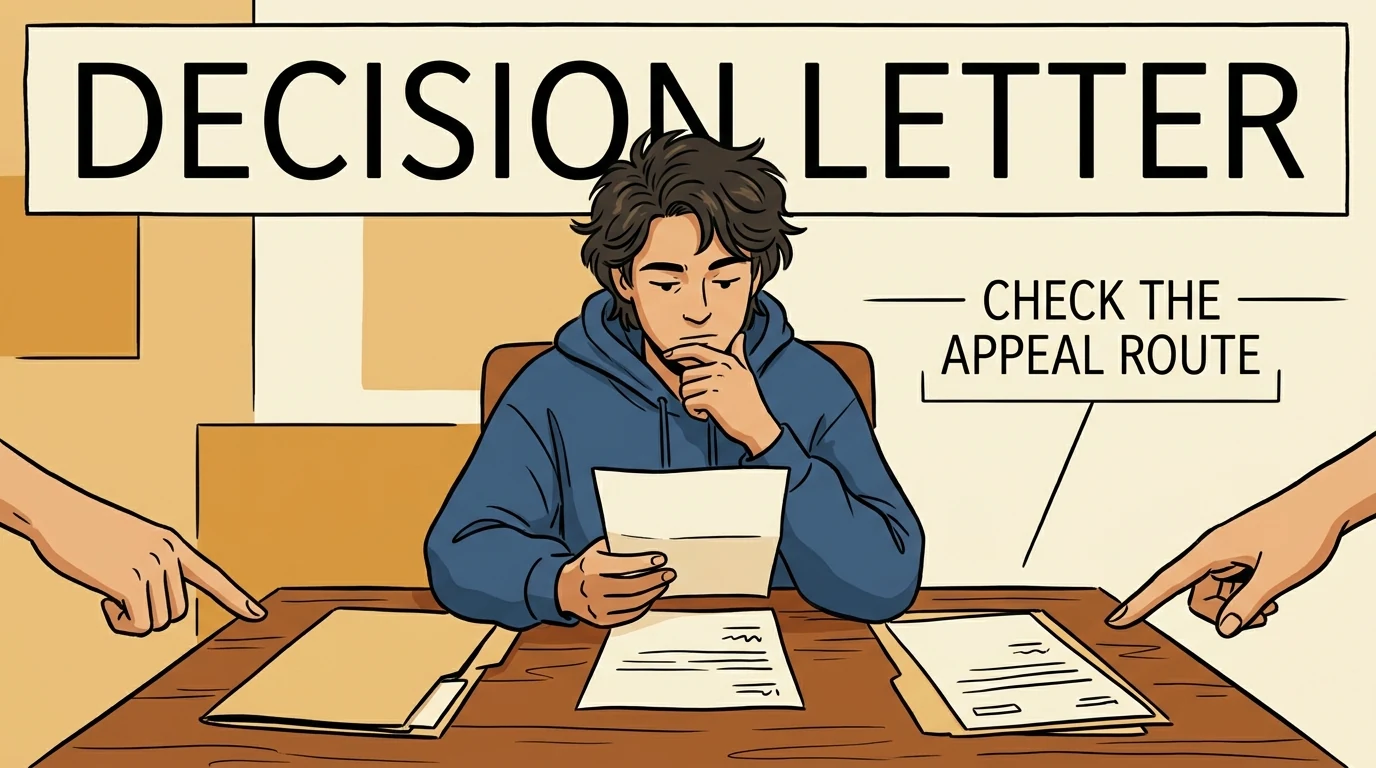
An academic-misconduct appeal is due within ten working days of being sent the formal outcome letter, on evidence-supported approved grounds. Lateness may be rejected. Students admitting the act/accepting proven facts cannot later use procedural-irregularity or manifestly-perverse-decision grounds under 6.8. This is the misconduct route, not the separate Stage1/Stage2 academic-appeal web guidance.
Estudiante · Obligatorio en este procedimiento
Dentro del plazo indicado. Compruebe el inicio, el ámbito y las excepciones en el resumen y el original.
Ámbito: Students appealing an academic-misconduct outcome · Only the captured source, version, audience and conditions; no exhaustive currency certification.
Ámbito: Students appealing an academic-misconduct outcome · university
6. APPEALS
6.1. Appeals against academic misconduct outcomes will follow the University’s Student Discipline Appeals
Policy and Procedures. Appeals against a disciplinary, academic misconduct outcome may be formally
requested, subject to the acceptable grounds for an academic misconduct appeal.
6.2. In the academic misconduct outcome letter, the University will inform the appellant of their
right to submit an Academic Misconduct Appeal, where appropriate.
6.3. It is not the purpose of an academic misconduct appeal to re-examine a student academic
misconduct outcome decision, but to ensure that the outcome decision had been
conducted in accordance with the University’s Global Student Academic Misconduct
Policy.
It is the University’s Discipline Committee’s role to use the academic expertise and
judgement of its members to investigate and make decisions to determine if, on the
balance of probability, academic misconduct has occurred, or not, in accordance with the
University’s Global Student Academic Misconduct Policy.
6.4. The appeal must clearly state the grounds for appeal as specified below and must specify
whether the student accepts the statement of facts held to be proven. The burden of proof
is on the student to demonstrate the reason for the appeal.
6.5. The students must submit their appeal within ten working days of being sent their formal
academic misconduct outcome letter. An appeal may be rejected if it is not submitted
within the time limit set out above. If the appeal is rejected for this reason the student will
be informed within ten working days of the receipt of their appeal.
6.6. Students cannot appeal on the basis that they believe the outcome was unfair, that they
were not satisfied or that they were unhappy with the outcome. Appellants have to
demonstrate, with evidence, that the academic misconduct outcome meets one of the
grounds for an academic misconduct appeal to be considered.
6.7. Students who are found guilty, or proven to have committed, of an act of academic
misconduct can only appeal on the approved grounds below, for which the appellant must
provide direct evidence to support their appeal.
6.8. Students who admit to the act of academic misconduct (either during or prior to the
Discipline Committee consideration) or accept the statement of facts held to be proven
(that is, that the evidence presented in their case was accurate) cannot subsequently
appeal on the grounds that there was a procedural irregularity in the process undertaken or
that the decision reached was manifestly perverse.
6.9. Acceptable Grounds for an Academic Misconduct Appeal against the decision by a Discipline
Committee:
Student can only appeal against academic misconduct outcomes on the following grounds.
6.9.1.There was a procedural irregularity in the process undertaken
This does not apply in the case of an offence admitted by a student.Ver fuente oficial ↗Recopilado: 2026-10-08 · 669–719
SHA-256: fc7a0a272ba7f9177d91e912c5f327bba0802d9ee487550c9872979c02a9a2b8
Interpretación del sitio
The separate academic-appeal page uses Stage1 ten working days from becoming aware of the issue, and Stage2 twenty working days from the Stage1 outcome being issued. Late submission without good reason is rejected and Stage2 requires Stage1 completion. FormB users without login must reply to its confirmation with evidence within two working days. These periods must not replace the misconduct clock.
Estudiante · Obligatorio en este procedimiento
Dentro del plazo indicado. Compruebe el inicio, el ámbito y las excepciones en el resumen y el original.
Estudiante · Obligatorio en este procedimiento
Dentro del plazo indicado. Compruebe el inicio, el ámbito y las excepciones en el resumen y el original.
Ámbito: Students in the separate academic-appeal process · Only the captured source, version, audience and conditions; no exhaustive currency certification.
Ámbito: Students in the separate academic-appeal process · university
How to submit an appeal
You must ensure that your appeal:
meets one or more of the specific grounds for appeal and is supported by appropriate evidence.
Evidence in a language other than English must include a certified translation.
Evidence from parents or friends is not considered independent and cannot be used.
is submitted within the required timescale:
Stage 1 appeals: within 10 working days of the date you became aware of the issue forming the basis of your appeal.
Stage 2 appeals: within 20 working days of the Stage 1 outcome being issued. Appeals submitted late without good reason will be rejected. Stage 2 appeals can only be submitted after you have received the official outcome of your Stage 1 appeal. If you have not completed Stage 1, you are not eligible to submit a Stage 2 appeal.
Appeal forms
All academic appeals must now be submitted using the University’s online appeal forms. There are two types of forms for each Stage of appeal and it is essential that you use the correct one.
Appeal Form A is for students with a HWU login and should be the most standard form used which requires you to log in using your Heriot‑Watt email address. You must upload all supporting evidence when submitting the form. Appeals submitted without evidence will not be considered.
Appeal Form B is for students without a HWU login and should only be used if you do not currently have a Heriot‑Watt University email address, or your access to your University account is temporarily blocked. This form does not allow you to upload evidence. After submitting you will receive an automated email which you must reply to within two working days, attaching all supporting evidence. If evidence is not received within two working days, your appeal will be dismissed without consideration. Please note that the University does not regard Saturday and Sunday as working days.Ver fuente oficial ↗Recopilado: 2026-10-08 · 22–33
SHA-256: a1e7653b5a51ea863dcd77495d6a04af6c9f6b5fd5df224b59edf6b21b0e8f7e
Complementos publicados basados en fuentes. Los resúmenes en inglés y las citas originales se separan del registro revisado. Los procesos y resultados posibles no son sanciones automáticas por usar IA. La aplicabilidad actual no se ha confirmado de forma independiente; compruebe el ámbito y la versión de la fuente.
Comparado con el original guardado; traducción no oficial
Los hashes permiten comparar textos guardados; no certifican vigencia ni inmutabilidad. Los temas no forman una secuencia obligatoria.
El acceso no autoriza su uso en una evaluación. Comprueba las reglas de la tarea, los usuarios elegibles y las restricciones de datos.
Aún no hay un registro de herramientas respaldado por fuentes para esta universidad. Esto no implica indisponibilidad ni prohibición.
Reviewed record
Afirmaciones revisadas: 2
Academic Integrity
Valor normalizado: suspected_genai_misuse_handled_under_academic_misconduct_policy
Evidencia original
Evidencia 1Misuse of Generative Artificial Intelligence (GenAI) Tools: any suspected misuse of generative artificial intelligence (GenAI) will be dealt with under this policy.
Vista localizada only
The policy treats suspected GenAI misuse as a matter under the Student Academic Misconduct Policy.
Ai Tool Treatment
Valor normalizado: generative_ai_permitted_if_identified_referenced_and_course_allows
Evidencia original
Evidencia 1Use of generative artificial intelligence (GAI) is permitted provided that such use is clearly identified and referenced.
Vista localizada only
The student guidance permits GAI use when it is clearly identified and referenced.
Source record
Fuentes: 2
hw.ac.uk
lta.hw.ac.uk
Citation: University AI Policy Tracker. "Heriot-Watt University AI Policy Tracker record." Last checked May 16, 2026. https://eduaipolicy.org/universities/heriot-watt-university
Original university source language remains canonical. This tracker is not an official university statement.
Abrir registro de cambiosSaved from University AI Policy Tracker. This record summarizes the cited sources; it is not an official university statement or assessment permission. Source and review dates are listed above. Hashes identify retained content, not authorization.